S.E. Cupp: Zohran Mamdani’s rise from nowhere to City Hall
The recent New York City mayoral election concluded with a historic victory for Zohran Mamdani, a 34-year-old democratic socialist who has become the youngest mayor in over a century, as well as the first Muslim, first South Asian, and first African-born mayor of the city. Mamdani’s triumph was marked by a campaign that resonated deeply with voters, focusing on pressing issues such as affordability, housing, mass transit, and childcare—topics that he prioritized over broader ideological debates. His approach was a refreshing throwback to grassroots campaigning, emphasizing personal connections and direct engagement with constituents, which starkly contrasted with his opponents’ more detached strategies. This method not only helped him build a broad coalition of support but also positioned him as a relatable figure amid an election overshadowed by the controversies surrounding incumbent Mayor Eric Adams and former Governor Andrew Cuomo.
Mamdani’s victory signals a significant moment for the Democratic Party, which has been seeking to regain momentum after a series of electoral setbacks. His campaign strategy highlighted the importance of addressing voters’ immediate concerns rather than focusing solely on identity politics or national ideological trends. While Mamdani’s win is celebrated as a progressive achievement, it also serves as a cautionary tale for Democrats: the need for moderation and practical solutions remains crucial, especially in swing states where more extreme positions may alienate potential supporters. His success was largely independent of the national Democratic Party’s backing, relying instead on the support of the Democratic Socialists of America, raising questions about the party’s relevance in local elections.
As Mamdani steps into the role of mayor, the challenge will be whether he can translate his campaign success into effective governance. His ability to navigate relationships with the City Council, the NYPD, and diverse community groups will be critical in implementing his agenda. Moreover, his idealistic vision for change will be put to the test in a city known for its complexity and cynicism. The coming months will reveal whether Mamdani can maintain the momentum of hope and engagement he fostered during his campaign to bring about meaningful change in New York City.
One of the wildest and most dramatic New York City mayoral elections in modern history finished with the flare of a presidential race and with the national attention to match.
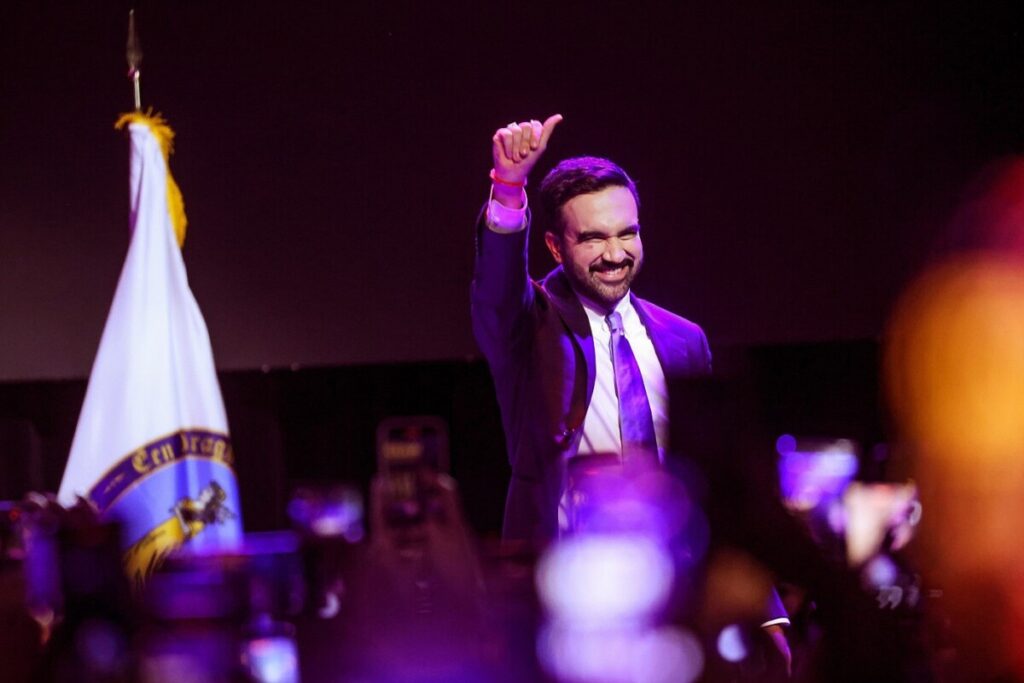
“Hear me, President Trump, when I say this: to get to any of us, you will have to get through all of us,” said a
defiant and triumphant Zohran Mamdani
in a shot across the bow to his shadow opponent throughout this campaign.
Mamdani, the 34-year-old democratic socialist most people hadn’t heard of when this race began — and whose name even his fellow candidates struggled to correctly pronounce — just became mayor of the biggest city in the country, the financial hub of the United States and the world, with a municipal employee base that’s bigger than some Fortune 500 companies.
Mamdani also becomes
Gotham’s first Muslim mayor
, first mayor of South Asian descent, first mayor born in Africa, and the youngest in more than a century.
He ran a marvel of a campaign. But it should also be noted that the conditions were helpful too — running against an incumbent mayor surrounded by corruption, a former governor who hardly campaigned, and a president who made him a constant target, thereby elevating him in stature.
Still, his campaign should and will be studied closely by Democrats, whose party was in desperate need of a win since 2024’s bruising defeats — and actually got three, in NYC, New Jersey and Virginia.
Here are the important takeaways:
Mamdani ran an old-school, grassroots campaign, the likes of which we’ve increasingly been abandoning for more high-tech, new media endeavors that rely less on face-to-face interactions, coalition-building and canvassing, and more on texts and social media. Mamdani did all of that, too — his social media game was unquestionably effective — but without pounding the pavement, visiting the churches and synagogues and mosques, canvassing the taxi lines at LaGuardia Airport, riding the buses, sitting with cops and developers and rabbis, and even hitting the nightclubs, the rest just look like cheap gimmicks.
It sounds counter-intuitive, but Mamdani also capitalized on his limited name ID when he began this race. He knew he’d have to introduce himself to voters in a way his most competitive opponent, former New York governor and Democratic dynasty scion Andrew Cuomo, didn’t. While Mamdani was in the streets, Cuomo was running a Rose Garden strategy that ultimately set Cuomo up to fail.
But Mamdani’s most important move was on the issues that mattered to New Yorkers. His laser-focus on affordability, housing, mass transit, child care, and quality of life met voters where they are, not where the left wants them to be — existentially worried about less tangible things like democracy, climate change, and social issues. It’s not that those things aren’t important, but they aren’t a top priority to a majority of voters when they are choosing between paying rent or paying for health insurance.
This race should also be a nail in the coffin for the left’s identity politics. While Mamdani’s win represents a number of important firsts, he didn’t run on them — he ran on solving problems, not filling quotas.
Dems should also know that Mamdani’s win doesn’t mean democratic socialism should be the national model. A candidate who’s talked about defunding the police, globalizing the intifada, and “seizing the means of production” probably isn’t going to win in Georgia, or Michigan, or other important swing states where Dems need to pick up seats.
If
Mikie Sherrill
and
Abigail Spanberger’s
wins tell us anything, it’s that Democrats still need moderates to appeal to voters in the middle of the country, in the suburbs, and even in the cities where crime and immigration are still motivating fears for plenty of people.
Mamdani’s win is also a warning to Dem leadership. He won largely without the help or backing of the national Democratic Party, and in many cases without their endorsements, and instead relied on the infrastructure of the Democratic Socialists of America. If the party isn’t necessary to get candidates elected, what is its purpose?
The biggest question now is, can Zohran govern? He may have run a nearly-flawless campaign, but that’s not the same thing as running a giant city like New York. This will test his relationship-building skills, both with the City Council and Albany but also with the NYPD and Jewish voters. It will test his organizational skills, his executive leadership, his ability to make good on promises, his commitment to transparency (even when the news is bad).
What will be tested most, however, is Mamdani’s idealism. In a city as cynical and hardened as New York, is hope enough to make meaningful change? Only time will tell.
S.E. Cupp is the host of “S.E. Cupp Unfiltered” on CNN.


