NASA to Share Comet 3I/ATLAS Images From Spacecraft, Telescopes
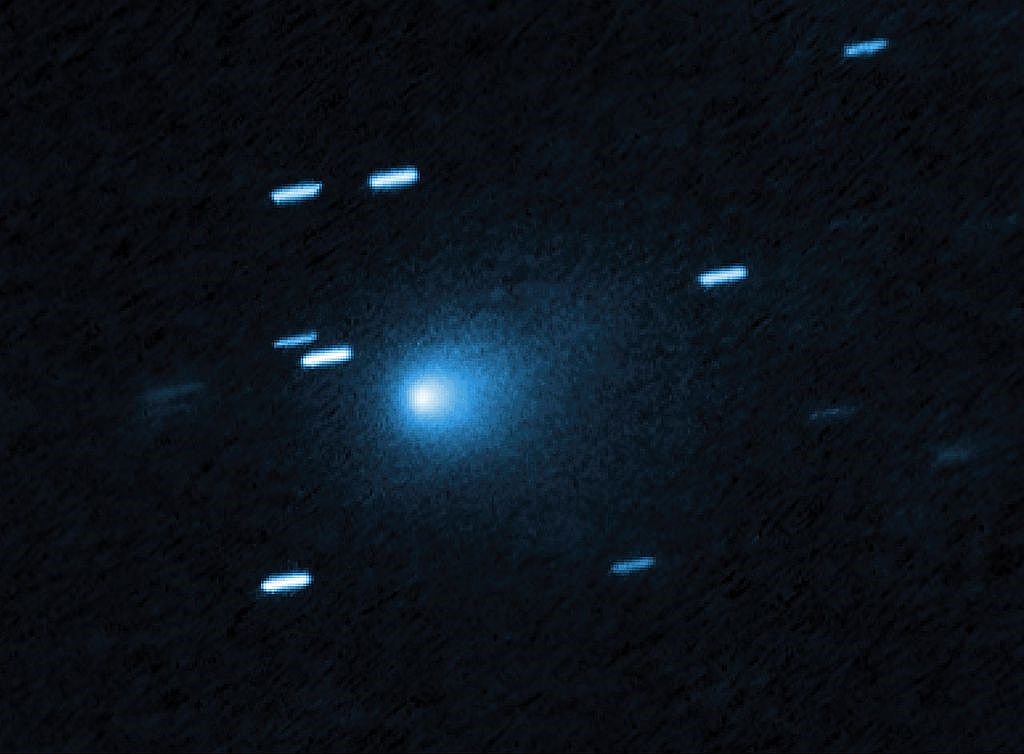
NASA’s Hubble Space Telescope has recently captured stunning imagery of the interstellar comet 3I/ATLAS, showcasing a teardrop-shaped cocoon of dust emanating from its icy nucleus. This remarkable image, taken on July 21, 2025, when the comet was approximately 277 million miles from Earth, highlights the comet’s unique characteristics as it traverses our solar system. Discovered by the ATLAS (Asteroid Terrestrial-impact Last Alert System) observatory on July 1, 2025, 3I/ATLAS is only the third known object to enter our solar system from interstellar space, following in the footsteps of the famous ‘Oumuamua and comet 2I/Borisov. Although the comet poses no threat to Earth—its closest approach will be at a safe distance of 170 million miles—it did come within 19 million miles of Mars in early October, providing a fascinating opportunity for observation.
To share these breathtaking findings, NASA is hosting a live event on November 19, 2025, at 3 p.m. EST from its Goddard Space Flight Center in Greenbelt, Maryland. The event will feature a panel of experts, including NASA Associate Administrator Amit Kshatriya and Nicky Fox, Associate Administrator for the Science Mission Directorate, who will discuss the comet’s journey and the scientific insights gained from its observation. The event will be accessible to the public via multiple platforms, including NASA+, the NASA app, and YouTube, allowing viewers to engage directly with the scientists by submitting questions using the hashtag #AskNASA. This initiative underscores NASA’s commitment to public engagement and education, inviting audiences to learn more about the mysteries of our solar system and the significance of interstellar objects like 3I/ATLAS.
NASA’s extensive array of scientific instruments, both on spacecraft and ground-based observatories, enables continuous observation of 3I/ATLAS as it passes through our celestial neighborhood. This multifaceted approach allows scientists to study the comet’s behavior from various perspectives, enhancing our understanding of its composition and dynamics. As we delve deeper into the cosmos, the study of interstellar comets like 3I/ATLAS not only enriches our knowledge of the origins of our solar system but also provides valuable insights into the building blocks of planetary systems beyond our own. For those interested in following the comet’s journey or learning more, additional information is available on NASA’s dedicated webpage.
Hubble captured this image of the interstellar comet 3I/ATLAS on July 21, 2025, when the comet was 277 million miles from Earth. Hubble shows that the comet has a teardrop-shaped cocoon of dust coming off its solid, icy nucleus.
Credit: NASA, ESA, David Jewitt (UCLA); Image Processing: Joseph DePasquale (STScI)
Lee este comunicado de prensa en español
aquí
.
NASA will host a live event at 3 p.m. EST, Wednesday, Nov. 19, to share imagery of the interstellar comet 3I/ATLAS collected by a number of the agency’s missions. The event will take place at NASA’s Goddard Space Flight Center in Greenbelt, Maryland.
Comet 3I/ATLAS, discovered by the NASA-funded ATLAS (Asteroid Terrestrial-impact Last Alert System) observatory on July 1, is only the third object ever identified as entering our solar system from elsewhere in the galaxy. While it poses no threat to Earth and will get no closer than 170 million miles to Earth, the comet flew within 19 million miles of Mars in early October.
The event will air on
NASA+
, the NASA app, the agency’s
website
and YouTube channel, and Amazon Prime.
Briefing participants include:
NASA Associate Administrator Amit Kshatriya
Nicky Fox, associate administrator, Science Mission Directorate
Shawn Domagal-Goldman, acting director, Astrophysics Division
Tom Statler, lead scientist for solar system small bodies
To participate virtually in the NASA Live event, members of the media must send their full name, media affiliation, email address, and phone number no later than two hours before the start of the event to Molly Wasser at:
molly.l.wasser@nasa.gov
. Members of the public also may ask questions, which may be answered in real time during the broadcast, by using #AskNASA on social media.
Assets within NASA’s science missions give the United States the unique capability to observe 3I/ATLAS almost the entire time it passes through our celestial neighborhood, and study – with complementary scientific instruments and from different directions – how the comet behaves. These assets include both spacecraft across the solar system, as well as ground-based observatories.
For more information on 3I/ATLAS, visit:
https://go.nasa.gov/3I-ATLAS
-end-
Karen Fox / Molly Wasser
Headquarters, Washington
202-358-1600
karen.c.fox@nasa.gov
/
molly.l.wasser@nasa.gov
Share
Details
Last Updated
Nov 17, 2025
Location
NASA Headquarters
Related Terms
Science Mission Directorate
Astrophysics Division
Science & Research
The Solar System


