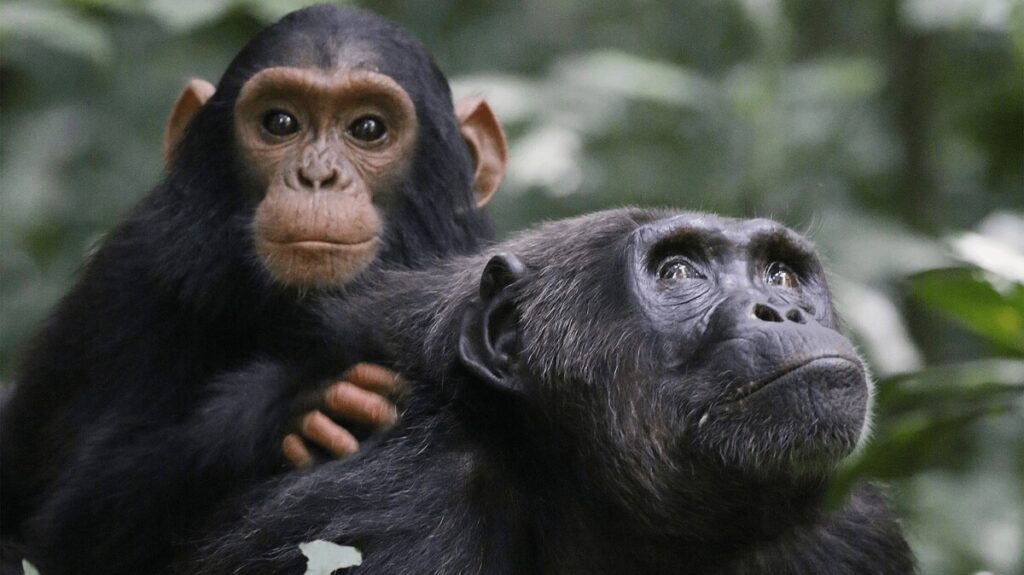
Chimpanzees’ brutal battle for territory leads to a baby boom
In a groundbreaking study published in the *Proceedings of the National Academy of Sciences*, researchers have unveiled the complex dynamics of territorial warfare among Uganda’s Ngogo chimpanzees, revealing how their brutal intergroup conflicts can lead to significant reproductive advantages. Known for their violent confrontations, the Ngogo chimpanzees have been observed for over three decades in Kibale National Park, where they engage in lethal skirmishes to expand their territory. This territorial expansion is not merely a matter of land; it directly correlates with increased reproductive success. Following a coordinated attack that resulted in the deaths of at least 21 rival chimpanzees, the Ngogo group’s territory expanded by 22 percent. This newfound space allowed female chimpanzees to give birth to 37 offspring in the subsequent three years, more than doubling their fertility rate, while the infant mortality rate plummeted from 41 percent to just 8 percent.
The study’s co-author, John Mitani, emphasizes the importance of food resources in these territorial battles, noting that chimpanzees rely heavily on seasonal fruit, which can be scarce. The ability to secure more territory means access to more food, ultimately enhancing the health and reproductive capabilities of females. While many animals exhibit territorial behavior, chimpanzees stand out for their extreme violence, with coordinated attacks that can involve groups of 10 to 20 individuals. This method of aggression, although difficult for human observers to witness, appears to be a strategic evolutionary behavior that has significant implications for their survival and reproductive success. The researchers also explored alternative explanations for the increase in fertility, ruling out factors such as fluctuations in food availability, thereby reinforcing the link between territorial expansion and reproductive outcomes.
This research not only sheds light on the evolutionary advantages of aggression in chimpanzees but also invites reflection on the differences between human and chimpanzee behaviors. Mitani draws a stark contrast, highlighting that while chimpanzees often display xenophobic tendencies toward outsiders, humans have a unique capacity for compassion and support, even towards strangers in need. This insight into our closest living relatives encourages a deeper understanding of our own nature and the potential for altruism in humanity. As researchers continue to study chimpanzee populations, they hope to monitor the effects of territorial changes on reproduction and the well-being of displaced groups, thus unraveling more about the intricate social structures that govern both chimpanzees and humans.
Uganda’s
Ngogo chimpanzees
are well known for their “chimpanzee warfare.” Primatologists have observed their brutal, lethal fights between 10 or more
chimpanzees
for decades, deciphering what leads to such violence. Their fights are largely over territory, with the victors taking the spoils.
That territorial expansion can directly boost reproductive success. After a series of coordinated attacks against a rival group that claimed at least 21 lives, the Ngogo group’s territory grew by 22 percent. Over the next several years, females gave birth more often, and their infants were more likely to survive. The findings are detailed in a
study published today in the journal
Proceedings of the National Academy of Sciences
(
PNAS
).
‘Difficult to watch as a human observer’
The
Ngogo chimpanzees live in Kibale National Park
in Uganda, where they’ve been observed in their natural habitat for over 30 years. About 15 years ago, researchers witnessed the chimpanzees violently overtake the territory by killing the neighboring chimps. Ever since, they’ve tried to answer the question of what evolutionary advantage this behavior might provide.
Many animals are territorial and will defend their turf against neighbors. Cats big and small will spray trees and the ground with
their pungent urine
to mark their territory, while bald eagles will perch and aggressively fly
around their nesting sites
. Some monkey species are even
marking their territory more often as humans get louder
.
Just like these other species, chimpanzees defend their territory to protect valuable and scarce resources. Chimpanzees feed on ripe fruit that is only available seasonally. It is also fickle: sometimes there is a lot of fruit, other times there is very little.
“Territorial defense is especially important in these lean periods,”
John Mitani
, a study co-author and primatologist at the University of Michigan, tells
Popular Science
. “Food is particularly crucial for chimpanzees, as females rely on it to reproduce and raise infants successfully, as we demonstrate in this paper.”
While many animals are territorial, chimpanzees still stick out for their violence. According to Mitani, spider monkeys in Central America are the only other nonhuman primate that exhibit such
coordinated intergroup violence
. These cases are still rare compared to what Mitani and other scientists have observed in chimpanzees, which he says is “difficult to watch as a human observer.”
“It typically occurs when the aggressors have overwhelming numerical superiority over their victim,” says Mitani. “At Ngogo, 10 to 20 individuals often participate in killings. They first find and isolate a single neighbor before attacking. They have no weapons–no guns, knives, or clubs–to kill their neighbors.”
To kill, the chimpanzees pile on their victim and repeatedly hit them with their hands and feed over a very short period of time.
“I have witnessed cases where this kind of aggression results in death in just 12 to 14 minutes,” says Mitani.
More territory, more babies
In the three years before the Ngogo chimpanzees’ major territorial expansion, the females gave birth to 15 offspring. In the three years after, they
gave birth to 37 babies
, more than doubling their fertility rate. Infant survival also increased dramatically. Before the expansion, infants had a 41 percent chance of dying before the age of three. After, it was
only eight percent
.
“With additional land and the resources it contained, females could feed better and use that added nutrition to produce more infants,” says Mitani. “And mothers, now in better energetic condition, were more successful raising their young.”
Mitani adds that while these outcomes are rather logical and predictable, he is “still surprised by the extent to which female fertility and infant survivorship improved after territorial expansion.”
To be sure, the team including study co-author
Brian Wood
of The University of California, Los Angeles (UCLA), also
tested an alternative hypothesis
. The female chimpanzees may be reproducing more frequently because their infant mortality was high, a pattern that is seen in some primates. However, their data showed the opposite, since both fertility and survival improved with territorial expansion.
Another possibility was that fluctuation in food availability might explain the results. The fruit abundance in Ngogo’s pre-expansion territory remained stable or even declined slightly after the expansion, indicating that the food availability was not behind this boost in fertility.
Compare and contrast
According to the study, these findings can help us glean why chimpanzees and even our own early ancestors evolved to
coordinate violence
. With this in mind, scientists can now monitor members of multiple chimpanzee groups to see if another territorial expansion leads to increased reproduction. They can also document what happens to the remaining chimpanzees from the group that lost their territory, particularly if and how much their fertility rate decreases.
Chimpanzees and their sister species the
bonobo
are humankind’s closest living relatives. With that closeness, it is often tempting to draw parallels between these findings and ourselves. After studying how “xenophobic” and aggressive wild chimpanzees are for close to 40 years, Mitani focuses on some of these fundamental differences.
“Instead of behaving aggressively toward neighbors or strangers, we often go out of our way to help them. We frequently provide support to people suffering from famine or natural disasters, even when they are complete strangers,” concludes Mitani. “This kind of aid is never seen in chimpanzees or any other nonhuman animal. This aspect of human nature–revealing the ‘better angels of our nature’–gives me hope for humanity. I hope people take time to reflect on this after reading our paper.”
The post
Chimpanzees’ brutal battle for territory leads to a baby boom
appeared first on
Popular Science
.


