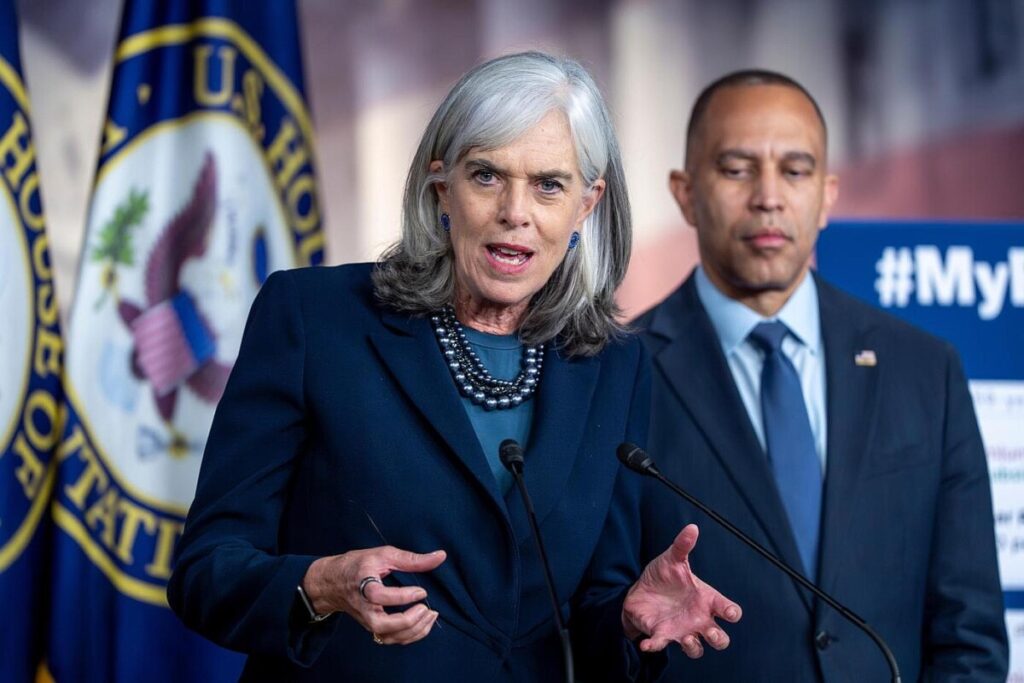
Battenfeld: Katherine Clark and Democrats’ obsession with Epstein the wrong message
In the evolving landscape of the Democratic Party, House Minority Whip Katherine Clark finds herself at a crossroads, representing a faction of the party that many see as outdated and out of touch with the current political climate. At 62, Clark’s alignment with the established leadership, particularly her close ties to former Speaker Nancy Pelosi, raises questions about her ability to drive the party’s necessary reinvention. Recent missteps, including her controversial comments on Israel’s conflict with Hamas and her characterization of the government shutdown as a “leverage” opportunity, have drawn criticism and highlighted a disconnect with the concerns of everyday Americans. Critics argue that Clark, alongside fellow Massachusetts Senator Elizabeth Warren, is more focused on sensational issues like the Epstein files rather than addressing the pressing economic challenges facing voters, such as rising rent and food costs.
Clark’s approach has sparked frustration among party members who believe the Democratic Party needs to pivot away from the “old playbook” that prioritizes elite narratives over the needs of the average voter. For instance, her remarks on the government shutdown, where she acknowledged that families would suffer but framed it as a strategic move against Trump, were met with backlash. House Republican Conference Chair Lisa McClain called her comments “shameful but revealing,” suggesting that such statements could alienate potential supporters. Furthermore, Clark’s insistence on being addressed as “Whip” and her attempts to downplay her controversial remarks only serve to reinforce the perception that she is entrenched in the old guard of the party, which may hinder her prospects for leadership in a future Democratic resurgence.
As the party grapples with its identity and direction, the need for fresh, innovative leadership has never been more critical. With younger voices emerging and a growing desire for a shift away from established figures, Clark’s connection to the Pelosi era could ultimately limit her influence. The Democratic Party’s success in upcoming elections may hinge on its ability to connect with voters on economic issues rather than getting embroiled in political scandals or historical grievances. If Clark and her contemporaries do not adapt their strategies to resonate with the electorate’s priorities, they risk being sidelined as the party seeks to redefine itself in a rapidly changing political environment.
If the Democratic party is going to be reinvented, it won’t start with House Minority Whip Katherine Clark.
Besides making missteps like calling the war against Hamas a “genocide” and poor people’s health care “leverage,” the 62-year-old Democratic Massachusetts congresswoman is part of the politics of the past – the Nancy Pelosi retread wing of the party.
Aside from insisting everyone calls her “Whip,” what use has she made of her position or brought back to Massachusetts in the form of clout?
Clark and Elizabeth Warren are following the same old stale Democratic playbook – going to their favorite liberal networks and focusing on President Donald Trump and the Epstein files rather than a laser focus on the economy.
“What we are seeing is outright corruption,” Clark declared on the former MSNBC, now called MSNow, accusing Trump and Republicans of a “cover up” on Epstein.
“We will do whatever it takes to get justice for the survivors and victims of Jeffery Epstein and to get to the bottom of whatever is in those files.”
Warren joined Clark on Monday in jumping on the Epstein story, calling on Harvard University to sever ties with the university’s former President Larry Summers over his ties to the convicted sex offender.
“For decades, Larry Summers has demonstrated his attraction to serving the wealthy and well-connected, but his willingness to cozy up to a convicted sex offender demonstrates monumentally bad judgement,” Warren told CNN.
Wrong answers.
The greatest threat to President Donald Trump and MAGA is not the Epstein files – it’s the economy and voter fatigue over the chaos of the Trump administration. Only Democratic die-hards care about Epstein. The average voter is more concerned with paying rent or putting food on the table.
Clark, a multi-millionaire, and Warren are showing they are part of the old Democratic regime which needs a complete overhaul if they want to retake Congress next year.
Clark’s gaffes should rule her out of any major future in the party.
“Of course, there will be families that are going to suffer….but it is one of the few leverage times we have,” Clark said of the impact of the government shutdown.
Clark mistakenly told the truth about Democrats’ real obsession with keeping the government closed – to get a victory over Donald Trump, but it gave a gaping opening to Republicans.
“Rep. Clark’s comments were shameful but revealing,” House Republican Conference Chair Lisa McClain (R-Mich.) said.
Back in August, Clark made another mistake by calling Israel’s war against Hamas “genocide” during a forum organized by a nonpartisan Quaker organization.
Worse, Clark’s aides attempted to cover up her comment by claiming her position on the war “had not changed” despite her genocide comment.
“The Israeli and Palestinian people deserve security and peace. It can only be achieved through a permanent ceasefire, the immediate return of the remaining hostages and a surge of humanitarian aid to Gaza,” spokesperson Joy Lee said in a statement to Politico, which reported on the “genocide” comment.
Clark promoted Lee, a longtime adviser to former Speaker Pelosi, to the post of communications director this month.
The 85-year-old Pelosi, facing a primary challenge, earlier this year announced she was retiring from Congress.
Clark’s close ties to Pelosi pretty much doom any chance she has of leading the Democratic Party’s rebuild. The party, looking for younger, fresher talent, is unlikely to turn to Clark if they return to power in Congress after the midterm elections.


