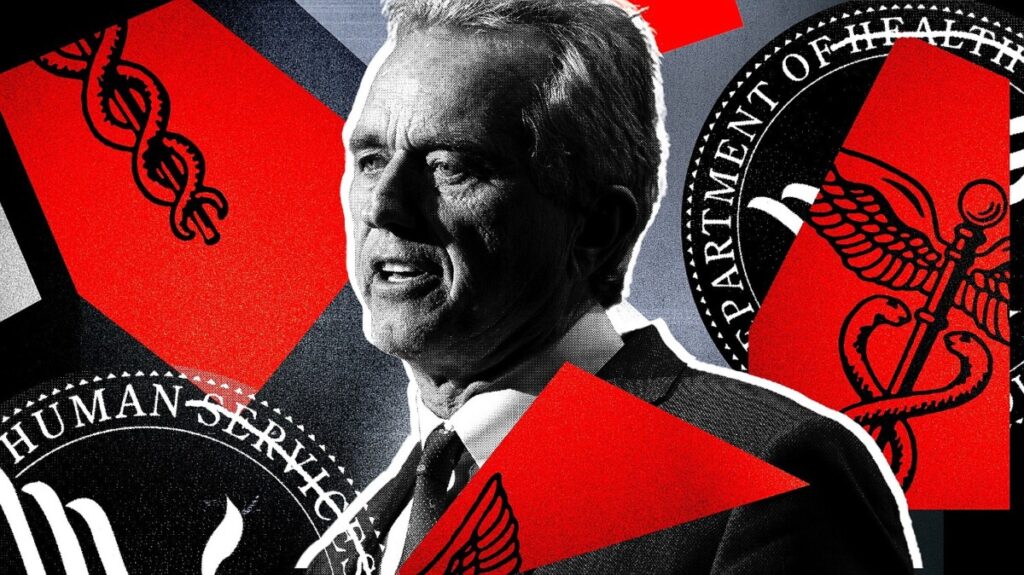
RFK Jr.’s Cheer Squad Is Getting Restless
Russell Brand made headlines during a recent appearance at the Children’s Health Defense conference in Austin, Texas, where he rallied an audience of 800 fervent supporters. The event, which was marked by a palpable sense of camaraderie among attendees, served as a platform for anti-vaccine sentiments and featured notable figures like Robert F. Kennedy Jr.’s wife, Cheryl Hines, and discredited vaccine researcher Andrew Wakefield. While Brand, who is currently facing serious legal allegations in the UK, entertained the crowd with a mix of humor and pointed criticisms of the medical establishment, he also reflected the growing legitimacy of the anti-vaccine movement under Kennedy’s leadership. The conference theme, “Moment of Truth,” encapsulated the attendees’ belief that their views, once marginalized, are gaining traction in mainstream discourse, particularly with Kennedy’s recent appointment as Health Secretary.
The atmosphere at the conference was charged with a mix of celebration and urgency. Many participants expressed their unwavering distrust of vaccines and the institutions that promote them. They viewed Kennedy’s rise as a pivotal moment for the movement, with some even calling for independent investigations into vaccine safety, reflecting a deep-seated belief that governmental and pharmaceutical interests conspire to hide vaccine-related harms. Speakers, including former Representative Dave Weldon and veteran anti-vaccine activist Sherri Tenpenny, urged attendees to remain vigilant and proactive, suggesting that Kennedy’s actions thus far, while promising, are merely the beginning of what they hope will be a broader overhaul of public health policy. This sentiment was echoed by conference-goers who sported vaccine-themed apparel and engaged in discussions about the perceived threats posed by vaccines, underscoring a collective commitment to their cause.
Despite the enthusiasm within the conference, there were underlying concerns about the challenges Kennedy faces, both from established medical authorities and the media, which attendees described as adversarial forces. The event culminated in calls for patience and continued support for Kennedy, as speakers highlighted the importance of upcoming elections and the potential for legislative changes that would align with their vision of health freedom. The conference not only illustrated the growing momentum of the anti-vaccine movement but also showcased the complexities of navigating public health discourse in a polarized environment, where trust in traditional institutions is waning and alternative narratives are gaining ground. As the movement continues to evolve, the implications for public health policy and community trust in vaccines remain significant and contentious.
Russell Brand had found his people, that much was clear. Last Saturday, in front of 800 fans in a hotel ballroom in Austin, the comedian doled out praise for Robert F. Kennedy Jr. (whom he called “Great Brother Kennedy”), disdain for the medical establishment (“flat-out evil”), and gratitude for Jesus Christ (“Thank God we have a forgiving God that died for us”). He also told a bunch of dick jokes and, later, called me a Nazi.
After the show, I’d asked Brand for an interview, and he told me that the media are “Luciferian,” and that reporters are Nazis. “Do you really think that?” I asked him. “You’re more like an individual Nazi,” he said, seemingly a concession that I was just following orders. (I didn’t get the interview.)
Brand and his fans had gathered for the annual conference of Children’s Health Defense, the anti-vaccine nonprofit founded in 2018 by the current secretary of Health and Human Services. Kennedy wasn’t there, but the movement’s other headliners were. Brand—who is awaiting trial for rape and sexual assault in the U.K. and has pleaded not guilty—was onstage with Kennedy’s wife, Cheryl Hines, to promote her memoir. Her publisher, Tony Lyons, was there in his role as president of MAHA Action, a nonprofit that holds weekly Zoom calls to galvanize support for Kennedy’s agenda. Also on the scene were Andrew Wakefield, who’s infamous for his discredited 1998
Lancet
study on the measles-mumps-rubella vaccine and autism, along with newer adherents such as Bret Weinstein, the evolutionary biologist, COVID-vaccine critic, and podcast host.
Everyone I spoke with at the conference shared a distrust of vaccines and a sense that, after they’d spent years on the fringes of scientific discourse, Kennedy’s rise to power had given them the legitimacy they once lacked. (The theme of the event was “Moment of Truth.”) As Polly Tommey, the program director of the organization’s video-and-audio operation, told the audience: “We never thought Bobby would be health secretary—I mean, come on! We’re in the best place we’ve been for ages!” But what should have been a victory lap at times felt like an attempt to rally the troops, or at least reassure them.
Kennedy’s tenure has been turbulent. In less than a year, he’s sent mixed signals about the benefits of vaccination during a measles outbreak, fired all of the CDC’s outside vaccine advisers and replaced them with his allies, axed the director of the CDC just weeks after she took the job, and stoked fears about prenatal Tylenol use as a cause of autism despite recent conflicting evidence. A string of top CDC officials, including the chief science officer, has resigned, and those who remain say morale has never been lower.
[
Read: ‘It feels like the CDC is over’
]
But the Kennedy faithful don’t care about the health secretary flouting institutional norms or sidelining subject-matter experts, because they view HHS, and the CDC in particular, as either useless or corrupt. In fact, some at the conference worried that Kennedy is not acting with enough urgency. (In an email, the HHS spokesperson Emily Hilliard wrote that Kennedy “remains committed to ensuring that all Americans have access to accurate, evidence-based information about vaccines.”)
They want Kennedy to investigate their belief that the government supposedly colluded with Big Pharma to hide the harms of vaccination. In a session on Saturday afternoon, former Republican Representative Dave Weldon, whose nomination to become CDC director was withdrawn in March amid outcry over his criticism of immunizations, called for the creation of an independent body to investigate vaccine-safety data and report only to Kennedy and President Donald Trump. “If it’s in the hands of the CDC, you’ll never get the answers you need,” he told the crowd. During a session titled “The Enduring Nightmare of COVID mRNA Technology,” Sherri Tenpenny, a veteran anti-vaccine activist who once said that one goal of COVID vaccination was to turn people into “transhumanist cyborgs,” called for the mRNA-based vaccines to be taken off the market: “It’s just the next level of atrocity of how they want to damage us and make us customers for life.” Mark Gorton, the founder of LimeWire who is now president of the MAHA Institute, a think tank, favors stopping routine shots altogether until they’ve undergone further testing. “The medical establishment will scream that plagues will sweep across the land,” he said from the stage. “We need to counter that their plague of vaccine poisoning is already amongst us.”
[
Read: The neo-anti-vaxxers are in power now
]
Other attendees were frank about their attempts to personally influence Kennedy. Steve Kirsch, a former tech executive turned anti-vaccine activist, told me at the conference that he texts directly with the health secretary. After getting vaccinated against COVID, Kirsch became convinced that the shot was unsafe and began campaigning against it. He said he later took a supplement marketed to remove spike proteins from the body, which he now blames for causing him to go blind in one eye. Kirsch told me he recently sent Kennedy some data from the Czech Republic that he believes prove that COVID shots increase mortality rates. (Multiple studies have shown that the vaccines reduce mortality rates, particularly in those over 60.) He is frustrated that he hasn’t heard back yet. “Kennedy’s taking baby steps, and that’s a big problem,” Kirsch told me. (When I asked Hilliard about Kennedy’s correspondence with Kirsch, she did not provide an answer.)
Although the MAHA merch table sold hats with slogans such as
RAW MILK IS MILK
and
MAKE FRYING OIL TALLOW AGAIN
, the attire of conference-goers was mostly vaccine-themed: One popular T-shirt featured an illustration of a syringe with the message
COME AND MAKE ME
. Mary Holland, the chief executive officer of Children’s Health Defense, began the conference by listing some of the environmental triggers that she believes cause chronic childhood disease, including stress, ultra-processed food, and electromagnetic radiation; attendees were asked to switch their phones to airplane mode out of consideration for those sensitive to Wi-Fi. But as she told the crowd, “It is in large part—predominantly—the vaccines.” Gorton agreed. “There’s been a lot of progress in terms of the MAHA movement, but if you look at real, meaningful changes in the health system, they’re trivial,” he said. He characterized the general feeling about the progress that’s been made since Kennedy became secretary as “mixed.”
The forces aligned against Kennedy, everyone at the conference seemed to agree, are formidable. Leslie Manookian, the president of the Health Freedom Defense Fund and the author of a recently passed Idaho law that makes vaccine mandates illegal, railed against the “pit of vipers” that Kennedy must deal with in Washington. In a session titled “Sustaining the Promise of Freedom Through Action,” the crowd applauded when Joseph Ladapo, Florida’s surgeon general, announced that the reporters from
The Atlantic
and
The Washington Post
in the room “represent forces who are working toward the enslavement of humanity”—though he allowed that he had “nothing against them.” (As
The Atlantic
’s editor in chief, Jeffrey Goldberg, told the
Post
, “In fact,
The Atlantic
is not working towards the enslavement of humanity, but I appreciate his concern.”) Ladapo spent most of his speech expounding on his experience with psychotherapy and his relationship with his wife. The day after Brand declined to speak with me and called me a Nazi, Alex Jones posted a two-hour interview in which a bathrobe-clad Brand dismissed the allegations against him as a “governmental and media operation.”
Several speakers counseled patience in the face of such powerful enemies, encouraging attendees to keep their faith in Kennedy. Wakefield (who received a hero’s welcome himself) insisted that Kennedy was on the right path: “We need, collectively, to give Bobby Kennedy—a very, very brave and smart man—the support he needs to get through the next round.” Del Bigtree, who served as communications director for Kennedy’s presidential campaign and identified himself as a lifelong Democrat, emphasized the importance of Republicans doing well in next year’s midterms so that Kennedy can continue to carry out the “Make America Healthy Again” agenda.
[
Read: RFK Jr.’s victory lap
]
Kennedy may not have gone far enough yet in realizing the goals of the so-called medical-freedom movement, Bigtree said, but given enough time and popular support, he still might: “We’ve got to hold it together so that Bobby can just work.”


