Google updates its weather forecasts with a new AI model
Google has unveiled its latest innovation in weather forecasting with the introduction of an upgraded AI weather model, WeatherNext 2, which promises to enhance the accuracy and efficiency of weather predictions across its popular platforms, including Search, Gemini, and Pixel devices. This new model marks a significant shift from experimental applications to practical, user-friendly tools, as highlighted by Peter Battaglia, senior director of research and sustainability at Google DeepMind. With a focus on delivering reliable forecasts, Google is positioning WeatherNext 2 as a key feature for both individual consumers and enterprise clients, emphasizing its potential to transform decision-making in various sectors.
WeatherNext 2 stands out for its remarkable speed and accuracy, generating forecasts up to eight times faster than its predecessor while achieving an impressive 99.9% accuracy in predicting critical weather variables such as temperature and wind. This leap in performance is largely attributed to Google’s innovative Functional Generative Network (FGN), which allows the model to produce numerous possible outcomes from a single input in less than a minute, a task that would typically take hours with conventional physics-based models. The AI-driven approach focuses on identifying patterns within historical weather data rather than recreating complex atmospheric physics, enabling forecasts that can extend up to 15 days in advance and provide hourly updates. Such capabilities are particularly appealing to industries like energy, agriculture, and logistics, where precise weather information can significantly impact operational decisions.
In addition to integrating WeatherNext 2 into its existing services, Google is also launching an early access program for custom modeling, allowing businesses to tailor forecasts to their specific needs. The forecast data will also be accessible through Google Earth Engine for geospatial applications and BigQuery for extensive data analysis, further enhancing its utility. However, Google faces competition from other tech giants and organizations, including Nvidia and the European Center for Medium-Range Weather Forecasts, all striving to leverage generative AI in the realm of weather forecasting. As Google continues to refine its AI capabilities, WeatherNext 2 represents a pivotal advancement in making accurate and timely weather information more accessible to users worldwide.
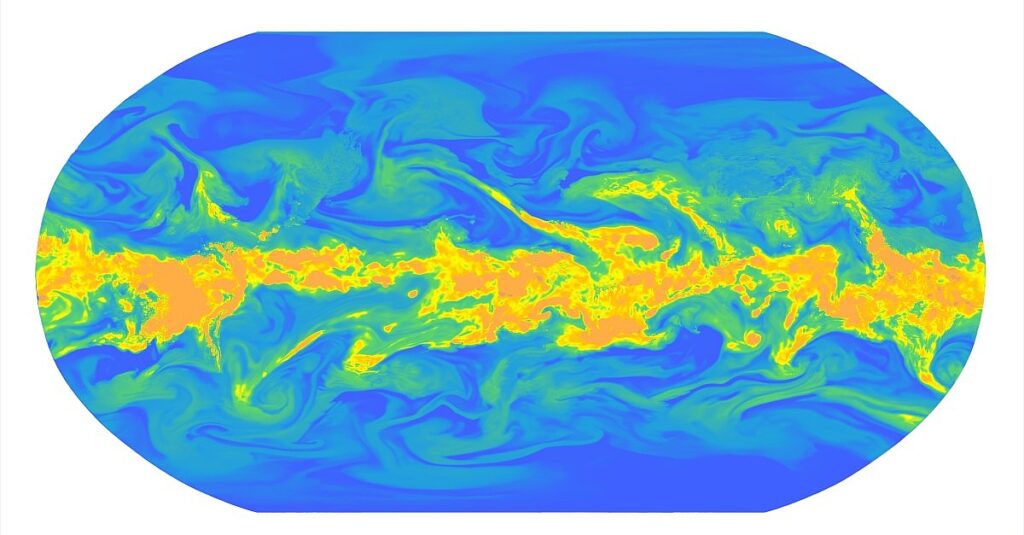
An illustration from Google’s new AI weather model. | Image: Google
Google
debuted a new and improved AI weather model
today that will be incorporated into popular products like Search, Gemini, and Pixel phones.
The company’s AI-enhanced forecasts have
proven themselves to be quite accurate
so far
. AI weather models have also been able to make predictions faster and more efficiently than conventional physics-based models. Until now, Google’s work in this area has been mostly
experimental
. Now, it’s making those predictions a selling point for Google products and services.
“We’re taking it out of the lab and really putting it into the hands of users”
“We’re taking it out of the lab and really putting it into the hands of users in more ways than we have before and sort of shedding off the experimental kind of designation because we have confidence that our forecasts are really quite effective and quite useful,” Peter Battaglia, senior director of research and sustainability at Google DeepMind, said in a briefing with reporters.
The
new AI model, WeatherNext 2,
can generate forecasts eight times faster than Google’s previous model, and is also more accurate in predicting 99.9 percent of variables like temperature or wind. WeatherNext 2 can pump out hundreds of potential outcomes from a particular starting point. It takes less than a minute using one of Google’s TPU chips to make a prediction, which the company says would typically take several hours to accomplish using physics-based models on a supercomputer.
Those conventional models are computationally intensive because they’re essentially attempting to recreate the complicated physics of the atmosphere to produce forecasts. AI models, in contrast, try to discern patterns out of historical weather data in order to predict future outcomes.
Google was able to streamline its process by using a strategy it calls a
Functional Generative Network
(FGN) in WeatherNext 2. Older AI weather models still required repeated processing to generate one forecast. FGN is more efficient because it incorporates noise — or targeted randomness — into the model each time it’s provided an input so that WeatherNext 2 can generate many different possible outcomes in a single step.
The advancements allow WeatherNext 2 to make predictions up to 15 days in advance and generate hourly forecasts. Google’s banking on that appealing to enterprise customers as well as individual consumers.
“We found that energy, agriculture, transportation, logistics, and customers in many other industries are quite interested in these one-hour steps. It helps them make more precise decisions relating to things that affect their business,” Akib Uddin, a product manager at Google Research, said on the call.
Aside from adding WeatherNext 2 to Maps, Search, Gemini, and Pixel Weather, Google is also offering an
early access program
for customers interested in custom modeling. The forecast data is also available in Google
Earth Engine
for geospatial analysis and
BigQuery
for large-scale data analysis.
Google has competition, of course, when it comes to figuring out how to make generative AI useful in weather forecasting. The
European Center for Medium-Range Weather Forecasts
,
Nvidia
,
Huawei
, and other companies are similarly developing their own AI weather models.