Google Antigravity is an ‘agent-first’ coding tool built for Gemini 3
Google has recently unveiled Antigravity, an innovative development tool designed to leverage the capabilities of its Gemini 3 Pro model, as well as other third-party AI models. This announcement coincided with the debut of Gemini 3 Pro and marks a significant step towards an “agent-first future” in software development. Antigravity is engineered to support multiple agents, granting them direct access to essential tools such as the editor, terminal, and browser. This architecture is intended to enhance productivity and streamline workflows for developers, making it easier to manage complex tasks and projects.
A standout feature of Antigravity is its self-reporting capability through what Google refers to as “Artifacts.” As the AI completes tasks, it generates a variety of documentation, including task lists, plans, screenshots, and browser recordings. These Artifacts serve as tangible evidence of the AI’s progress and performance, making it simpler for users to verify the work done without sifting through extensive logs of actions and tool calls. Additionally, Antigravity introduces two distinct usage views: the default Editor view, reminiscent of traditional Integrated Development Environments (IDEs) like GitHub Copilot, and a new Manager view that allows users to oversee multiple agents simultaneously. This Manager view functions like a mission control center, enabling users to orchestrate and monitor various agents across different workspaces efficiently.
Moreover, Google has enhanced user interaction with AI agents by allowing feedback directly on specific Artifacts, enabling agents to incorporate comments without interrupting their workflow. This feature, coupled with the agents’ ability to learn from previous tasks, positions Antigravity as a powerful tool for developers looking to optimize their coding processes. In a practical demonstration, Antigravity successfully built and tested a basic flight tracker app, showcasing its capabilities in real-world applications. Currently available in public preview for Windows, macOS, and Linux, Antigravity is free to use, boasting generous rate limits for Gemini 3 Pro, while also supporting other models like Claude Sonnet 4.5 and OpenAI’s GPT-OSS. With its innovative features and user-friendly design, Antigravity promises to significantly enhance the future of software development.
Antigravity should report on its work plan, and produce evidence of what it’s done along the way.
Alongside today’s announcement of
Gemini 3 Pro
, Google has revealed Antigravity, a development tool that uses Gemini 3 Pro, along with other third-party models. Google says that Antigravity, which supports multiple agents and gives them direct access to the editor, terminal, and browser, is designed for an “agent-first future.”
One of the key components of Antigravity is how it reports on its own work. As it completes tasks, it will produce what Google calls Artifacts: task lists, plans, screenshots, and browser recordings that are intended to verify both the work it’s done and what it will do. Antigravity will also report on its actions and external tool use along the way, but Google says that Artifacts are “easier for users to verify” than full lists of a models’ actions and tool calls.
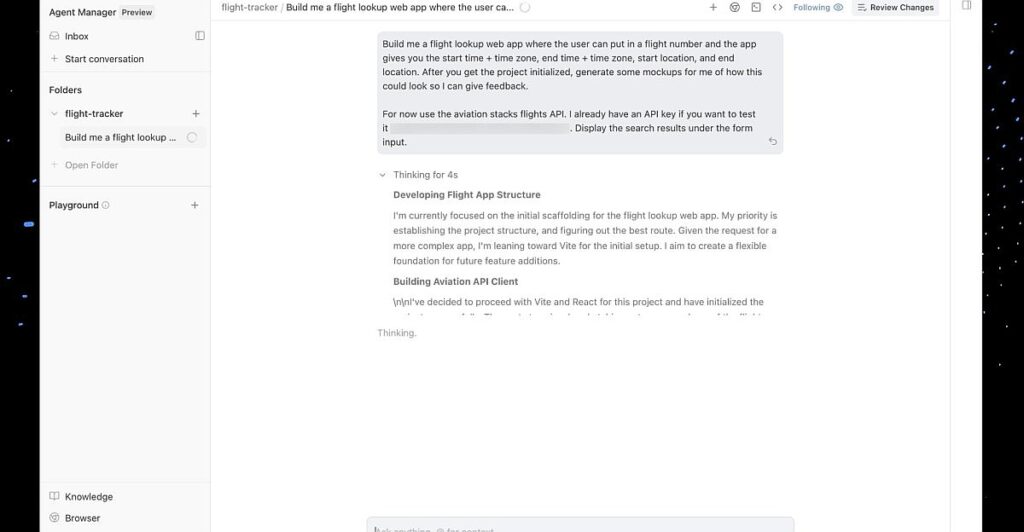
Antigravity’s other big change is that it offers two main usage views. The default Editor view offers a familiar Integrated Development Environment (IDE) experience, similar to rivals like Cursor and GitHub Copilot, with an agent in a side panel. The new Manager view is instead designed for controlling multiple agents at once, allowing each to work more autonomously. Google compares it to “mission control for spawning, orchestrating, and observing multiple agents across multiple workspaces in parallel.”
Google has introduced more ways to give feedback to AI agents as they work, with the ability to leave comments on specific Artifacts for an agent to take into account without breaking up its work to do so. The company also says that agents in Antigravity will be able to “learn from past work,” retaining specific snippets of code or the steps required to carry out certain tasks.
In this demo, Antigravity builds a basic flight tracker app, tests it, and reports on that test with a browser recording.
Antigravity is available in a public preview now, compatible with Windows, macOS, and Linux. It’s free to use, with what Google calls “generous rate limits” for Gemini 3 Pro, though it also supports
Claude Sonnet 4.5
and
OpenAI’s GPT-OSS
. Google says rate limits refresh every five hours, and that only “a very small fraction of power users” will ever hit the limits.