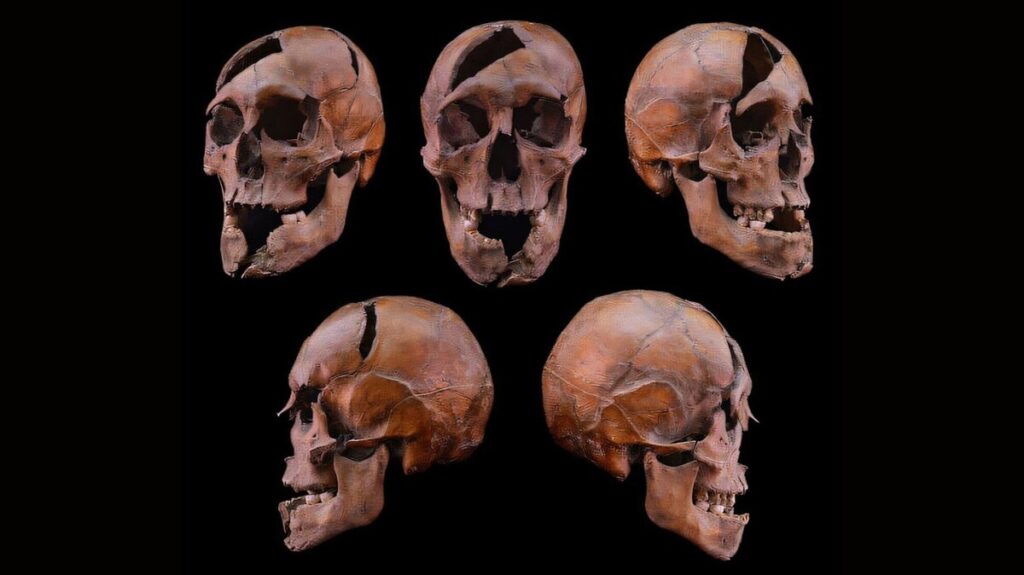
Medieval duke’s remains recount his grisly murder
In a significant breakthrough for historical forensic science, researchers have shed light on the mysterious murder of Béla of Macsó, a 13th-century Hungarian duke. Born around 1243 CE into the illustrious House of Árpád, Béla was the grandson of King Béla IV and served as the Ban of Macsó. His life was cut short in November 1272 CE when he was brutally slain by rivals, with records indicating that a fellow Ban, Henrik Kőszegi, was involved in the attack. For centuries, the details surrounding his death remained elusive, but a recent interdisciplinary study published in *Forensic Science International: Genetics* has provided new insights into the nature of the ambush that led to his grisly demise.
The researchers, who included archaeologists, geneticists, and bioanthropologists, successfully identified Béla’s remains, which had been rediscovered in a wooden box at the Hungarian Museum of Natural History in 2018 after being lost for decades. Their analysis revealed a shocking tally of 26 injuries, with nine to the skull and 17 to other parts of the body, indicating that Béla was not a victim of a spontaneous duel but rather the target of a planned and coordinated attack by three assailants. The study suggests that Béla was aware of the aggression and attempted to defend himself, as evidenced by the defensive wounds he sustained. The attackers used a combination of weapons, likely a sabre and a longsword, and the nature of the injuries points to a confrontation filled with intense emotional involvement, suggesting personal animosity rather than a mere political assassination.
The findings not only clarify the circumstances of Béla’s death but also contribute to a broader understanding of the genetics of medieval royalty. As the only nearly complete skeleton from the House of Árpád, Béla’s remains offer a unique opportunity for researchers to explore the genetic lineage of Hungarian nobility. This pioneering study exemplifies the power of interdisciplinary collaboration in uncovering historical truths, paving the way for further investigations into cold cases from the medieval period. With the genetic data cataloged, researchers are optimistic about the potential to unlock more secrets of the past, ultimately enriching our understanding of historical figures and their tumultuous times.
In 1272 CE, a Hungarian duke was
murdered
in cold blood. Details surrounding the grisly killing of the 13th century Hungarian duke named Béla of Macsó have remained murky for centuries. The duke met his demise at the hand of enemies, but far less is known about what motivated his killers or how the attack really unfolded.
Now, after years of reexamination and interdisciplinary analysis, an international team of researchers has a much clearer and reliable picture of Béla’s fatal encounter. Their findings published in the journal
Forensic Science International: Genetics
not only corroborate the dignitary’s
skeletal remains
–they show that the duke’s death was no crime of passion.
Who was Béla of Macsó?
Béla of Macsó was born into the House of Árpád some time around 1243 CE. The grandson of Hungarian King Béla IV on his mother’s side and part of the northern Scandinavian Rurik dynasty from his father, Béla eventually became the Ban (a title similar to a viceroy) of Macsó. Austrian records from the 13th century report that a fellow Ban named Henrik Kőszegi killed Béla sometime in November 1272 CE. His mutilated remains were later collected by his sister Margit and niece Erzsébet to be buried in a Dominican monastery’s sacristy near present-day Budapest.
Béla’s body remained interred for around 643 years, until an archaeological excavation in 1915. A subsequent bioanthropological analysis published in 1936 revealed the duke did not die in a duel contrary to some accounts. Instead, the 23 sword gashes and multiple fatal skull injuries indicate that an ambush from multiple assailants was the most likely cause of death. Anthropologists thought for decades that Béla’s bones likely disappeared sometime during World War II. However, his remains were before accidentally rediscovered in a wooden box at the Hungarian Museum of Natural Museum in 2018.
A murder with ‘intense emotional involvement’
After this chance discovery,archaeologists, geneticists, and dentists began a multiyear effort to finally understand how and why the duke met his grisly end.
After confirming that the remains actually belonged to Béla of Macsó, the team sought to reconstruct the duke’s crime scene based on his many injuries. Experts identified 26 injuries sustained around the time of death–nine to the skull and 17 to postcranial bones. Given the angles of each trauma, the study’s authors believe the coordinated attack was undertaken by three people. One person approached Béla head-on while the other two met him simultaneously on his left and right.
“The location of the injuries suggests that the duke faced his assassins in an open confrontation, was aware of the aggression, and attempted to defend himself,” an
accompanying announcement explained
. “The attackers used two different types of weapons to commit the murder, likely a sabre and a longsword.”
The deep gashes indicate the duke also wasn’t wearing any body armor. Researchers are even confident they have a potential timeline of injuries. It appears Kőszegi and his accomplices began by striking Béla on the head and upper body before he tried to block them, resulting in grievous defensive wounds. Additional attacks on his sides caused Béla to fall to the ground, at which point his murderers continued to aim at his head and face.
“The pattern of injuries indicated both planning and intense emotional involvement,” the study’s authors wrote. In addition to confirming Béla’s identity, they said that their approach illustrates “the power of integrating multidisciplinary methods to confirm historical hypotheses and reconstruct violent deaths from the past with unprecedented detail.”
Aside from Béla’s own story, the bones represent the only nearly complete skeleton from a descendant of the House of Árpád apart from King Béla III. Cataloging the genetic information will now allow researchers to learn valuable details about the genetics of the era’s royalty. With this data, it may only be a matter of time before additional medieval cold case files are closed.
The post
Medieval duke’s remains recount his grisly murder
appeared first on
Popular Science
.


