Doomscrolling in the 1850s
In the latest edition of Time-Travel Thursdays, The Atlantic revisits its own rich history, particularly the inception of The Atlantic Monthly in November 1857. This period was marked by a profound sense of instability in American life, with political tensions over slavery igniting violence, and a global financial panic causing widespread economic distress. The question posed by a character in Herman Melville’s *Moby-Dick*—“whether the world is anchored anywhere”—resonated deeply with the American public, as they grappled with the chaos surrounding them. In response to this cultural turbulence, Ralph Waldo Emerson and other intellectuals sought to create a publication that would serve as a stabilizing force amidst the overwhelming influx of information and misinformation. The Atlantic aimed to be a “reserve currency” of ideas, providing readers with substantial, enduring content rather than the ephemeral and often sensational material that characterized much of the media landscape at the time.
The 1850s saw an explosion in the number of newspapers and magazines, with nearly 1 billion copies printed across 4,000 titles by the end of the decade. However, the rapid proliferation of print media led to a saturation of information, making it difficult for readers to discern quality from noise. Emerson, who was involved in the founding of The Atlantic, had previously experienced the challenges of launching literary publications that struggled to survive in a competitive market. The Atlantic was born out of a desire to rise above the “thrice-diluted trash” of its contemporaries, focusing instead on publishing original works of “abstract and permanent value.” The magazine’s inaugural issue featured essays, poems, and reflections that not only addressed the pressing issues of the day—such as the Panic of 1857—but also sought to provide deeper philosophical insights into the human experience, as exemplified by Emerson’s essay on “Illusions.”
Despite its modest circulation at first, The Atlantic quickly gained recognition beyond Boston, attracting contributions from notable figures like Emily Dickinson and William Dean Howells. The magazine’s commitment to serious literary and political discourse allowed it to carve out a unique niche in American culture, one that continues to resonate today. As the nation faced the impending Civil War and other tumultuous events, the enduring mission of The Atlantic—to explore the complexities of existence and to challenge the status quo—remains as relevant as ever. The magazine’s legacy serves as a reminder that even in times of uncertainty, there exists a need for thoughtful reflection and meaningful dialogue, a pursuit that is as vital now as it was in the 19th century.
This is an edition of Time-Travel Thursdays, a journey through
The Atlantic
’s archives to contextualize the present.
Sign up here.
Late in Herman Melville’s
Moby-Dick
, one character wonders to another “
whether the world is anchored anywhere
.” It was a fair question in November 1851, when
Moby-Dick
was published; it was still an open one in November 1857, when the first issue of
The Atlantic Monthly
came out. American life felt unmoored. Political conflict over slavery continued unabated, having brought violence to the plains of Kansas and the floor of the Senate in the previous year. A global financial panic gripped markets and crippled businesses. The precise causes of the panic were fuzzy, though there were plenty of newspapers and magazines ready to venture explanations.
“In this kingdom of illusions,” Ralph Waldo Emerson
wrote
in that first issue of
The Atlantic
, “we grope eagerly for stays and foundations.” The magazine he helped start was dedicated to finding these stays and foundations. It was the intellectual equivalent of publications such as
Day’s New-York Bank Note List and Counterfeit Detecter
, which helped readers navigate the bewildering array of paper currency circulating in 19th-century America. Amid an overload of information of uncertain value,
The Atlantic’s
founders wanted to create something that was solid and enduring—a kind of reserve currency. On the occasion of the magazine’s 168th anniversary, that endurance is worth revisiting.
There was no shortage of reading material in 1857. In fact, there was way too much. The
1860 census
recorded a 118 percent increase in the number of newspapers printed in the United States just in the 1850s, when nearly 1 billion copies were printed under some 4,000 different titles (this was about 30 papers for every person in the country). Book publishing and magazines expanded at no less prodigious rates: The 1850s saw the publication of
Atlantic
founding contributor Harriet Beecher Stowe’s
Uncle Tom’s Cabin
, which became a best seller of previously almost unimaginable proportions. More generally, the book business expanded to the point where the publisher Harper and Brothers was New York City’s largest employer in 1853.
Magazines, meanwhile, proved to be shakier, often shorter-lived ventures. Of the
2,500 or so founded from 1850 to 1865
, the average lifespan was about four years. Still, they were a vital part of the cultural landscape. There were magazines dedicated to just about every subculture, health fad, and reform movement:
photography
,
phrenology
,
abolition
, and more. Big, lavishly illustrated national weeklies and monthlies served as staples of mainstream culture. And magazines of all varieties, with their serialized content, served as feeders to book publishing (most famously,
Uncle Tom’s Cabin
ran in 40 installments in the antislavery weekly
The National Era
).
Not everyone was pleased. Although the authors of the 1860 census crowed over the glories of a free press, the reality was murkier. In its infancy, mass printed media was a disruptive innovation. Ishmael, the narrator of
Moby-Dick
, jokes that one benefit of a three- to five-year whaling voyage is the
“sublime uneventfulness”
it affords, being entirely free of news and empty information. Looking at the Panic of 1857,
Hunt’s Merchants’ Magazine
, a leading business publication (there were those, too), speculated that one possible cause of the panic was an excess of ready news, sped along
instantaneously
by the “electro-telegraph.”
Those who would join the
Atlantic
circle were keenly aware of the cultural problems of so much information, as well as the business challenges of magazines. The publication’s inaugural editor, James Russell Lowell, had launched a magazine in Boston called
The Pioneer
in the previous decade, promising a better publication for “
the intelligent and reflecting portion of the Reading Public
.” Readers would find no “thrice-diluted trash” and no “loss of time and deterioration of every moral and intellectual faculty” that comes with it. The venture
lasted just three months. For his part, Emerson founded, in the 1840s, the seminal transcendentalist journal
The Dial
, to provide “one cheerful, rational voice amidst the din of mourning and polemics.” That magazine, also launched during an economic downturn, lasted four years. Emerson could thus knowingly remark in 1850 that
“the measles, the influenza, and the magazine”
flared up as “periodic distempers” in and around Boston.
But the conditions that birthed these magazine flare-ups only got worse. In 1853, a publisher’s assistant named Francis Underwood briefly persuaded his boss, the publisher who’d taken a chance on publishing
Uncle Tom’s Cabin
, to use some of the proceeds from Stowe’s novel to start a magazine that would combine antislavery activism with serious literary content. That venture, like many others, collapsed before it even made it to print. But in 1856, Underwood resumed conversations in Boston with the people who would form the
Atlantic
circle—Emerson, Lowell, Henry Wadsworth Longfellow, Oliver Wendell Holmes, and others. At a long dinner in the spring of 1857, the group resolved on going forward with the venture.
The magazine they launched was not nearly as strident as Lowell had once been in dismissing the “thrice-diluted trash” that filled most publications. Nor was it quite as direct in its political commitments as Underwood had initially imagined. The goals remained the same, however.
The Atlantic
would publish original work of
“abstract and permanent value”
(as its mission statement—signed by Emerson, Stowe, Nathaniel Hawthorne, Melville, and others—put it) while promising to “deal frankly” with politics outside of any direct affiliation with political figures, parties, or reform movements.
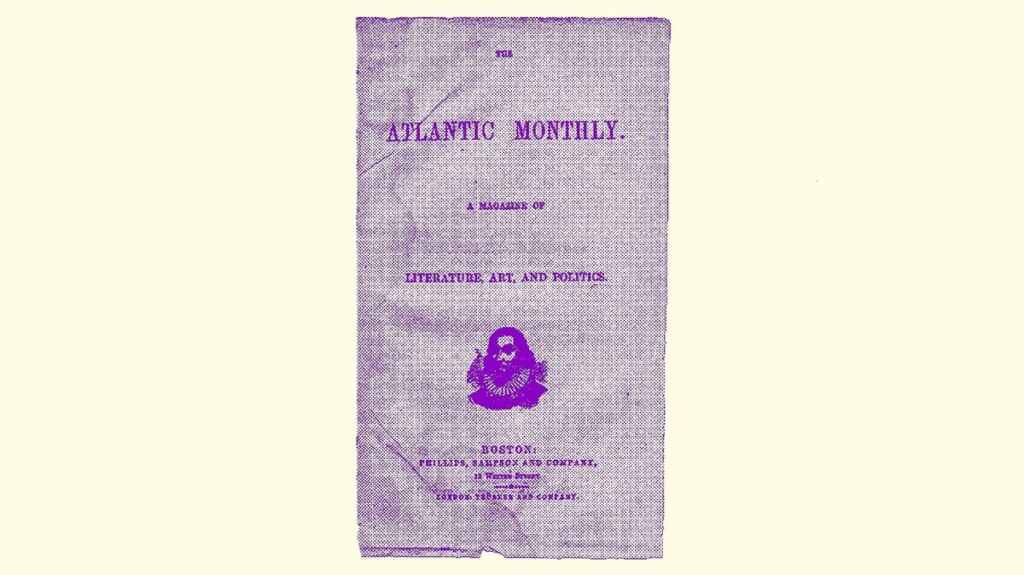
The first issue offered 128 double-columned pages in service of that vision, but its purpose was stated most plainly by the stern visage of Massachusetts Bay Colony Governor John Winthrop on the cover: a declaration of Bostonian seriousness against the light, illustrated ephemerality of popular periodicals from New York and Philadelphia. The magazine’s aim, Emerson wrote in his personal journal, was to “
guide the age
,” even if that meant that it must “defy the public” and refuse what was merely popular or sensational.
We might say that the mission of defying the public was readily realized by the first issue’s 6,500-plus words on “
Florentine Mosaics (Part I)
,” but it is best embodied in Emerson’s own essay on “Illusions,” which confronted current conditions without being entirely captive to them. Emerson reckons with the disorientations of the moment but also finds broader philosophical meaning in the struggle to understand what’s real.
Although much of the material in
The Atlantic
’s first issue does not transcend its time (current readers may well wonder who
Douglas Jerrold
is and why an article on him would lead the issue), it fits within the project of offering serious and substantive reflection. The issue includes a decidedly un-panicked
reflection on the Panic of 1857
; a
story
about a minister’s journey through a series of religious fads and enthusiasms, ending with a conversion to Catholicism;
Harriet Beecher Stowe
on the relationship between the outward symbols and inner experience of mourning; and poems by
Emerson
and
Longfellow
.
Perhaps remarkably, the project seemed to work. Although the early
Atlantic
never had the wide circulation of the national magazines its founders wished to improve upon, its footprint quickly extended beyond Boston. William Dean Howells, who would become the magazine’s third editor, read it in Columbus, Ohio, and yearned to put his writing in its pages. Emily Dickinson, in Amherst, Massachusetts, viewed the magazine as “a temple” and commenced a correspondence with one of its contributors in the 1860s that would culminate in the first publication of her work there.
Subsequent events, beginning with the Civil War, would show that the world was not, in fact, anchored anywhere. It still isn’t. Perhaps that is why
The Atlantic
has endured.


