What does ‘pro-life’ mean? There’s no one answer – even for advocacy groups that oppose abortion
Pope Leo XIV, the first American pope, has garnered attention for his nuanced stance on the pro-life movement, particularly in relation to immigration and abortion. During a recent general audience in St. Peter’s Square, he addressed the controversial decision by the Archdiocese of Chicago to honor U.S. Senator Dick Durbin with a lifetime achievement award for his work on immigration. Durbin, a long-serving senator, has faced criticism from some Catholic circles due to his support for legal abortion, leading him to decline the award. In his remarks, Pope Leo emphasized the importance of a broader interpretation of pro-life, suggesting that one cannot claim to be pro-life while simultaneously endorsing inhumane treatment of immigrants or capital punishment. His comments challenge the traditional binary view of the pro-life label, urging a more holistic understanding that encompasses various social issues.
This perspective aligns with recent survey data from the Public Religion Research Institute (PRRI), which reveals a complex landscape of American public opinion on the intersection of immigration and abortion. While a significant majority (61%) of Americans support basic rights for immigrants, including legal protections, there is a stark divide among those who oppose abortion. Only 40% of individuals who believe abortion should be illegal also support immigrant rights, compared to 75% of those who favor legal abortion. This discrepancy highlights the challenges faced by pro-life advocates who seek to broaden their focus beyond abortion to include social justice issues such as immigration rights, economic inequality, and systemic discrimination. The pope’s comments reflect a growing movement within the pro-life community that seeks to adopt a “consistent life ethic,” advocating for the dignity of life at all stages and in all contexts, which is often at odds with more traditional, single-issue approaches.
Pope Leo XIV’s remarks open up a vital conversation about what it truly means to be pro-life in today’s sociopolitical climate. As various factions within the pro-life movement grapple with these complexities, the pope’s call for a more inclusive definition resonates with a segment of the population that views pro-life advocacy as encompassing a range of human rights issues. This evolving dialogue not only reflects the diversity of beliefs within the Catholic Church but also highlights the necessity for a more integrated approach to advocacy that champions human dignity in all its forms.
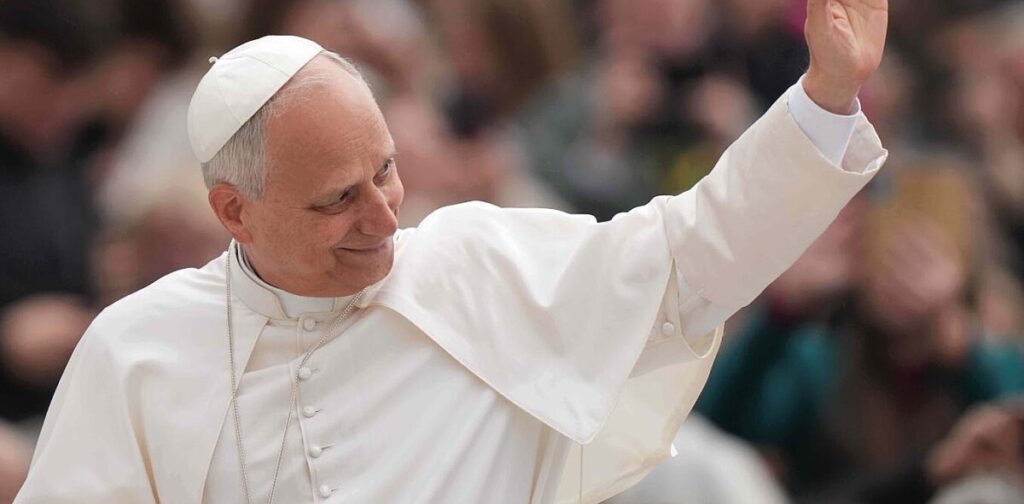
Pope Leo XIV arrives for his weekly general audience in St. Peter’s Square, at the Vatican, on Oct. 22, 2025.
AP Photo/Andrew Medichini
As the
first American pope
, Leo XIV has largely avoided
speaking out about domestic politics in the United States
.
He waded into controversy, however, by commenting on the Archdiocese of Chicago’s plan to honor
U.S. Sen. Dick Durbin
, who has represented Illinois since 1997, with a lifetime achievement award for his work on immigration issues. Some Catholic critics were opposed to Durbin, who has supported the right to a legal abortion, receiving such an award – and he ultimately declined it.
On Sept. 30, 2025, when reporters in Italy asked about the situation,
Leo said
, “It’s important to look at many issues that are related to the teachings of the church.”
“Someone who says I’m against abortion but is in favor of the death penalty is not really pro-life,”
he said
. “And someone who says I’m against abortion but I’m in agreement with the inhuman treatment of immigrants in the United States, I don’t know if that’s pro-life.”
The family of a detained man from Ecuador is comforted by a priest on Sept. 25, 2025, in New York City.
Stephanie Keith/Getty Images
In American politics, being “pro-life” is often equated with
being opposed to abortion
. But as Leo’s comments highlight, it’s not so simple.
In
my research
into the modern pro-life movement, I have found great variety in how different people and organizations use the term, what issues they campaign for, and how religious convictions drive their work.
Public opinion
If being pro-life means caring about immigrants’ rights and opposing abortion, a minority of Americans appear to subscribe to the pope’s vision.
On Oct. 22, 2025, PRRI – a think tank that researches the intersection of religion, culture and politics – released results from
a survey asking respondents about immigration
and abortion
. The survey was conducted online in August and September.
Among all respondents, 61% say that immigrants, regardless of legal status, should have basic rights and protections, including the ability to challenge deportation in court. Sixty-five percent oppose deporting undocumented immigrants without due process to prisons in other countries.
The Rev. Frank O’Loughlin, an Irish priest, celebrates Mass on Aug. 16, 2025, outside the immigrant detention center known as ‘Alligator Alcatraz’ in Ochopee, Fla., standing in solidarity with those detained.
Chandan Khanna/AFP via Getty Images
Support for immigrants’ rights is less common, however, among people who oppose the right to an abortion.
Overall, 36% of respondents believe abortion should be illegal in all or most cases, while 61% believe the procedure should be
legal in all or most cases
.
Among people who believe abortion should be illegal, only 40% say immigrants should have basic rights, compared to 75% of respondents who believe abortion should be legal in all or most cases.
When asked whether the government “should detain immigrants who are in the country illegally in internment camps until they can be deported,” only 37% of Americans agree. Among those who oppose legalized abortion, however, that percentage increased to 57%. Among Americans who support legalized abortion, only 27% support detention.
Looking at responses from U.S. Catholics, there are clear patterns based on race and ethnicity.
Forty-two percent of white Catholics believe abortion should be illegal in all or most circumstances, compared to 35% of Hispanic Catholics.
Forty-seven percent of white Catholics, meanwhile, disagree with immigrant detention. Among Hispanic Catholics, that percentage rises to 76%. Similarly, 50% of white Catholics believe immigrants should have basic rights, compared to 76% of Hispanic Catholics.
‘Pro-life’ label
Leo’s comments and public opinion data demonstrate the challenge of defining what it means to identify as pro-life.
In my interviews with pro-life activists and
research into their advocacy
, I have also observed wide variation within the movement.
Organizations are strategic in choosing the pro-life issues they work on.
Some groups that use that label advocate against abortion and do not see it in their mission to go beyond that. One advocate I interviewed said, “We want to be single-issue. … We want to have a large coalition, and being single-issue is how we do that.”
This advocate works for a secular, national organization that opposes abortion because it ends the life of a human organism. She acknowledged that it can be difficult to decide where to draw the line: “How connected does something have to be to abortion for it to count?” This question arises when the group chooses whether to take a position on policies such as expanding funding for adoption services.
A protester demonstrates in front of a Planned Parenthood clinic on July 12, 2022, in Saint Paul, Minn.
AP Photo/Abbie Parr
Other groups that identify as pro-life are ideologically conservative and often take on other culture war issues. The
Center for Christian Virtue
, for example, advocates against abortion but also is in favor of school choice and increased funding for “responsible fatherhood initiatives,” such as parenting classes and mentorship programs.
Still other groups focus on both beginning-of-life and end-of-life issues. These organizations are inspired by religious beliefs that life is a gift from God and should be protected from conception until
natural death
. In addition to abortion, these organizations oppose the use of embryos and fetal stem cells in scientific research and often oppose in vitro fertilization. They also advocate against legalizing euthanasia and
physician-assisted suicide
.
A fourth type of group has a more expansive definition of pro-life, closely aligned with Leo’s comments. These groups, whose mission statements are often secular, sometimes refer to themselves as protecting life “womb to tomb,” or “pro-life for the whole life.” Groups such as
Democrats for Life of America
and
New Wave Feminists
incorporate issues such as economic inequality, systemic discrimination and support for migrants into their advocacy.
Organizations with this type of holistic approach may also describe themselves as following a “consistent life ethic.” Popularized by
Cardinal Joseph Bernardin
in the 1980s, the term stems from Catholic social teaching but is also used by secular groups. This approach emphasizes human dignity and supporting
policies that affirm life at all stages
. That may include opposition to the death penalty and support for social programs, such as food and housing assistance.
Role of religion
From my research, I have not found a clear relationship between the policies a group advocates on behalf of and its religious affiliation.
Many explicitly call themselves Catholic or Christian. Their mission statements may mention religion. Their publications may include Bible quotes or prayers. They sponsor events in collaboration with churches.
For example, the
American Life League
identifies itself as “the oldest grassroots Catholic pro-life education organization in the United States.”
Students for Life of America
calls its statement of faith “Judeo-Christian,” even though roughly 8 in 10
American Jews support legal abortion
.
Anti-abortion protesters wait outside the Supreme Court for a decision on the Russo v. June Medical Services LLC case on June 29, 2020.
Patrick Semansky/AP
Even in groups that do not describe themselves as religious, though, some leaders and members say they are drawn to the cause because of their faith. An advocate from one such group described many of the members as “
Pope Francis Catholics
,” indicating a more progressive view on many social issues.
Another advocate I spoke with described herself as a devout Catholic but recognized that the anti-abortion movement is often “bashed for being religious.” To
break away from that stereotype
, she said, “That’s why we’re kind of relying on the science. And when I send emails, I never bring in Scripture, and I think people think I might be just agnostic or whatever.”
Other secular groups tie their pro-life advocacy to a broader fight for human rights.
Rehumanize International
, to name one, says its mission is to “ensure that each and every human being’s life is respected, valued, and protected.” Such groups may hold progressive views such as opposing war and the death penalty, as well as concern about climate change. Political science research indicates that positioning opposition to abortion as a
human rights issue
, rather than a religious one, may attract more younger Americans.
It would be a mistake to assume that everyone in these movements adheres to one viewpoint, or is interested only in stopping abortion. In reality, there are many motivations that lead to people using the phrase “pro-life.”
Anne Whitesell is a 2025-2026 PRRI Public Fellow.


