Bad Bunny is the latest product of political rage — how pop culture became the front line of American politics
In September 2025, the NFL announced that Puerto Rican superstar Bad Bunny would headline the Super Bowl halftime show, igniting a firestorm of political outrage from conservative circles. Known for blending pop culture with political activism, Bad Bunny quickly became a target for right-wing commentators who framed his selection as emblematic of America’s so-called “woke” decline. Prominent figures such as Homeland Security Secretary Kristi Noem and former President Donald Trump publicly criticized the NFL’s decision, with Trump labeling it “absolutely ridiculous.” The backlash was amplified on social media, where hashtags like #BoycottBadBunny began trending, and the performer was derogatorily branded as a “demonic Marxist” by conservative influencers.
In a bold response to the controversy, Bad Bunny took to “Saturday Night Live,” where he defended his heritage and challenged his critics, urging them to learn about his culture. This moment underscored how the outrage surrounding his performance had become a battleground in the ongoing culture wars that have increasingly defined American politics. As sociologist James Davison Hunter noted, these culture wars are no longer spontaneous reactions to cultural events but are often initiated by partisan operatives looking to stoke outrage. This manufactured outrage not only permeates national conversations but also seeps into local politics, where activists from both sides of the spectrum engage in protests that echo the narratives spun by mainstream media.
The situation surrounding Bad Bunny exemplifies a broader trend in American political discourse, where outrage is strategically cultivated and marketed to galvanize partisan bases. As the Super Bowl approaches, the division is stark: while some will celebrate Bad Bunny’s performance, others will tune into an alternative “All-American Halftime Show” organized by conservative groups. This duality reflects a nation increasingly polarized, with each side perceiving the other through a lens of hostility. The spectacle of the Super Bowl, once a unifying event, now serves as a microcosm of a divided America, highlighting how cultural figures like Bad Bunny can become symbols in the larger political narrative.
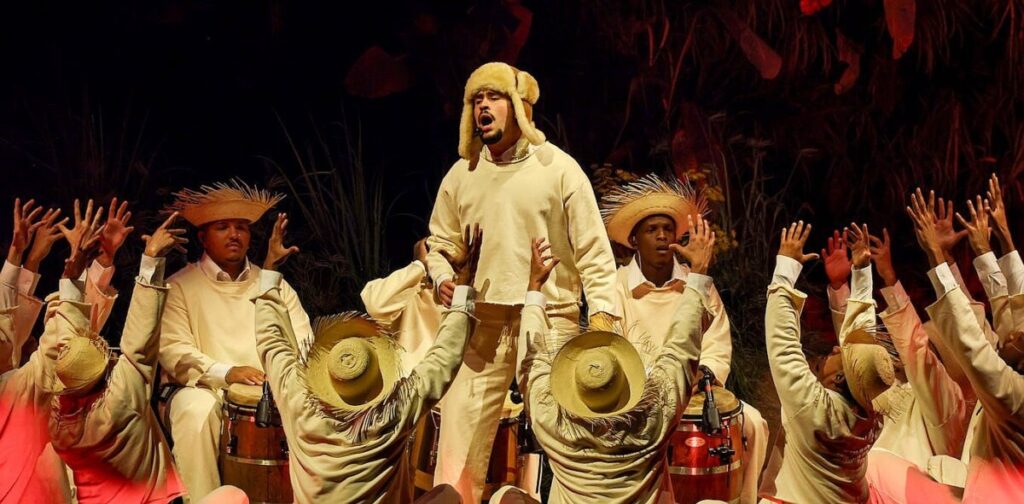
Bad Bunny performs in San Juan, Puerto Rico, on July 11, 2025.
Kevin Mazur/Getty Images
When the NFL in September 2025 announced that
Bad Bunny would headline the next Super Bowl
halftime show, it took only hours for the political outrage machine to roar to life.
The Puerto Rican performer, known for
mixing pop stardom with outspoken politics
, was swiftly recast by conservative influencers as the latest symbol of
America’s “woke” decline
.
Homeland Security Secretary
Kristi Noem joined the critics
on conservative commentator
Benny Johnson’s
podcast.
“Well, they suck, and we’ll win,” she said, speaking of the NFL’s choice. “And they’re so weak, we’ll fix it.”
President Donald Trump called Bad Bunny’s selection “
absolutely ridiculous
” on the right-wing media outlet Newsmax. And far-right radio host and prominent conspiracy theorist
Alex Jones
fanned the flames of anti-NFL sentiment online. Hashtags like #BoycottBadBunny spread on the social platform X, where the performer was branded a “
demonic Marxist
” by right-wing influencers.
Then it was Bad Bunny’s turn. Hosting “Saturday Night Live,” he embraced the controversy, defending his heritage and
answering his critics in Spanish before declaring
, “If you didn’t understand what I just said, you have four months to learn.”
By the time NFL Commissioner Roger Goodell
addressed the backlash
, the outrage had already served its purpose. The story had become another front in the culture war between left and right, complete with nationalism, identity politics, media spectacle and performative anger.
As
a researcher of propaganda
, I’ve spent the past three years tracking these cycles of outrage across social platforms and partisan media, studying how they hijack the national conversation and spill into local politics. My recent book, “
“Populism, Propaganda, and Political Extremism,”
is guided by a single question: How much of our political outrage is really our own?
Outrage before the event
Culture wars have long shaped American politics, from battles over
gun rights
to disputes over
prayer in schools
,
book bans
and
historical monuments
.
Sociologist James Davison Hunter
coined the term “culture wars” to describe a recurring struggle, not just over social issues but over “
the meaning of America
.” These battles once arose from spontaneous events that struck a cultural nerve. An American flag is set ablaze, and citizens quickly take sides as the political world responds in kind.
But today that order has reversed. Culture wars now begin in the political sector, where professional partisans
introduce them
into the public discourse, then watch them take hold. They’re marketed to media audiences as storylines, designed to spark outrage and turn disengaged voters into angry ones.
One clear sign that outrage is being manufactured is when the backlash begins long before the designated “controversial event” even occurs.
In 2022, American audiences were
urged by conservative influencers
to condemn Pixar’s film “Lightyear” months before it reached theaters. A same-sex kiss turned the film into a vessel for accusations of Hollywood’s “
culture agenda
.” Driven by partisan efforts, the outrage spread online, mixing with darker elements and eventually culminating in
neo-Nazi protests
outside Disney World.
This primed outrage appears across the political spectrum.
Last spring, when President Donald Trump announced a military parade in Washington, leading Democrats quickly framed it as an unmistakable
show of authoritarianism
. By the time the parade arrived months later, it was met with dueling
“No Kings” demonstrations across the country
.
And when HBO host Bill Maher said in March that he would be dining with Trump, the comedian faced a
preemptive backlash
, which escalated into vocal criticism from the
political left
before either of the men raised a fork.
The El Capitan Theatre in Los Angeles promotes LGBTQIA+ Pride Month and Pixar’s ‘Lightyear’ on June 21, 2022.
AaronP/Bauer-Griffin/GC Images
Today, few things are marketed as aggressively as political anger, as seen in the recent firestorm against Bad Bunny. It’s promoted daily through
podcasts
, hashtags,
memes
and
merchandise
.
Increasingly, these fiery narratives originate not in politics but in popular culture, providing an enticing hook for stories about the left’s
control over culture
or the right’s
claims to real America
.
In recent months alone, outrage among America’s polarized political bases has flared over a Cracker Barrel
logo change
, “
woke Superman
,” Sydney Sweeney’s
American Eagle ad
and, with Bad Bunny, the NFL’s
Super Bowl performer
.
Platforms like X and TikTok deliver the next diatribes, amplified by partisan influencers and spread by algorithms. From there, they become national stories, often marked by headlines promising the latest “
liberal meltdown
” or “
MAGA tantrum
.”
But manufactured outrage doesn’t stop at the national level. It surfaces in local politics, where these stories play out in protests and town halls.
The local echo
I wanted to understand how these narratives reach communities and how politically active citizens see themselves within this cycle. Over the past year, I
interviewed
liberal and conservative activists, beginning in my hometown, where
opposing protesters
have faced off every Saturday for two decades.
Their signs echo the same narratives that dominate national politics: warnings about the left’s “woke agenda” and charges of “Trump fascism.” When asked about the opposition, protesters reached for familiar caricatures. Conservatives often described the left as “radical” and “socialist,” while those on the left saw the right as “cultlike” and “extremist.”
Yet beneath the anger, both sides recognized something larger at play – the sense that outrage itself is being engineered. “The media constantly fan the flames of division for more views,” one protester said. Across the street, his counterpart agreed: “Politics is being pushed into previously nonpolitical areas.”
When Cracker Barrel attempted to change its logo in August 2025, the move was met by severe criticism from loyal customers who preferred the brand’s traditional image. President Donald Trump soon weighed in and urged the company to revert to its old logo.
AP Photo/Ted Shaffrey
Both camps pointed to the media as the primary culprit, the force that “causes and benefits from the outrage.” A liberal activist observed, “Media tend to focus on whoever shouts the loudest.” A conservative demonstrator agreed: “I feel like the media promotes extreme idealists. The loudest voice gets the most coverage.”
“It’s been a crazy few years, moving further to the extremes, and tensions are always rising,” one protester reflected. “But I think people are realizing that now.”
Across the divide, protesters understood that they were participants in something larger than their weekly standoffs, a system that converts every political difference into a national spectacle. They saw it, resented it and yet couldn’t escape it.
That brings us back to Bad Bunny. The anger that Americans are encouraged to feel over his selection – or in defense of it – keeps the country locked in its corners. Studies show that as a result of these cycles, Americans on the left and right have developed an
exaggerated sense
of the other side’s hostility, exactly as some
political demagogues
intend.
It has created a split screen of the country, literally in the case of Bad Bunny. On Super Bowl night, there will be dueling halftime shows. On one screen, Bad Bunny will perform for approving viewers. On the other,
the conservative nonprofit Turning Point USA
will host its “
All-American Halftime Show
” for those intent on tuning Bad Bunny out.
Two screens. Two Americas.
Adam G. Klein does not work for, consult, own shares in or receive funding from any company or organization that would benefit from this article, and has disclosed no relevant affiliations beyond their academic appointment.


