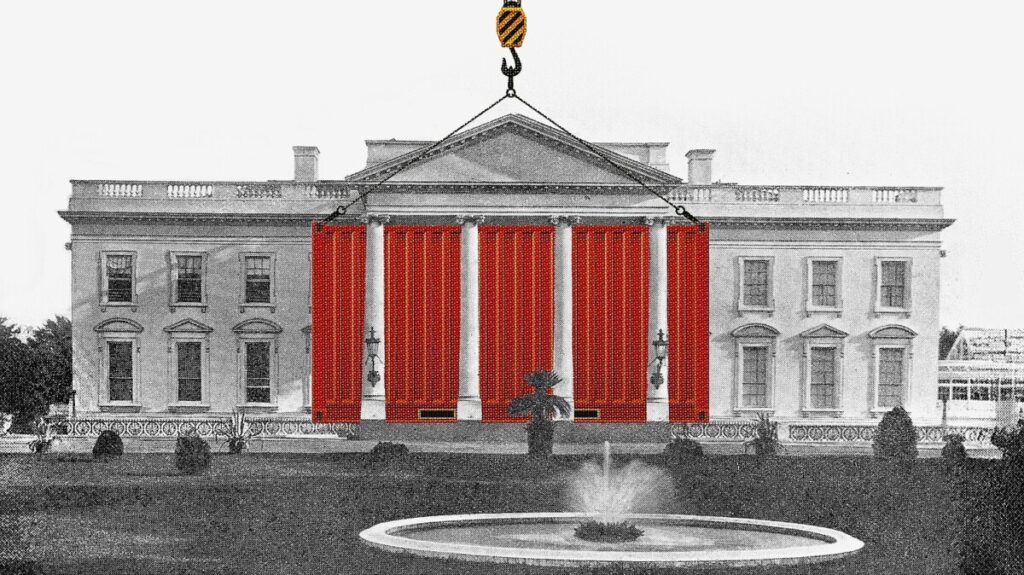
What Tariffs Did
The ongoing trade war, initiated by former President Donald Trump, may be approaching a pivotal moment as the Supreme Court deliberates on two significant cases that challenge the legality of his tariff policies. A coalition of state governments and businesses, spanning various sectors from toys to plumbing supplies, argues that the trade deficits cited by the Trump administration do not constitute a legitimate emergency under the International Emergency Economic Powers Act. This legal framework has been used to justify the imposition of tariffs, which currently stand at an effective rate of nearly 18%, the highest in nearly a century. If the Court rules against the tariffs, it could potentially halve this rate, leading to a substantial decrease in revenue for the Treasury and requiring the government to return billions in tariffs collected from businesses.
The financial implications of such a ruling could be profound for American households. While the economy is currently growing, the burden of high living costs—exacerbated by the tariffs—remains a pressing concern for many families. The tariffs have contributed to an estimated additional cost of $1,800 per family for essentials like groceries and clothing, overshadowing recent tax cuts. Moreover, the tariffs have forced the Federal Reserve to maintain higher interest rates to combat inflation, further straining household finances and stifling investment in critical sectors. As businesses navigate this uncertainty, many are hesitant to hire or invest, exacerbating the economic challenges faced by the country.
In a recent social media post, Trump proposed sending out $2,000 rebates to Americans, a move that raises questions about its feasibility and potential impact on inflation. While such financial assistance could provide temporary relief, experts warn it may complicate the Federal Reserve’s efforts to control rising prices. The Supreme Court’s decision could ultimately provide a much-needed reprieve for American consumers, easing inflationary pressures and allowing for greater economic stability. By potentially dismantling the legal basis for the tariffs, the Court could help restore consumer confidence, stimulate spending, and promote long-term investments, thereby alleviating the cost-of-living crisis that has plagued many households.
https://www.youtube.com/watch?v=6d1XsGInzZc
T
he trade war
might be coming to a strange end.
Last week, the Supreme Court heard two cases questioning the legal underpinnings of Donald Trump’s tariff regime. A group of state governments and businesses—selling toys, wine, plumbing supplies, bicycle saddles, and other goods—argued that the United States’ trade deficits do not constitute an emergency and that the International Emergency Economic Powers Act does not give the White House the unilateral authority to impose tariffs anyway.
The president argued that it “would literally destroy the United States of America” if the Court rules against him. Alas, I guess, the justices—three Trump appointees among them—seem likely to do so, as three lower courts have so far this year, and as a formidable group of
conservative legal experts
insists they must.
The financial fallout would be messy. Such a ruling would cut in half the country’s effective tariff rate—which, at nearly 18 percent, is the highest it has been since 1934—meaning that the revenue the Treasury collects from businesses would
fall by half
. The White House might have to figure out how to return tens of billions of dollars to companies that have paid import fees this year, plus interest. Despite the probable chaos, however, a ruling against the tariffs would be good for Americans’ pocketbooks, and good for ensuring that the current slowdown does not transform into a recession.
The American economy is growing at a decent-enough pace at the moment, and the jobless rate is rising but low. The real problem is the cost of living, as households have told pollsters and politicians over and over and over again. Trump’s tariffs are certainly not the cause of sky-high rents, obscene utility bills, child-care shortages, and ridiculous out-of-pocket health costs. But they have pumped up the price of consumer goods. The average family will pay $1,800 more for groceries, clothing, and other necessities thanks to the Trump administration’s trade policies in 2025. For many lower-income households, the tariffs will end up swamping the tax cuts Republicans passed this summer.
Moreover, the tariffs have forced the Federal Reserve to keep borrowing costs relatively high to tamp down on inflation—perhaps 0.5 percentage points higher than they
would be otherwise
. That means fewer homes being built, driving up real-estate costs. It means more credit-card delinquencies. It means fewer Americans being able to afford a house, a car, a medical bill. It means fewer companies pouring money into novel products and technologies.
The Trump administration’s inane and perhaps illegal policies have hit certain sectors particularly hard: the fashion industry, agribusinesses, small-scale firms selling household goods. But few businesses have gone unscathed. “You’ve got uncertainty,” Diane Swonk, the chief economist at the accounting firm KPMG US, told me. “Measures of uncertainty are extremely elevated.” Given that uncertainty, many companies outside of the health-care industry have declined to add workers, and investors have poured little money into anything other than AI.
On Sunday, Trump announced in a social-media post that the government would send Americans a tariff rebate: “$2000 a person (not including high income people!).” It’s not clear whether he can. If his administration does send the rebates, the checks might help some families get by. But they would also make the Federal Reserve’s effort to hold down inflation even harder. “We have a low-hire-with-layoffs-coming environment, and that may be blunted a bit by this fiscal stimulus,” Swonk told me. “But we also know from the pandemic: When you add a lot of fiscal stimulus when prices are already going up, you get stickier inflation. It’s a very difficult situation.”
The better policy would have been no policy at all. Imagine what the economy would look like right now if Trump had never started the trade war. The Yale Budget Lab
estimates
that the tariffs have depressed real GDP growth by 0.5 percentage points this year, lifted the unemployment rate by 0.3 percentage points, and cost the economy close to half a million jobs. Moody’s Analytics estimates the hit to real GDP growth to be 0.8 percentage points. In other words, the Trump administration has likely cut the country’s expansion by a third or more and its annual employment gains in half—for nothing.
The Supreme Court can’t undo the damage by affirming the lower courts’ rulings, nor can the Trump administration undo the damage by sending out checks. The Court can’t even end the trade war entirely. The tariffs on steel and aluminum will still stand, for instance, because Trump did not invoke the same economic-emergency authority when making them.
Nevertheless, the Court could do what Congress, the White House, and the Fed haven’t been able to this year: help nudge the economy out of its stagflationary funk. Inflation should temper. Real household disposable incomes should rise. Uncertainty should ease. The Fed should have more room to lower rates. Companies should import more goods and spend more money on long-range investments. American households hate the cost-of-living crisis—and the Court might finally give them some relief.


