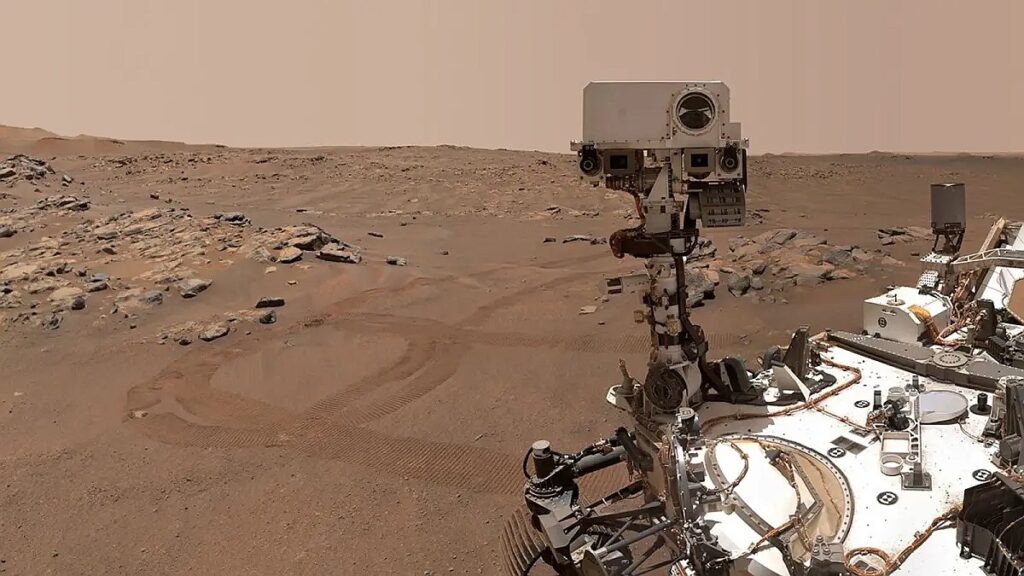
NASA rover spots something on Mars that doesnt belong there
NASA’s Perseverance rover has made an exciting discovery on Mars: a rock that scientists believe may be an iron-nickel meteorite, affectionately dubbed Phippsaksla. This intriguing find, measuring over 2.5 feet across, stands out against the flat, fractured landscape of the Jezero crater, where Perseverance has been conducting its mission since landing in February 2021. The rover captured images of this peculiar rock on September 2 and September 19, but details about the discovery were only recently released due to a prolonged federal government shutdown that delayed routine communications from NASA. The announcement came on November 13, generating renewed interest in the rover’s ongoing exploration of the Martian surface.
If confirmed as a meteorite, Phippsaksla would mark a significant milestone for the Perseverance mission, as it would be the first such discovery by this rover. Previous Mars rovers, including Curiosity, Opportunity, and Spirit, have identified several metal-rich meteorites, particularly in Gale Crater, which lies approximately 2,000 miles away. The absence of similar finds in Jezero crater had puzzled scientists, leading to questions about the geological history and impact events in the region. Candice Bedford, a research scientist at Purdue University, noted the unexpected lack of iron-nickel meteorites in Perseverance’s path, especially considering the crater’s similar age to Gale and the presence of smaller impact craters that suggest meteorites could have landed there over time.
Initial analyses from Perseverance’s SuperCam, a sophisticated instrument that utilizes a laser to assess rock composition, indicated high levels of iron and nickel in Phippsaksla, which are characteristic of meteorites formed deep within large asteroids. Meteorites are relatively common in the solar system, with an estimated 48.5 tons entering Earth’s atmosphere daily, though most disintegrate before reaching the ground. To date, approximately 60,000 meteorites have been cataloged on Earth, with a small number originating from Mars and the Moon. The discovery of Phippsaksla could provide valuable insights into the history of Mars and the processes that shaped its surface, as iron meteorites are known to endure the planet’s harsh conditions far better than other types of rocks. As Perseverance continues its exploration of older bedrock in Jezero crater, scientists are eager to conduct further analyses to determine the rock’s origins and potentially add it to the growing list of Martian meteorites recognized by The Meteoritical Society. If Phippsaksla is confirmed as a meteorite, it would solidify Perseverance’s role in unraveling the mysteries of Martian geology and its extraterrestrial visitors.
https://www.youtube.com/watch?v=I6FM2ApqGb0
NASA
’s
Perseverance
rover has identified an exotic rock on
Mars
that may be an iron-nickel
meteorite
, according to scientists on the mission team.
The oddly sculpted rock, nicknamed Phippsaksla, measures more than 2.5 feet across and drew researchers’ attention because it jutted above the surrounding flat, fractured terrain. Perseverance targeted the object for closer study while working outside Jezero crater, the river-carved basin the rover has explored since landing in 2021.
The rover, a car-size mobile laboratory, photographed Phippsaksla on Sept. 2 and Sept. 19. But the public is only now learning of the find. A prolonged federal government shutdown delayed routine communications from the U.S.
space
agency, and NASA did not post details of the detection — along with other mission updates — until Nov. 13.
If confirmed as a meteorite, Phippsaksla would be the first such discovery for Perseverance. The Curiosity rover has cataloged several metal-rich meteorites during its exploration of Gale Crater
roughly 2,000 miles away
, and earlier rovers, Opportunity and Spirit, found these foreign rocks as well. Their absence along Perseverance’s route has puzzled mission scientists.
“It has been somewhat unexpected that Perseverance had not seen iron-nickel meteorites within Jezero crater,” said Candice Bedford, a Purdue University research scientist, in a delayed Oct. 1
mission update
, “particularly given its similar age to Gale crater and number of smaller impact craters suggesting that meteorites did fall on the crater floor, delta, and crater rim throughout time.”
SEE ALSO:
NASA has a broken giant antenna that could upend its 2026 plans
Initial readings from Perseverance’s SuperCam, an instrument that fires a laser to analyze a rock’s composition, revealed high levels of iron and nickel, a combination commonly found in meteorites that originate deep inside large asteroids. The chemistry suggests the rock formed elsewhere before landing on Mars.
Meteorites are common in the solar system, but harder to spot on Earth. Scientists estimate that about 48.5 tons of this
debris
reach the planet each day, most of it burning up in the atmosphere or falling into oceans. Only about 60,000 meteorites have been identified on Earth to date.
The oddly sculpted rock, nicknamed Phippsaksla, measures more than 2.5 feet across and drew researchers’ attention because it jutted above the surrounding flat, fractured terrain.
Credit: NASA / JPL-Caltech / ASU
Most known meteorites come from asteroids, though a small number originate from the
moon
or Mars. At least
175 Martian meteorites
have been found on Earth — all igneous rocks that once crystallized from magma.
On Mars itself, iron-nickel meteorites tend to survive well in the thin atmosphere and harsh environment. Since 2005, The Meteoritical Society, an international organization that
tracks such finds
, has formally recognized 15 Martian meteorites spotted by rovers. Curiosity’s 2023 discovery of
a foot-wide rock nicknamed Cacao
, also believed to be metal-rich, is not yet among them.
Phippsaksla, possibly a meteorite, sits on Martian terrain outside the Jezero crater rim in the upper left corner of this image.
Credit: NASA / JPL-Caltech / ASU
Scientists suspect iron meteorites might be able to resist erosion on Mars, which may explain why some appear perched on flat ground rather than embedded in craters. In other cases, a crater may have weathered away long ago, leaving only the rock behind.
Perseverance is now operating on older bedrock mottled by past impacts outside Jezero crater, a setting where meteorites may be more likely. Mission researchers are planning further analysis to determine Phippsaksla’s origin.
“If this rock is deemed to be a meteorite,” Bedford wrote, “Perseverance can at long last add itself to the list of Mars rovers who have investigated the fragments of rocky visitors to Mars.”