NASA goes on an ESCAPADE – twin small, low-cost orbiters will examine Mars’ atmosphere
NASA’s ESCAPADE mission, which stands for Escape and Plasma Acceleration and Dynamics Explorers, marks an exciting new chapter in space exploration with its launch on November 13, 2025. This innovative mission involves two twin spacecraft, aptly named Blue and Gold, designed to study the Martian atmosphere. Each spacecraft is roughly the size of a copy machine, embodying the ongoing trend of miniaturization in the aerospace industry. This approach not only allows for more efficient use of resources but also reduces costs, making deep space exploration more accessible. With a budget of only $80 million, ESCAPADE exemplifies how leveraging commercial technologies can lead to significant advancements in scientific inquiry while maintaining affordability.
The mission aims to unravel the mysteries surrounding Mars’ atmospheric history, particularly the loss of its once-thick atmosphere, which enabled liquid water to flow on its surface billions of years ago. As part of its scientific objectives, ESCAPADE will measure remnants of Mars’ ancient magnetic field and analyze how the planet’s atmosphere interacts with solar wind. This research is crucial for understanding not only the planet’s past but also its potential for hosting life. By deploying two spacecraft, NASA ensures redundancy in its data collection efforts; even if one fails, the other can still provide valuable insights. This dual approach enhances the overall reliability of the mission, allowing scientists to gather comprehensive data about Mars’ atmospheric dynamics and the factors contributing to its current state.
ESCAPADE’s journey to Mars is uniquely designed to optimize fuel efficiency, utilizing a trajectory that allows the spacecraft to collect solar data at the L2 Lagrange point before making a gravity-assisted flyby of Earth. This innovative route not only reduces the amount of propellant needed but also offers greater flexibility in planning future missions, potentially paving the way for more frequent cargo and human expeditions to the red planet. As a collaborative effort involving NASA, commercial partners, and academic institutions, ESCAPADE serves as a blueprint for a new era of space exploration, demonstrating that with creativity and cooperation, humanity can expand its reach into the cosmos while enhancing our understanding of other worlds.
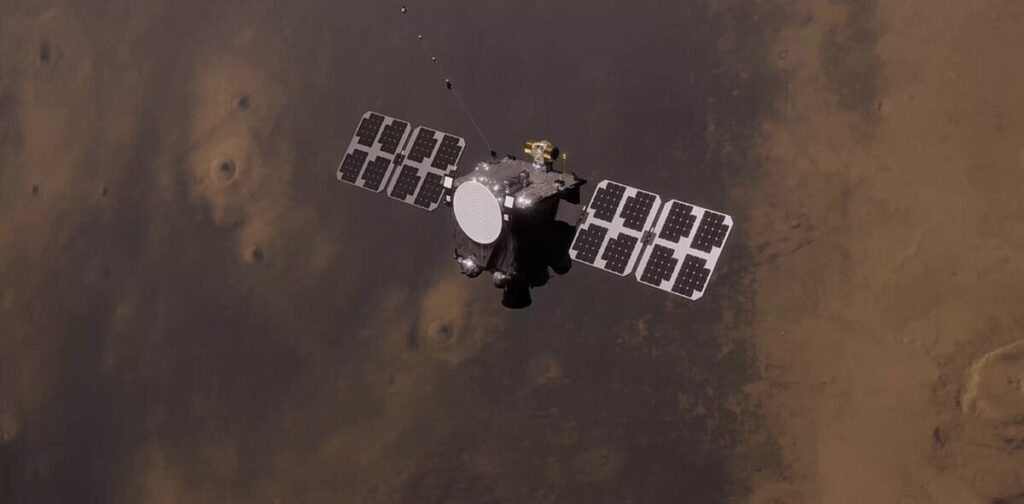
This close-up illustration shows what one of the twin ESCAPADE spacecraft will look like conducting its science operations.
James Rattray/Rocket Lab USA/Goddard Space Flight Center
Envision a time when hundreds of spacecraft are exploring the solar system and beyond. That’s the future that
NASA’s ESCAPADE
, or Escape and Plasma Acceleration and Dynamics Explorers, mission will help unleash: one where small, low-cost spacecraft enable researchers to learn rapidly, iterate, and advance technology and science.
The ESCAPADE
mission launched
on Nov. 13, 2025 on a
Blue Origin New Glenn rocket
, sending two small orbiters to Mars to study its atmosphere.
As aerospace engineers
,
we’re excited
about this mission because not only will it do great science while advancing the deep space capabilities of small spacecraft, but it also will travel to the red planet on an innovative new trajectory.
The ESCAPADE mission is actually
two spacecraft instead of one
. Two identical spacecraft will take simultaneous measurements, resulting in better science. These spacecraft are smaller than those used in the past, each
about the size of a copy machine
, partly enabled by an ongoing miniaturization trend in the space industry. Doing more with less is very important for space exploration, because it typically takes most of the mass of a spacecraft simply to transport it where you want it to go.
The ESCAPADE mission logo shows the twin orbiters.
TRAX International/Kristen Perrin
Having two spacecraft also acts as an insurance policy in case one of them doesn’t work as planned. Even if one completely fails, researchers can still do science with a single working spacecraft. This redundancy enables each spacecraft to be built more affordably than in the past, because the copies allow for more acceptance of risk.
Studying Mars’ history
Long before the ESCAPADE twin spacecraft Blue and Gold were ready to go to space – billions of years ago, to be more precise – Mars
had a much thicker atmosphere
than it does now. This atmosphere would have
enabled liquids to flow
on its surface, creating the channels and gullies that scientists can still observe today.
But where did the bulk of this atmosphere go? Its loss turned Mars into the cold and dry world it is today, with a surface air pressure
less than 1% of Earth’s
.
Mars also once
had a magnetic field
,
like Earth’s
, that helped to shield its atmosphere. That atmosphere and magnetic field would have been critical to any life that might have existed on early Mars.
Today, Mars’ atmosphere is very thin. Billions of years ago, it was much thicker.
©UAESA/MBRSC/HopeMarsMission/EXI/AndreaLuck
,
CC BY-ND
ESCAPADE will measure remnants of this magnetic field that have been preserved by ancient rock and study the flow and energy of Mars’ atmosphere and how it interacts with
the solar wind
, the stream of particles that the sun emits along with light. These measurements will help to reveal where the atmosphere went and how quickly Mars is still losing it today.
Weathering space on a budget
Space is not a friendly place.
Most of it is a vacuum
– that is, mostly empty, without the gas molecules that create pressure and allow you to breathe or transfer heat. These molecules keep things from getting too hot or too cold. In space, with no pressure, a spacecraft can easily get too hot or too cold, depending on whether it is in sunlight or in shadow.
In addition, the Sun and other, farther astronomical objects
emit radiation
that living things do not experience on Earth. Earth’s magnetic field protects you from the worst of this radiation. So when humans or our robotic representatives leave the Earth, our spacecraft must survive in this extreme environment not present on Earth.
ESCAPADE will overcome these challenges with a shoestring
budget totaling US$80 million
. That is a lot of money, but for a mission to another planet it is inexpensive. It has kept costs low by leveraging commercial technologies for deep space exploration, which is now possible because of prior investments in fundamental research.
For example, the
GRAIL mission
, launched in 2011, previously used two spacecraft, Ebb and Flow, to map the Moon’s gravity fields. ESCAPADE takes this concept to another world, Mars, and costs
a fraction as much as GRAIL
.
Led by Rob Lillis of UC Berkeley’s Space Sciences Laboratory,
this collaboration
between spacecraft builders Rocket Lab, trajectory specialists Advanced Space LLC and launch provider Blue Origin – all commercial partners funded by NASA – aims to show that deep space exploration is now faster, more agile and more affordable than ever before.
NASA’s ESCAPADE represents a partnership between a university, commercial companies and the government.
How will ESCAPADE get to Mars?
ESCAPADE will also use a new trajectory to get to Mars. Imagine being an archer in the Olympics. To hit a bull’s-eye, you have to shoot an arrow through a 15-inch – 40-centimeter – circle from a distance of 300 feet, or 90 meters. Now imagine the bull’s-eye represents Mars. To hit it from Earth, you would have to shoot an arrow through the same 15-inch bull’s-eye at a distance of over 13 miles, or 22 kilometers. You would also have to shoot the arrow in a curved path so that it goes around the Sun.
Not only that, but
Mars won’t be at the bull’s-eye
at the time you shoot the arrow. You must shoot for the spot that Mars will be in 10 months from now. This is the problem that the ESCAPADE mission designers faced. What is amazing is that the physical laws and forces of nature are so predictable that this was not even the hardest problem to solve for the ESCAPADE mission.
It takes energy to get from one place to another. To go from Earth to Mars, a spacecraft has to carry the energy it needs, in the form of rocket fuel, much like gasoline in a car. As a result, a high percentage of the total launch mass has to be fuel for the trip.
When going to Mars orbit from Earth orbit, as much as 80% to 85% of the spacecraft mass has to be propellant, which means not much mass is dedicated to the part of the spacecraft that does all the experiments. This issue makes it important to pack as much capability into the rest of the spacecraft as possible. For ESCAPADE, the propellant is only about
65% of the spacecraft’s mass
.
ESCAPADE’s route is particularly fuel-efficient. First, Blue and Gold will go to the
L2 Lagrange point
, one of five places where gravitational forces of the Sun and Earth cancel out. Then, after about a year, during which they will collect data monitoring the Sun, they will fly by the Earth, using its gravitational field
to get a boost
. This way, they will arrive at Mars in about 10 more months.
This new approach has another advantage beyond needing to carry less fuel: Trips from Earth to Mars are typically favorable to save fuel about every 26 months due to the two planets’ relative positions. However, this new trajectory makes the departure time more flexible. Future cargo and human missions could use a similar trajectory to have more frequent and less time-constrained trips to Mars.
ESCAPADE is a testament to a new era in spaceflight. For a new generation of scientists and engineers, ESCAPADE is not just a mission – it is a blueprint for a new collaborative era of exploration and discovery.
This article was updated on Nov. 13, 2025 to reflect the ESCAPADE launch’s date and success.
Christopher E. Carr is part of the science team for the Rocket Lab Mission to Venus (funding from Schmidt Sciences and NASA). More information is available at
https://www.morningstarmissions.space/rocketlabmissiontovenus
Glenn Lightsey does not work for, consult, own shares in or receive funding from any company or organization that would benefit from this article, and has disclosed no relevant affiliations beyond their academic appointment.


