NASA Glenn Teams Win 2025 R&D 100 Awards
NASA’s Glenn Research Center in Cleveland has recently garnered significant recognition by winning two prestigious 2025 R&D 100 Awards. This accolade highlights their groundbreaking advancements in space technology, particularly through the development of the High-Rate Delay Tolerant Networking (HDTN) protocol and the co-invention of VulcanAlloy, a new class of soft magnetic nanocrystalline materials. With these latest achievements, NASA Glenn’s total R&D 100 Awards has reached an impressive 130, underscoring its long-standing commitment to innovation in aerospace technology.
The HDTN protocol, spearheaded by engineers Daniel Raible and Rachel Dudukovich, represents a major leap forward in data transmission capabilities for space missions. Unlike traditional delay-tolerant networking systems, which often struggle with latency and data loss, HDTN offers a solution that is up to ten times faster and more efficient. This advanced software enables reliable high-speed communication between spacecraft and Earth, even under the harsh conditions of space. Its open-source nature encourages collaboration across the burgeoning commercial space industry, potentially laying the groundwork for a solar system-wide internet that could facilitate near real-time communication for future missions to the Moon and Mars.
In addition to HDTN, NASA Glenn has also contributed to the development of VulcanAlloy, a revolutionary soft magnetic material designed to operate at extreme temperatures exceeding 500°C. This innovation, created in partnership with the University of Pittsburgh and CorePower Magnetics, is a game-changer for various applications, including electrified aircraft and advanced energy systems. VulcanAlloy’s unique nano-engineered structure allows it to maintain efficiency in high-temperature environments, reducing the need for bulky cooling systems. As industries increasingly seek smaller, lighter, and more efficient components, VulcanAlloy stands poised to make a significant impact on electric vehicles, data centers, and microgrids, thereby advancing the next generation of power electronics. The R&D 100 Awards continue to celebrate such pioneering innovations, showcasing the vital role of organizations like NASA Glenn in pushing the boundaries of technology and science.
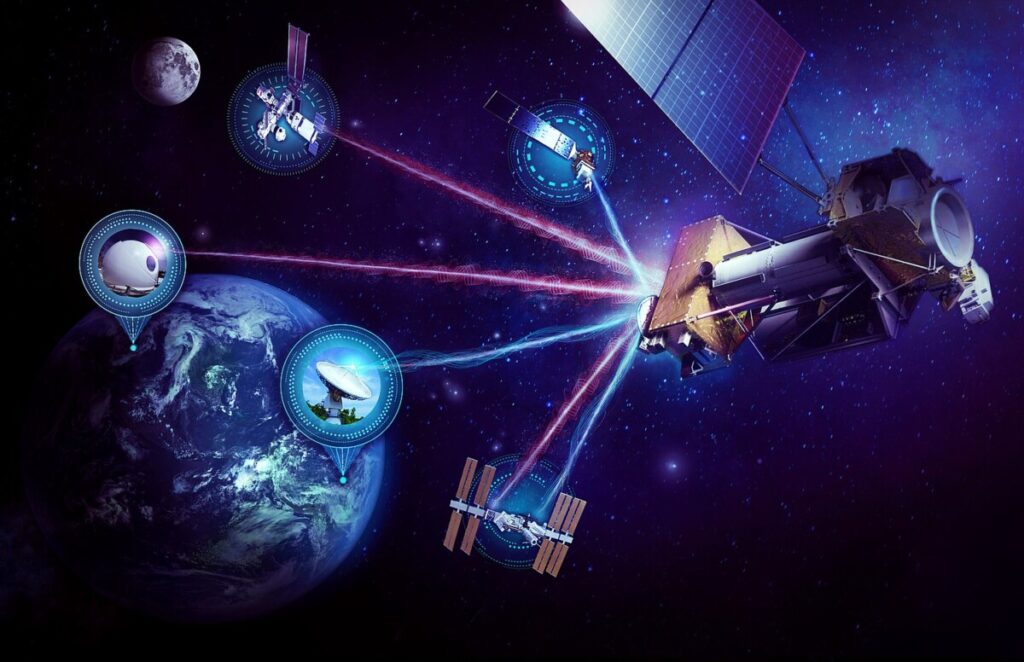
Artistic rendering of the High-Rate Delay Tolerant Networking protocol being used on the Laser Communications Relay Demonstration to transfer radio and optical communications between Earth and space.
Credit: NASA
NASA’s Glenn Research Center in Cleveland has earned
2025 R&D 100 Awards
for developing a system that delivers high-speed internet for space and co-inventing technology for a new class of soft magnetic nanocrystalline materials designed to operate at extreme temperatures. This brings NASA Glenn’s total to 130 R&D 100 Awards.
High-Rate Delay Tolerant Networking
NASA Glenn’s Daniel Raible and Rachel Dudukovich led their team of engineers to create
High-Rate Delay Tolerant Networking
(HDTN)
,
a cutting-edge software solution designed to revolutionize data streaming and communication in space. HDTN enables reliable, high-speed transmission of data between space and Earth — even under the extreme conditions of space — minimizing loss and system delay.
High-Rate Delay Tolerant Networking team photo, left to right: Tad Kollar, Eric Brace, Brian Tomko, José Lombay-González, Nadia Kortas, Daniel Raible, John Nowakowski, Shaun McKeehan, Ethan Schweinsberg, Prash Choksi, and Rachel Dudukovich.
Credit: NASA/Jef Janis
“The HDTN software protocol allows faster, automated, and seamless data transfer between spacecraft, even across communication systems operating on different link speeds,” Raible said. “It’s up to 10 times faster than current delay-tolerant networking (DTN).”
This advanced technology has far-reaching implications beyond NASA. With its open-source code, HDTN paves the way for collaboration, innovation, and adoption across the rapidly expanding commercial space industry, offering near real-time communication capabilities.
Looking ahead, HDTN could form the foundation of a solar system-wide internet, supporting data exchange between Earth, spacecraft, and even future missions involving human travel to the Moon and Mars.
VulcanAlloy
In a project led by the University of Pittsburgh, researchers at NASA Glenn, including Nick Bruno, Grant Feichter, Vladimir Keylin, Alex Leary, and Ron Noebe, partnered with CorePower Magnetics to develop VulcanAlloy — a breakthrough soft magnetic nanocrystalline material.
NASA’s Glenn Research Center in Cleveland tested high-temperature inductors using VulcanAlloy technology in the NASA Glenn Extreme Environments Rig, which simulates the conditions on Venus’ surface, on May 13, 2025.
Credit: NASA
VulcanAlloy, developed under NASA’s High Operating Temperature Technology Program using processing capability established by the Advanced Air Transport Technology project, operates above 500°C, far beyond the limits of conventional soft magnetic materials. Its nano-engineered structure maintains efficiency at high temperatures and frequencies.
With adjustable magnetic properties, it can replace multiple materials in components like inductors, transformers, motors, and sensors while reducing the need for bulky cooling systems — ideal for extreme environments.
Raytheon has tested VulcanAlloy cores, highlighting their potential in electrified aircraft, defense, and aerospace systems.
This innovation also promises major impact in electric vehicles, data centers, microgrids, and energy systems, where smaller, lighter, and more efficient components are key to advancing next-generation power electronics.
The R&D 100 Awards, a worldwide science and innovation competition, received entries from organizations around the world. Now in its 63rd year, this year’s judging panel included industry professionals from across the globe who evaluated breakthrough innovations in technology and science.
Return to Newsletter
Explore More
2 min read
NASA Glenn Reinforces Role in Aerospace Innovation During Ohio Space Week
Article
2 months ago
3 min read
NASA Glenn’s AeroSpace Frontiers Newsletter Takes a Bow
Article
2 months ago
1 min read
Glenn Highlights Space Exploration at Minnesota State Fair
Article
2 months ago


