Meta’s CMO says Big Tech’s soaring spending on AI is ‘aggressive, but not crazy’
In a recent interview at the Web Summit tech conference, Alex Schultz, Meta’s Chief Marketing Officer (CMO), addressed the ongoing surge in artificial intelligence (AI) investments, which he described as “aggressive, but not crazy.” As Meta plans to allocate up to $72 billion this year on AI infrastructure—an investment that is expected to increase further in 2024—Schultz emphasized the substantial returns these investments are generating. Meta’s AI initiatives have already contributed billions in revenue by enhancing advertising tools and optimizing content ranking algorithms, which are crucial for capturing user engagement on platforms like Facebook and Instagram. With Meta projected to generate around $200 billion in revenue this year, Schultz underscored the importance of AI in navigating the evolving digital landscape, especially as users increasingly consume “unconnected content” that does not originate from their direct social connections.
Despite concerns that the current AI investment boom could be indicative of a bubble akin to historical economic phenomena, Schultz argued that the present spending levels remain relatively modest in comparison to past tech booms. For instance, Goldman Sachs analysts noted that AI-related investments in the U.S. currently account for less than 1% of GDP, significantly lower than the 2% to 5% observed during the railroad expansion of the late 19th century. Schultz also discussed Meta’s innovative Vibes feed, which features short-form, AI-generated video content, highlighting its potential as a significant part of the company’s future. While some critics have dismissed Vibes as “AI slop,” Schultz maintained that the feed has shown promising user retention rates and is part of a broader strategy to leverage AI’s capabilities.
Moreover, Schultz acknowledged the environmental implications of AI technologies, particularly the energy demands associated with video-generation models. He reassured stakeholders that while the power requirements are considerable, they are not so excessive as to threaten critical resources. Schultz pointed out that the rise of AI has catalyzed essential discussions regarding energy production, including the safety of nuclear power and the viability of desalination plants for freshwater generation. In his view, these conversations are vital for fostering a future where humanity can enjoy greater abundance. Ultimately, Schultz’s insights reflect a balanced perspective on the AI boom, recognizing both its potential for innovation and the need for responsible resource management.
https://www.youtube.com/watch?v=2cukB4_hDCI
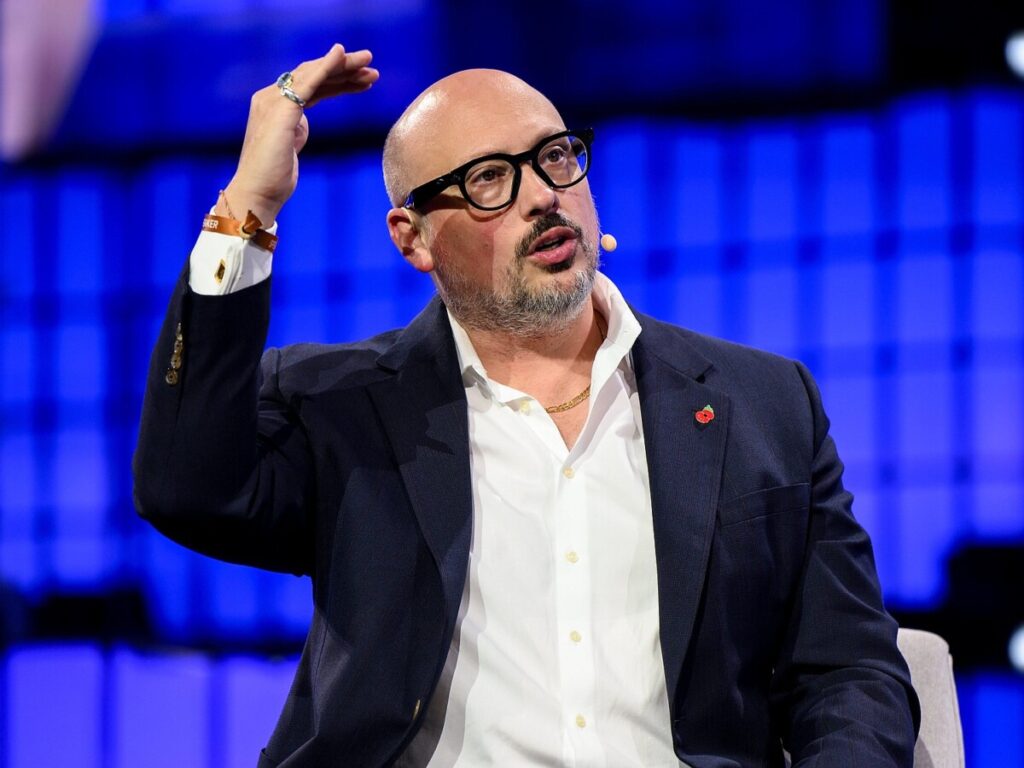
Alex Schultz is Meta’s CMO.
Alex Broadway/Sportsfile for Web Summit via Getty Images
Alex Schultz, Meta’s CMO, says the AI spending boom is “aggressive, but not crazy.”
Meta’s AI investments have driven billions in revenue and enhanced its content ranking systems.
Schultz said the AI wave has prompted productive conversations about energy.
Meteoric levels of investment in AI infrastructure have sparked concerns that Big Tech’s latest boom is veering into bubble territory. So, is Meta, along with the rest of Silicon Valley, overspending on AI?
“Clearly no Meta executive would ever answer that question with a ‘yes,'” Alex Schultz,
Meta’s CMO
and VP of analytics, said in an interview with Business Insider at the Web Summit tech conference in Lisbon this week.
Meta plans to spend up to $72 billion this year on
AI infrastructure
, and has said spending will climb higher next year. CEO Mark Zuckerberg said this year that he’d rather risk “misspending a couple of hundred billion dollars” than be late to the
development of superintelligence
. Amazon, Google, Microsoft, and privately held AI companies like OpenAI are logging record-breaking
capital expenditures
on all things AI. That includes chips and data centers, as well as big salaries to attract and retain top AI research and engineering talent.
There are eyewatering sums of money at play, but Schultz said that, compared to historical bubbles, the current trend is not huge as a percentage of the sector’s market capitalization or revenue. Compared to the US railroad bubble of the late 19th century, “it seems aggressive, but not crazy,” said Schultz of the current AI boom.
In an October research note,
Goldman Sachs analysts
estimated that AI-related investment in the US is under 1% of GDP, compared with the 2% to 5% of GDP reached during earlier
technology booms
, including the railroad expansion.
Schultz said Meta’s AI investments are already translating into billions of dollars in revenue for the company, as they improve its
advertising tools
and content ranking algorithms. Meta is expected to ring in around $200 billion in revenue this year and is trading at a market cap of about $1.5 trillion.
Schultz said the biggest AI-powered revolution for Meta has been its more sophisticated content recommendation system. He said this was necessary because the majority of time spent on Facebook and Instagram now is people looking at “unconnected content” — content that isn’t from a friend, or from a page or group you actively follow.
“If we hadn’t made that pivot, how much smaller would we be as a company today?” Schultz said. “We managed a massive disruption without becoming irrelevant, and it is incremental to our business.”
Schultz said the Meta AI app’s newly released Vibes feed — a feed of short-form, purely AI-generated video content — represents “probably a large chunk of the future” for the company and has demonstrated “good retention” of users so far once they use it. (
Vibes has been panned
by many online as “AI slop.”)
Video-generation models require more computing power than text or image ones, creating huge
energy demands
that have the potential to strain power grids and water supplies. The popularity of apps like
OpenAI’s Sora
has sparked questions about whether the entertainment value is worth it for the environmental trade-offs.
“Vibes isn’t that big — it’s not draining lakes or using multiple nuclear power stations,” Schultz said. He added that it’s one of many experiments the company is working on to train and learn from its AI models.
“There’s sort of this Western European Calvinist streak to society that’s like, doing nice things that are fun is not what life’s about,” Schultz said. “And life
is
about doing nice things that are fun, and we do all the other stuff so that we can do nice things that are fun.”
The AI wave has prompted what Schultz described as productive conversations about the safety of nuclear power stations and the use of desalination plants to produce freshwater from seawater.
“In general, humanity has the ability to have a lot more abundance than it does,” Schultz said.
Read the original article on
Business Insider