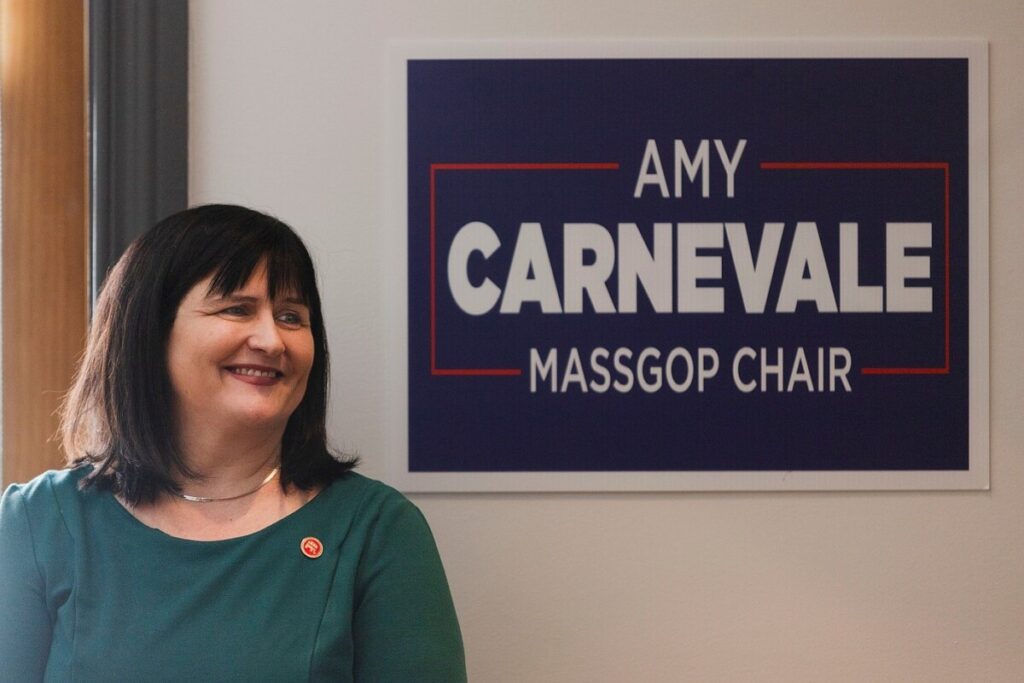
Battenfeld: Massachusetts needs new political movement to save it from Democrats
The Massachusetts Republican Party (MassGOP) is facing a critical juncture, struggling under the weight of a dwindling voter base and an inability to present compelling candidates for federal and statewide offices. With only about 423,000 registered Republicans in a state of nearly 5 million residents, the party has become a fringe entity, overshadowed by the dominant Democratic Party and a significant number of unenrolled voters. This scenario raises pressing questions about the future of the MassGOP: can it reinvent itself into a viable political force, or is it destined to remain ineffective in the face of overwhelming opposition?
The internal strife within the MassGOP is palpable, evidenced by recent leadership changes and a lack of prominent candidates. The party’s executive director, John Milligan, has stepped down, and while officials have tried to downplay the significance of this transition, it highlights deeper issues within the organization. Currently, the party struggles to recruit candidates who can garner serious attention, with potential contenders like John Deaton and others lacking the star power needed to inspire voters. Even with the looming 2026 elections, the MassGOP’s ability to attract quality candidates appears bleak, particularly as popular figures like former Governor Charlie Baker are unlikely to return to the political arena. Polls indicate that incumbent Democrats, such as Senator Ed Markey and Governor Maura Healey, maintain substantial leads over any potential Republican challengers, underscoring the uphill battle the party faces.
In this context, there is a growing call for the emergence of a new political movement within Massachusetts—one that could unite conservatives and independents disillusioned by the current state of affairs. Drawing inspiration from the youth-driven conservative movements seen elsewhere, such as those led by figures like Charlie Kirk, advocates argue that Massachusetts could benefit from a similar coalition that transcends traditional party lines. This coalition could potentially tap into the large pool of unenrolled voters, who represent a significant voting bloc that the MassGOP has failed to engage effectively. Without a fresh approach and renewed energy, the party risks becoming increasingly irrelevant as it continues to struggle against a formidable Democratic majority. The question remains: will the MassGOP adapt and evolve, or will it fade into obscurity?
The MassGOP is dead in the water, plagued by a shrinking voter base and struggling to come up with strong, dynamic candidates for federal and statewide office.
The state Republican Party can continue to spin its wheels in the next few elections, or can it morph into something new and more formidable – a common sense movement of conservatives and independents who can be a force at the ballot box?
Look at the youthful conservative movement inspired by the slain Charlie Kirk. Millions of voters who have rejected party labels have coalesced to form a powerful union that will be a major factor in the next election.
Massachusetts needs a similar movement to avoid complete Democratic party rule, which has been a disaster for the state.
The MassGOP has essentially become a fringe party.
Bay State Republicans now are divided by internal strife, plagued by a lack of superstars on the bench and fighting an impossible battle against Democrats, who hold a huge numbers advantage.
No one takes the state GOP seriously, no matter how many city councilors and dog catchers they elect in municipal elections.
Who is the Republican rising star in Massachusetts?
Not only can the party not recruit candidates that are taken seriously, they can’t recruit voters. Just some 423,000 voters in Massachusetts of the state’s 5 million voters are now registered Republicans, less than 10%. They are dwarfed by 1.3 million Democrats and by far the dominant group of unenrolled voters, at around 3.2 million.
Unenrolled voters are ripe to be tapped, but the Republican Party can’t do it.
Cracks are already appearing in the leadership of the state GOP. The Republican Party’s executive director, John Milligan, just stepped down, replaced by finance chair Haley Jones.
Officials downplayed the shakeup, saying in an email to state committee members that “it’s natural for transitions to occur within our organization.”
“MassGOP is in the thick of launching our plans to rebuild our political infrastructure, recruit and train top-tier candidates, and compete aggressively across the Commonwealth in 2026,” the email said.
Top tier? The party is so weak it can only attract retreads like John Deaton for U.S. Senate and inexperienced unknowns like Brian Shortsleeve, Mike Kennealy and Mike Minogue to make a run for statewide office.
And the party has almost zero chance of winning a congressional seat, which are all controlled by Democrats.
Charlie Baker isn’t walking through that door. The popular former governor is making far too much money leading the NCAA to come to the rescue.
If the election were held tomorrow, incumbent Sen. Ed Markey (or another Democrat) and Gov. Maura Healey would clobber their Republican opponents. Healey is up by 20 points to her three GOP rivals.
And considering the battering she has taken for her handling of the economy and migrants, her reelection numbers in the polls aren’t bad.
Nearly six in ten votes approve of the job she’s done.
The national GOP doesn’t seem to give much hope for the local team.
Where’s President Donald Trump? Where’s Pam Bondi? Where are the national Republicans coming up to campaign?
Trump got about 1.3 million votes last year. Why do so many people vote for Trump but reject the state Republican Party?
And redrawing the state’s congressional boundaries won’t make much difference. You can redistrict all day long, but coming up with a Republican leaning district would take a Hail’s Mary play.
Maybe it’s simply time for another party in Massachusetts. Because this is not working.
The state Republican Party is thinning. (AP file)


