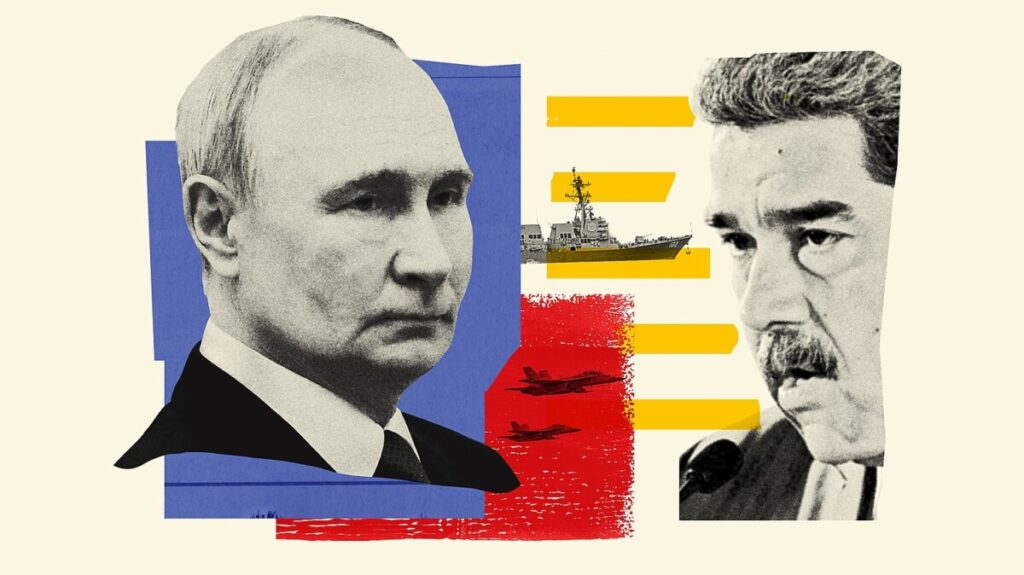
Why Maduro Probably Can’t Count on Putin
In a recent broadcast, Venezuelan President Nicolás Maduro expressed an optimistic outlook regarding his relationship with Russia, despite the looming threat of U.S. military action against his regime. During his weekly television show, Maduro emphasized the strong bond between Venezuela and Russia, asserting their unity in the face of U.S. pressure. This sentiment comes as the U.S. military, led by the USS Gerald R. Ford aircraft carrier, has mobilized significant forces in the Caribbean, ready to respond to alleged drug trafficking activities linked to Venezuela. Maduro’s administration has ramped up military preparations, ordering a “massive mobilization” of troops to defend the nation. However, the Kremlin’s response to Maduro’s escalating crisis has been tepid, leaving many to question the reliability of Russia as an ally.
Historically, Venezuela has maintained a close relationship with Russia, dating back to the presidency of Hugo Chávez, who sought to counter U.S. influence through military and economic alliances. Over the years, Venezuela has purchased advanced military equipment from Russia, including fighter jets and air-defense systems, and has engaged in various trade agreements. However, the ongoing war in Ukraine has significantly strained Russia’s resources, limiting its ability to support allies like Maduro. Russian Foreign Minister Sergei Lavrov recently indicated that Venezuela has not requested military assistance, highlighting the Kremlin’s reluctance to engage in another conflict while its own military capabilities are stretched thin. This situation mirrors the experiences of other Russian allies, such as Armenia and Syria, who have found themselves abandoned in times of need.
As tensions escalate, the potential for U.S. military action against Venezuela raises concerns about the implications for regional stability and international relations. While Russia may consider providing some support to Maduro, such as drones or electronic warfare capabilities, its focus remains on its own military priorities. The Kremlin’s limited resources and the ongoing demands of the Ukraine conflict suggest that Maduro may find himself isolated and vulnerable, despite his public declarations of solidarity with Russia. The fate of his regime may ultimately hinge on the U.S. response and the extent to which Russia can or will intervene to protect its ally.
Sign up for our
newsletter about national security
here
.
N
icolás Maduro
sounded remarkably chipper last week for a man about to face off with a United States armada. In his weekly
television show
—an hour of Maduro as host, lecturer, and interviewee—the Venezuelan president welcomed a question about his foreign allies. He singled out one in particular: Russia.
“We are like this,” he gushed, interlocking his fingers to show the closeness of the bond. “More united than ever.”
“Russia,” the interviewer said—“that great power, right?”
Maduro nodded.
Vladimir Putin’s Russia may seem like an obvious place for Maduro to turn as he scours the world for well-armed friends willing to help him withstand a U.S. pressure campaign that threatens his 12-year reign. Russia considers Venezuela its closest ally in the Americas and has deep military, commercial, and cultural ties there. Earlier this year, Maduro signed what he called a “historic and strategic” pact with Putin to expand trade and military cooperation.
But the Kremlin’s response to Maduro’s existential crisis has been underwhelming for a country that considers itself a great power. Putin has said nary a word about Maduro or Venezuela lately. Nor has any senior Kremlin official suggested that Russia would come to Venezuela’s aid if the U.S. broadens its targets from alleged drug boats to the mainland. Russian Foreign Minister Sergei Lavrov
told Russian media
this week that Venezuela hasn’t requested military help from Moscow. He added that, according to the terms of their cooperation deal, the Kremlin is under no obligation to defend Venezuela from foreign attack.
Indeed, Maduro may be about to learn the same difficult lesson absorbed by the governments of other Russian allies, including Armenia, Syria, and Iran. They all recently appealed to the Kremlin for help only to discover that the war in Ukraine has taken such a toll, and remains such a priority, that Russia’s ability to come to the rescue is severely diminished.
[
Read: How Ukraine turned the tables on Russia
]
“As a result of the events in Ukraine, the capabilities of Russia have changed,” Armenian President Nikol Pashinyan
told
Politico
after his country’s defeat in a 2023 war against Azerbaijan. Under a collective security pact that Putin signed more than two decades ago with a handful of former Soviet countries, Russia was treaty-bound to come to the defense of Armenia, its southern neighbor. Instead, Putin looked away.
V
ladimir Putin
and Hugo Chávez, the presidents of petrostates 6,000 miles apart, shared a dislike for U.S. influence over world affairs and an affinity for the authoritarianism of Fidel Castro’s Cuba. In 2006, Chávez, Maduro’s predecessor and mentor, signed an arms deal with Russia, buying helicopters and fighter jets. More purchases ensued. “The deals will guarantee the sovereignty of Venezuela, which is being threatened by the United States,” Chávez said when he arrived in Moscow for what
The Guardian
called an
“arms spending spree.”
Russia’s ties to Venezuela showed up in other ways. Chávez’s government built public housing in the
style
of Soviet blocks; the tiny windows, meant for frigid weather, stood out in the tropical heat. In Saint Petersburg, a monument was erected to honor Francisco de Miranda, a Venezuelan independence hero who was received in Catherine the Great’s 18th-century court. Graffiti murals of the two countries’ flags
adorn
buildings across Caracas. Russian firms often win concessions for gold mining in Venezuela, and Venezuela’s state-owned oil company
buys
supplies from Russia. Russian equipment forms the backbone of Venezuela’s military.
Russia’s heightened presence in Latin America has only amplified the threat that successive U.S. presidents saw in Chávez and then Maduro. President Donald Trump has said that he wants to see Maduro gone, but he
has not committed
to negotiation or military force.
[
Read: Why Venezuela?
]
The USS Gerald R. Ford aircraft carrier and its accompanying ships are on their way to
join the roughly 10,000 American troops
, eight warships, and at least one nuclear-powered attack submarine already in the Caribbean. U.S. forces have obliterated 19 alleged drug boats in the Caribbean and eastern Pacific since September 2. Venezuela’s defense minister said yesterday that Maduro had ordered a
“massive mobilization”
of active-duty military and reserves for the defense of the nation.
E
ven if Putin
wanted to bolster Venezuela’s military and weaken the U.S. in its own neighborhood, he may not get the chance. Trump has favored long-range strikes elsewhere this year, and it seems likely he’d do so again if he opts for force, keeping U.S. troops and military assets out of reach.
In March, he approved a barrage of missile strikes against Yemen, carried out by Navy fighter jets from a U.S. carrier in the Red Sea and from nearby military bases. In June, U.S. bombers struck Iran’s nuclear program, six months after Iran and Russia signed a pact to strengthen military and economic ties. When Iran’s foreign minister flew to Moscow to appeal for help, the Kremlin offered little beyond statements of concern.
The temptation for Putin to intervene in Venezuela may prove greater. If the U.S. military approaches the coastline or attempts to land forces onshore, Russia could supply Caracas with cheap drones to harass U.S. forces, a tactic both sides in the Ukraine war have used to devastating effect. Putin and his generals may see turning those weapons against the U.S. as poetic justice, given Washington’s support of Kyiv.
If U.S. planes or sophisticated drones entered Venezuela’s airspace, Russian tools of electronic warfare could potentially jam GPS and radio signals, Francisco Mora, the Obama administration’s deputy assistant secretary of defense for the Western Hemisphere, told us. Even one of Russia’s older air-defense systems, such as the S-300, could cause trouble for F-18 fighter jets and possibly others in closer combat if Venezuela has properly maintained them. “That would be a challenge and the risk level would go up,” Mora said.
[
Read: The U.S. is preparing for war in Venezuela
]
Putin’s greatest opportunity to bog down the U.S. would come if Trump orders a land invasion, a very remote prospect for now. Even then, the kinds of weapons Venezuela would need are the ones the Kremlin can least afford to offer.
Russia’s air-defense batteries are designed to shoot down U.S. fighter jets and bombers. But Ukrainian drone strikes on oil refineries and other energy installations across Russia this summer and fall have strained its defenses. The attacks forced the Kremlin to extend a temporary ban on gasoline exports.
Faced with a choice between helping Venezuela and protecting one of its own refineries, Putin would surely prioritize the infrastructure that keeps Russia’s economy running. After almost four years of war, he has sacrificed hundreds of thousands of his own troops, spent down most of his national liquid reserves, and shifted Russia’s industrial base to the production of weapons. Yet he has still failed to subjugate his much smaller neighbor. Achieving that goal would require all the military assets Russia can muster, leaving little to give his allies on the other side of the world.
So far, a Russian cargo plane that landed in Caracas in late October is the only evidence that Moscow has sent fresh supplies. A few days later, Alexei Zhuravlev, a Russian lawmaker, notorious warmonger, and television pundit, told a Russian
news site
that the Kremlin had delivered two advanced air-defense systems, the Pantsir-S1 and the Buk-M2E. That claim could not be independently verified.
Those weapons would be a formidable addition to Venezuela’s arsenal; a variant of the Buk-M2E was used by Russian proxy forces to shoot down a Malaysian airliner over eastern Ukraine in 2014, apparently by mistake. Zhuravlev also suggested there would be “no obstacles” to giving Maduro a supply of Russia’s newest ballistic missile system, the Oreshnik. “Information about the volumes and exact types of Russian supplies is a secret,” Zhuravlev said. “So the Americans could be in for surprises.”
Maybe so. But the fact that Russia has used the Oreshnik only once in Ukraine suggests that Putin may not have many of these weapons to spare.
[
Read: Putin and Xi are holding the West together
]
In many ways, Putin faces a similar calculation to the one Ukraine’s allies did in the days after Russia invaded in 2022. The U.S. and other backers refused to provide heavy weaponry, such as artillery and armored vehicles, in part because they expected Russian forces to overrun Ukraine with ease. Any equipment from NATO countries would then have ended up in Russian hands. If Putin figures Maduro is doomed, he may be reluctant to risk gifting Russian weapons to a new regime in Caracas.
All of this suggests that Maduro, despite his public demonstrations of affection for Putin, may be left largely on his own, much like Russia’s former closest ally in the Middle East. Starting in 2015, the Russian military spent years propping up the regime of Bashar al-Assad in Syria. Last winter, with Russia and Ukraine locked in a war of attrition, an Islamist militia marched on Damascus. The Kremlin offered Assad an evacuation flight to Moscow, where he now resides.


