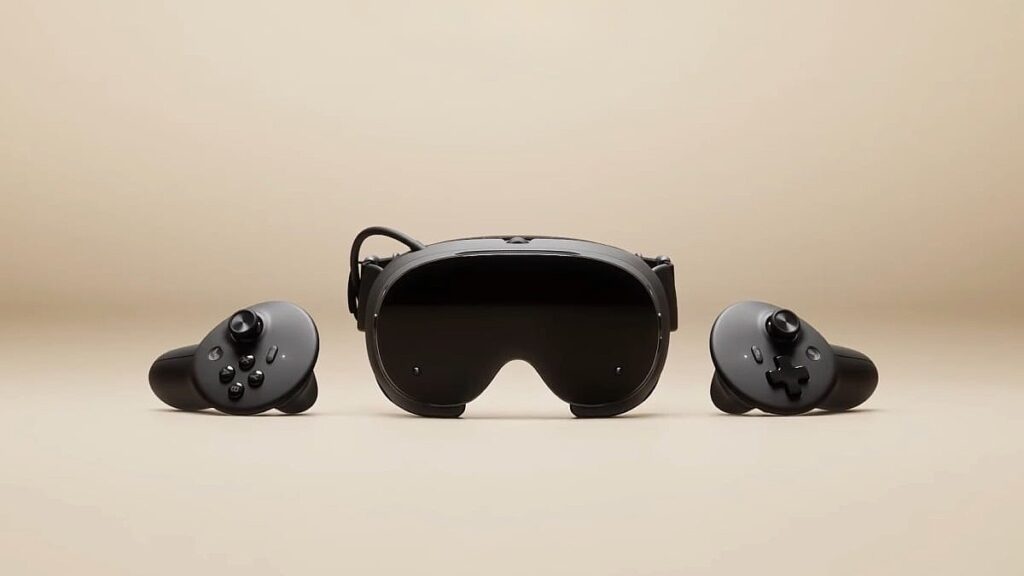
Steam Frame vs Apple Vision Pro vs Meta Quest 3 — Which has stronger specs, and which is best for gaming?
The virtual reality (VR) landscape is rapidly evolving, with major tech players like Sony, Apple, and Meta leading the charge alongside the latest entrant, Valve. Following the success of its 2019 Valve Index, the company has announced the Steam Frame, a new VR headset designed to enhance gaming experiences by providing compatibility with the entire Steam library. This innovative device is positioned as a streaming-first headset, allowing users to enjoy both VR and non-VR games seamlessly. Scheduled for release in early 2026, the Steam Frame boasts impressive specifications, including a powerful Snapdragon 8 Gen 3 processor, 16GB of RAM, and a high-resolution display of 2160 x 2160 pixels per eye. Its unique design includes a user-accessible front expansion port that could potentially support future upgrades, making it a versatile option in the burgeoning VR market.
When comparing the Steam Frame to its competitors, the Apple Vision Pro and Meta Quest 3, several distinctions emerge. The Vision Pro, recently updated with the M5 chip, offers stunning visuals at a resolution of 3,660 x 3,200 pixels per eye, but it comes with a hefty price tag of $3,499 and is not primarily focused on gaming. On the other hand, the Meta Quest 3 provides a more budget-friendly option at $499.99, featuring a solid selection of games, though its capabilities are limited to titles specifically designed for the platform. The Steam Frame’s ability to access the extensive Steam library gives it a significant edge for gamers, as it supports a wider range of titles compared to the more restrictive libraries of its rivals.
However, the Steam Frame does have limitations; it lacks the colored passthrough cameras found in the Vision Pro and Quest 3, which enable augmented reality (AR) features. This means that while the Steam Frame excels in delivering a pure VR experience, it does not support mixed reality environments. As the competition heats up in the AR/VR space, the Steam Frame’s focus on gaming and compatibility with existing Steam hardware could carve out a unique niche, appealing to dedicated gamers looking for a comprehensive virtual reality experience. With its anticipated launch in 2026, the Steam Frame is poised to challenge the status quo and redefine how gamers interact with virtual worlds.
https://www.youtube.com/watch?v=RIKTFKo5YJA
Virtual reality headsets have gotten increasingly popular over the past few years. Sony’s
PlayStation VR and VR2
, along with the just-launched
Samsung Galaxy XR
, and the
revamped Apple Vision Pro
are some examples. These tech giants join Meta in the virtual reality fray, giving us true competition in the AR/VR space for the first time.
Yesterday, Valve announced that it’s also creating a brand new virtual reality headset, the Steam Frame, which is a follow-up to the 2019 Valve Index headset. (Valve also announced
a ton more Steam hardware
.) It’s built to be a streaming-first experience that is compatible with your entire Steam library, whether your games are VR or non-VR. But how does it stack up with other headsets? Let’s take a look.
SEE ALSO:
Valve announces new Steam Machine console: Price, specs, release date
Steam Frame vs. Vision Pro vs. Quest 3: Just the specs
Meta Quest 3 VR headset with controllers.
Credit: Alex Perry / Mashable
Before we compare these headsets in more detail, let’s review the specifications for each. If you don’t care about how much storage or RAM each headset has, just keep scrolling.
You’ll have to wait until 2026 to get your hands (and face) on the Steam Frame. For now, we can only geek out over the specs:
Processor:
4 nm Snapdragon® 8 Gen 3, Architecture: ARM64
RAM:
16GB Unified LPDDR5X RAM
Storage:
256GB / 1TB UFS storage options, microSD card slot
Resolution:
2160 x 2160 (per eye)
Refresh Rate:
72-144Hz refresh rate (144Hz experimental)
Battery Capacity:
21.6Wh
Field of View:
Up to 110 degrees
Eyetracking included:
Yes
Price:
TBA
Apple just released its
new Vision Pro headset in October
. It’s largely the same headset as the original released in 2023, but now powered by M5 silicon. Here are all the details:
Processor:
Apple M5 chip
RAM:
16G
Storage:
256GB, 512GB, 1TB
Resolution:
3,660 × 3,200 (per-eye)
Refresh Rate:
90Hz, 96Hz, 100Hz, 120Hz
Battery Capacity:
Up to 2.5 hours of general use, video playback up to 3 hours
Field of View:
~100 degrees
Eyetracking included:
Yes
Price:
$3,499
And here are the Meta Quest 3’s specs:
Processor:
Snapdragon XR2 Gen 2
RAM:
8GB
Storage:
512GB
Resolution:
2064 x 2208 (per eye)
Refresh Rate:
72Hz, 90Hz, 120Hz
Battery Capacity:
19.44Wh
Field of View:
110 degrees horizontal and 96 degrees vertical
Eyetracking included:
No
Price:
$499.99
Which is best for gaming?
On the gaming side of things, the Steam Frame is going to have a huge advantage over the competition, as Valve promises you’ll be able to play your entire Steam library. With
Meta Quest 3
and Apple Vision Pro, you can only play games that were specifically designed or ported to that platform. While the Quest 3 has a decent selection of titles, the Vision Pro really wasn’t designed for gaming, and its library reflects that fact.
On top of that, the Steam Frame will be compatible with other Steam hardware, including the Steam Machine, Deck, and controller, making it a much more versatile headset than the others.
AR and VR: What’s the difference?
With virtual reality, you can disappear into fully realized virtual worlds. With
augmented
reality, you can still see and interact with the world around you. Where it gets messy is that AR headsets like the Vision Pro
also
support VR experiences, so it’s not a clean distinction. Based on what we know, the Steam Frame is very much in the VR category.
An augmented reality scene with the Vision Pro.
Credit: Apple
The Steam Frame only contains monochrome passthrough cameras, while the Apple Vision Pro and Meta Quest 3 have colored passthroughs. This means that the Quest and Vision Pro support augmented and mixed reality, while the Steam Frame seemingly cannot. On the surface, this makes Steam Frame more of a downgrade compared to its competition, as it’s a pure virtual reality headset. However, it also has a “user accessible front expansion port,” which could be utilized to add more features in the future, including color passthroughs.
The Quest 3 still wins out on price
Valve hasn’t revealed a price for the Steam Frame, but the
company is aiming to have it under $1,000
, which is the price of a Valve Index headset. Meta Quest 3 still seems to be the most affordable of the three headsets, sitting at $500. Apple’s Vision Pro remains the most expensive at a whopping $3,500, but it comes with higher-cost components, a premium design, and some futuristic AR features.
The Steam Frame is set to launch sometime in early 2026.