National 211 hotline calls for food assistance quadrupled in a matter of days, a magnitude typically seen during disasters
In late October 2025, as the U.S. government shutdown entered its fourth week, a concerning surge in calls for food assistance was observed, marking a rare spike outside of natural disasters. According to data from local 211 helplines, which connect individuals with community resources, calls seeking food pantries doubled from nearly 1,000 to over 2,200 per day as fears about the potential impact on Supplemental Nutrition Assistance Program (SNAP) benefits grew. With approximately 42 million Americans relying on SNAP each month, the announcement on October 26 that benefits would not be disbursed as scheduled sent calls soaring to an alarming 4,214 within just a few days. This dramatic uptick in requests for food assistance highlights the vulnerability of many families and the critical role that food pantries play as safety nets in times of crisis.
The 211 helpline system, akin to 911 for emergencies, serves as a vital resource for those in need, particularly low-income individuals and families. Each call is categorized by specific needs, such as food, housing, and utilities, and is linked to local resources that can provide assistance. The demographic of callers typically skews toward women with children, many of whom struggle to make ends meet. The recent surge in calls indicates a heightened public concern and need, reminiscent of the early days of the COVID-19 pandemic when food insecurity spiked dramatically. Experts from the 211 network, including Robin Pokojski from the United Way of Greater St. Louis and Tiffany Olson from Crisis Connections, noted that even those who usually rely on SNAP may find themselves turning to food banks as a supplement, especially in light of anticipated shortages.
To better understand and respond to these emerging needs, researchers have developed tools like 211 Counts, which aggregates data from 211 calls across the country. This initiative allows for real-time tracking of community needs and provides insights into trends that can inform local responses. The data collected through 211 serves as an early-warning system, helping to identify rising issues before they become crises, as seen with previous events like the Flint water crisis and the baby formula shortage. As food banks struggle to keep their shelves stocked, the urgency for support is clear. While the data itself cannot solve the scarcity of resources, it can guide communities in effectively allocating limited assistance and preparing for future demands. The recent surge in calls underscores the importance of maintaining robust support systems to ensure that no child goes hungry and that families receive the help they need during challenging times.
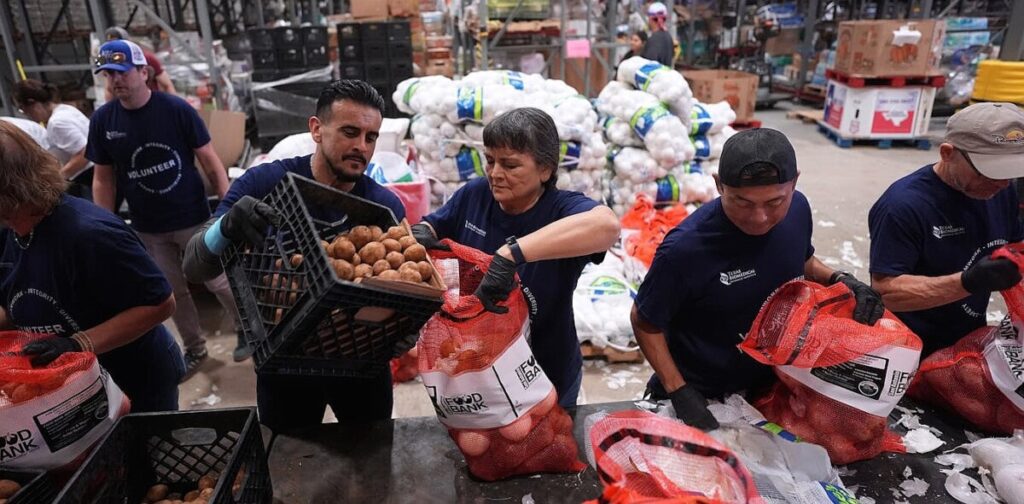
Sharp spikes in calls for food assistance are rare outside of natural disasters.
AP Photo/Eric Gay
Between January and mid-October 2025, calls to local 211 helplines from people seeking food pantries in their community
held steady at nearly 1,000 calls per day
.
But as the government shutdown entered its fourth week in late October,
states began to warn residents
that
Supplemental Nutrition Assistance Program
benefits, sometimes known as food stamps, would likely be affected. Nearly
42 million Americans receive SNAP benefits
each month.
Over the next several days,
calls to 211 from people seeking food pantries doubled
to over 2,200 per day. Then on Oct. 26, the Trump administration announced that SNAP benefits
would not be arriving
as scheduled in November. The next day, food pantry calls skyrocketed to 3,324. The following day, calls reached 3,870. By Wednesday, it was 4,214.
We are public health scientists
specializing in health communication
and
unmet social needs
. We and our colleagues have been working closely with the
211 network of helplines
across the U.S. for 18 years.
Excluding disasters, sudden surges of this magnitude in requests for food or any other need are rare at 211s, and can signal both public worry and need, as happened in the
first weeks of the COVID-19 pandemic
.
What is 211?
Like 911 for emergencies,
211 is a national three-digit dialing code
, launched in 2000, that connects callers to information specialists at the nearest local 211 helpline. Those specialists listen to callers’ needs and provide them with referrals to health and social service providers near them that may be able to help.
Every call to 211 is classified by the need of the caller, such as shelter, rent, utilities or food – each of which has its own code.
Callers are
disproportionately women
, most of whom have children or teens living in their homes. Most don’t make enough money to make ends meet. They call 211 seeking help paying rent or utility bills, getting food to feed their family, or securing household necessities like a winter coat for a child, or a mattress.
The hotline does not solve these problems for callers, but 211 information specialists use the most current local information available to refer callers to service agencies that are most likely to have resources to help.
The 211 network is the closest thing the U.S. has to a real-time surveillance system of the needs of low-income Americans.
There are roughly 200 state and local 211s in the U.S., and on an average day they will
collectively field between 35,000 and 40,000 requests
for help. Each request is coded using a taxonomy of over 10,000 need types, is time- and date-stamped, and is linked to the caller’s ZIP code. In addition to phone calls received by their helplines, 211s increasingly track requests they receive online, through their websites. The national network of 211s covers all 50 states and
99% of the U.S. population
.
It’s encouraging to us that with each passing year of giving talks and lectures about 211, more and more audience members raise their hands when asked if they’ve ever heard of 211. But it’s far from 100%. If you are one of those with your hand down, here’s what you need to know.
Food banks around the country are having trouble keeping their shelves stocked.
Gaining local insights
Our team aims to deploy the latest methods from data science, predictive analytics and artificial intelligence to detect trends in critical needs sooner and at a more localized level, increasing the speed and efficiency of getting needed help to local community members.
Our research has described the
needs of callers
who reach out to 211,
community capacity to respond to callers’ needs
, the ability of 211
to detect rapid changes
in community needs, and the benefits of
integrating health referrals
into 211s.
When we saw food requests rising sharply in late October, we reached out to local leaders at 211 call centers to get insights into what they were hearing from callers.
Robin Pokojski, vice president of 211 and community partnerships at United Way of Greater St. Louis, reported that with all the uncertainty around SNAP benefits, callers were initially “anticipating” a need for food pantries. Tiffany Olson, who directs essential services at Crisis Connections and its 211 call center in Washington state, shared that even callers who rely heavily on their SNAP benefits sometimes
need to use food banks as a supplement
.
Those callers know that pivoting to rely
solely on food banks probably won’t be enough
to meet their food needs in full. They realize that food pantries and food banks will be more heavily burdened if SNAP benefits are unavailable.
Increasing the impact of 211 data
The trove of daily data on the needs of U.S. callers to 211 at the ZIP code level is unparalleled. Yet for years it was virtually invisible to anyone who didn’t work at a 211 hotline.
Even for people who work and volunteer within the 211 system, formal reporting on caller needs within a community was minimal, such as a one-page annual summary.
That changed in 2013.
Working with 211s across the country, our team created
211 Counts
, a collection of user-friendly, public-facing data dashboards for local 211s across the U.S.
The dashboards allow users to explore the top needs in their community, see which neighborhoods are affected most and understand how needs are changing over time. The data can be sorted by legislative districts, school districts and counties to make the findings more relevant to different audiences.
Data on 211 requests are updated each night. Now in its 12th year, 211 Counts includes data on over 90 million requests from 211 callers in all or parts of 44 states. The local dashboards have been visited millions of times.
211 as an early-warning system
This is not the first time data collected through 211 hotlines has detected early signs of trouble for some Americans. Just weeks ago, we found that calls from people seeking assistance making car payments have been increasing steadily for five months, with daily calls peaking in October, at nearly twice the rate of May 2025.
Before that, 211s were months ahead of news reporting in seeing public distress
associated with the 2022 baby formula shortage
, the
2016 Flint water crisis
and the
2007 subprime mortgage crisis
.
When requests for major needs like food increase three- to fourfold overnight, every local 211 is likely to register this abrupt change.
But when less frequent needs, such as car payment assistance, creep up slowly, with an extra call here and there over several months, it’s unlikely that any local 211 hotline would notice.
That’s when the advantages of big data are greatest. By combining caller needs from 211s across the country, patterns emerge that would otherwise be missed. New data science tools are rapidly improving the speed and accuracy of detecting slight changes. When community and national leaders are made aware of potential rising threats, those threats can be tracked more closely and responses prepared.
It’s easy to lose sight of the fact that each data point is a hungry child or a worried parent.
Hotlines and food banks and food pantries need support in this moment to feed people. But most local safety net systems struggle to meet their community’s needs all the time. Data that documents the magnitude of need won’t fix the scarcity of local assistance, but it can help guide communities in allocating limited resources.
Matthew W. Kreuter receives funding from NIH.
Rachel Garg receives funding from NIH and NSF. She has previously received research support from Health Communication Impact, LLC to produce 211 data reports for United Way Worldwide.


