Tracking the winds that have turned Mars into a planet of dust
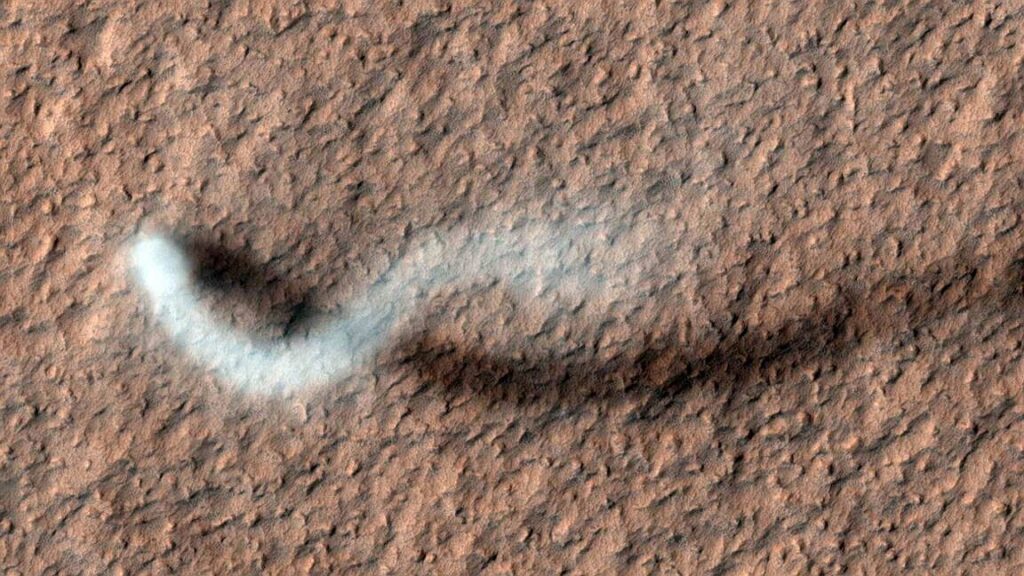
Mars, often depicted as a barren and inhospitable landscape, is not just a cold and dusty planet; it is also a dynamic environment shaped by powerful winds and dust storms. These winds, which can kick up tons of reddish dust, create phenomena known as dust devils—whirling columns of dust that can significantly impact the Martian atmosphere. A recent study led by researcher Valentin Bickel from the Center for Space and Habitability at the University of Bern has shed new light on the intensity and effects of these winds. Utilizing advanced imaging technology and deep learning, Bickel and his team analyzed stereo images captured by the Mars camera CaSSIS on the ExoMars Trace Gas Orbiter and the HRSC on the Mars Express. Their innovative approach allowed them to track the motion of dust devils and infer the dynamics of the winds responsible for lifting dust from the Martian surface.
The findings from this research are groundbreaking, revealing that Martian winds are even more vigorous than previously understood. The study indicates that these strong near-surface winds are not only abundant but also play a critical role in atmospheric dust sourcing, which is essential for developing accurate models of Mars’ climate and weather patterns. Bickel emphasized the significance of their observations, stating that the newly acquired data directly informs scientific models regarding the Martian atmosphere, enhancing our understanding of how dust storms and winds influence the planet’s weather systems. This research, published in the journal *Science Advances*, marks a significant advancement in planetary science and highlights the importance of utilizing cutting-edge technology in space exploration.
As we continue to explore Mars, understanding its wind patterns and dust dynamics will be crucial for future missions and potential colonization efforts. The insights gained from Bickel’s study not only provide a clearer picture of the Martian environment but also pave the way for further research into how these atmospheric phenomena could affect human activities on the planet. With Mars being a focal point for exploration and potential habitation, such studies are vital in preparing for the challenges that lie ahead in our quest to understand and possibly inhabit the red planet.
Mars is cold, parched, and extremely dusty. Powerful gusts of wind kick up literal tons of reddish dust that often takes the form of whorls known as dust devils. These winds also shroud the planet in dust by lifting material from the surface and blowing it into the atmosphere (what little Mars has left of an atmosphere), sometimes creating dust storms that rage for days.
Researcher Valentin Bickel wanted to know just how intense winds can be on the red planet. Using data obtained by the
Mars camera CaSSIS
(Color and Stereo Surface Imaging System), the
ExoMars Trace Gas Orbiter
, and
stereo camera HRSC
(High Resolution Stereo Camera) on board ESA orbiter Mars Express, he and his team used deep learning to analyze stereo images that were taken seconds apart at the same location. These images can track the motion of dust devils, and the researchers use them to infer how the winds behind the dust devils move and lift dust from the surface. That dust goes on to have a big influence on the Martian weather.
Bickel, of the Center for Space and Habitability at the University of Bern, noticed that the tumultuous Martian winds are even faster than previous observations had made them out to be. They carry more dust than was previously thought. “Our observations show that strong near-surface winds are abundant on Mars and play an important role in atmospheric dust sourcing, directly informing more accurate models of Mars’ atmosphere, weather, and climate,” the researchers said in a study recently published in
Science Advances
.
Read full article
Comments