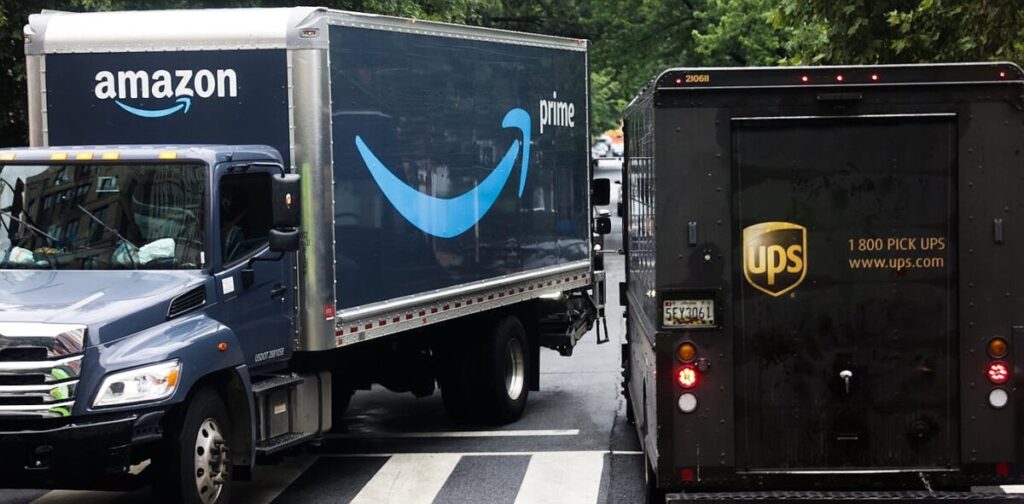
The unraveling of workplace protections for delivery drivers: A tale of 2 workplace models
In recent years, American households have become increasingly reliant on Amazon, with 83% of U.S. households receiving deliveries from the retail giant in 2024. This staggering statistic translates to over 1 million packages delivered daily and a jaw-dropping 9 billion items delivered on a same-day or next-day basis annually. Amazon’s rapid evolution from an online bookseller to a dominant force in retail has not only transformed consumer shopping habits but has also significantly impacted the workforce behind these deliveries. With more than a million individuals employed at Amazon’s fulfillment centers and delivery networks, the company has overtaken traditional delivery giants like UPS and FedEx in package volume, raising questions about the working conditions and compensation of these workers.
A recent study, co-authored by researchers from the Shift Project, provides a stark comparison of working conditions for delivery drivers at Amazon, UPS, and FedEx. The findings reveal a troubling disparity in wages and job security between Amazon drivers and their UPS counterparts. While UPS drivers benefit from union protections and a clear path to wage increases—starting at $21 an hour and reaching nearly $40 after ten years—Amazon drivers earn an average of just $19 an hour, with limited opportunities for advancement. The study highlights that Amazon’s reliance on independent contractors and subcontractors has not only contributed to its rapid growth as a delivery service but has also led to lower wages, less stable schedules, and fewer benefits for its workforce. Alarmingly, over 25% of Amazon drivers reported experiencing food insecurity, while many struggle to pay basic utility bills, reflecting a broader trend of financial instability among gig economy workers.
Moreover, the working conditions at Amazon are characterized by intense surveillance and performance tracking, with 60% of drivers and fulfillment workers receiving constant feedback on their work speed through technological monitoring. This level of oversight far exceeds what is experienced by employees at UPS and FedEx, raising concerns about the implications of such practices on worker morale and job satisfaction. As Amazon continues to expand its influence in the retail and delivery sectors, its business model poses a significant threat to the standards of wages and working conditions that have historically benefited workers, particularly in the wake of unionization efforts that have improved labor rights across various industries. The competition between Amazon and UPS not only reflects differing operational models but also represents a critical crossroads for the future of work, highlighting the need for a reevaluation of labor protections in an increasingly gig-oriented economy.
American households have become dependent on Amazon.
The numbers say it all
: In 2024, 83% of U.S. households received deliveries from Amazon, representing over 1 million packages delivered each day and 9 billion individual items delivered same-day or next-day every year. In remarkably short order, the company has transformed from an online bookseller into a juggernaut that has reshaped retailing. But its impact isn’t limited to how we shop.
Behind that endless stream of packages are
more than a million people
working in Amazon fulfillment centers and delivery vehicles. Through its growing dominance in retail, Amazon has
eclipsed its two major competitors
in the delivery business, UPS and FedEx, in terms of package volume.
What is life like for those workers? Between Amazon’s rosy
public relations
on the one hand and
reporters’
and
advocates’
troubling exposés on the other, it can be hard to tell. Part of the reason is that
researchers
like us
don’t have much reliable data: Workers’ experiences at companies such as Amazon, UPS and FedEx can be a black box. Amazon’s arm’s-length relationship with the drivers it depends on for deliveries makes finding answers even harder.
But that didn’t stop us. Using unique data from
the Shift Project
, our new study, co-authored with
Julie Su
and
Kevin Bruey
, offers
the first direct, large-scale comparison
of working conditions for drivers and fulfillment employees at Amazon, UPS and FedEx based on survey responses by more than 9,000 workers.
What we found was deeply troubling – not only for Amazon drivers but also for the future of work in the delivery industry as a whole.
2 models, 2 realities
For nearly a century, driving delivery trucks has been a pathway to the middle class, as epitomized by
unionized jobs
at
UPS
. UPS drivers, who have been members of the Teamsters union for decades, are employees with legal protections and a collective-bargaining contract.
In contrast, Amazon has embraced a very different model. Most important is that Amazon does not directly employ nearly any of its delivery drivers.
Instead, its transportation division, Amazon Logistics, relies on two methods to deliver most of its shipments: Amazon Flex, a platform-like system that treats drivers like
independent contractors
, and Amazon DSP, a franchise-like system that uses subcontractors. DSP subcontractors are almost all nonunion, and the company has cut ties with DSP contractors whose drivers have
attempted to unionize
. These practices place downward pressure on the wages and working conditions of drivers throughout the industry.
The impact on workers is stark.
Delivery workers at Amazon
receive significantly lower wages
than at UPS and FedEx, we found. Wage gaps are especially large between the delivery workers at Amazon, who earn US$19 an hour on average, and the unionized drivers at UPS, who make $35.
We also found that unionized UPS drivers have a clear pathway to upward mobility, while Amazon drivers don’t. At UPS, wages increase sharply the longer a worker has been on the job. Pay starts at $21 an hour, reaching nearly $40 an hour for drivers who’ve been with the company for at least 10 years – which is more than half of them.
At Amazon, wages start at $17 an hour and don’t increase with tenure. Nearly half of workers have less than a year on the job.
Between lower wages, more unstable schedules, fewer benefits and limited protections from employment laws, Amazon drivers struggle to make ends meet. More than 1 in 4 told us they had gone hungry because they couldn’t afford enough to eat within the past month, and 33% said they couldn’t cover their utility bills. Compared to drivers at UPS and FedEx, Amazon drivers face significant financial instability.
On top of that, Amazon drivers face intense workplace surveillance and speed tracking – as do workers at the company’s fulfillment centers. Sixty percent of both types of Amazon workers received frequent feedback on the speed of their work from a technological device, and more than two-thirds said that Amazon monitors the quality of their work using technology. That degree of technological surveillance and tracking far outpaces what UPS and FedEx workers told us they were exposed to, representing
an extreme case of worker monitoring and performance assessment
.
Using nonemployee drivers contributed to the exponential growth of Amazon as a package delivery company. In 2023, Amazon for the first time delivered more packages than UPS, making it the second-largest parcel carrier in the country – surpassed only by the U.S. Postal Service.
By building an online retail empire with the capacity to deliver the majority of its own shipments, Amazon’s expansion continues. UPS, by contrast, has seen drops in its
revenues
,
stock value
and
market capitalization
. Amazon’s sheer size and giglike approach are therefore changing industry standards, putting downward pressure on wages, benefits and job stability across the delivery sector.
The contrast between Amazon and UPS drivers isn’t just about two companies using different models for package delivery – it represents two competing futures for work. As the second-largest retail company and now largest private delivery company in the U.S., Amazon exerts market power that impacts the working conditions of workers beyond its own delivery drivers.
Recent reporting
indicates that UPS has been experimenting with using gig deliveries, much to the consternation of the union that represents three-quarters of its workforce.
In the post-World War II era, increasing unionization led to better wages and conditions across much of the economy, including nonunionized sectors. The continuing expansion of Amazon’s business model could signal the unraveling of wages, benefits and protections for working people more generally.
The authors do not work for, consult, own shares in or receive funding from any company or organization that would benefit from this article, and have disclosed no relevant affiliations beyond their academic appointment.


