Seashells from centuries ago show that seagrass meadows on Florida’s Nature Coast are thriving
**The Vital Role of Seagrass Meadows in Florida’s Coastal Ecosystem**
Seagrass meadows are crucial components of Florida’s coastal ecosystem, serving as habitats for a diverse array of marine life, including sea turtles and manatees. While many beachgoers casually collect seashells, paleontologists and marine ecologists like Jenny Adler and Michal Kowalewski view these shells as valuable historical records that provide insights into the ecological past. Through the lens of conservation paleobiology, researchers are uncovering how these habitats have evolved over time and what that means for current conservation efforts. Their studies reveal that the shells of mollusks living in seagrass meadows offer a reliable proxy for understanding the health and stability of these essential habitats.
Recent research along Florida’s Nature Coast—a 93-mile stretch of coastline—has demonstrated that seagrass meadows have maintained their ecological integrity for centuries. By analyzing mollusk shells from both living and dead specimens, scientists have found remarkable consistency in species composition over time. This suggests that the seagrass patches in this region have not only persisted but have also provided stable habitats for various marine organisms. The findings are significant, especially given the global decline of seagrass meadows due to environmental changes and human impact. Understanding the historical stability of these ecosystems can inform conservation strategies, emphasizing the need to protect these areas rather than attempting to replace them with newly planted meadows in less suitable habitats.
As seagrasses play a vital role in oxygenating ocean waters, stabilizing sediments, and providing economic benefits estimated at over $6 trillion annually, their decline poses a significant threat to coastal communities. The research highlights the importance of preserving the Nature Coast’s seagrass meadows as a benchmark for assessing other seagrass systems impacted by human activities. By recognizing the resilience and historical stability of these meadows, conservationists can better strategize efforts to restore and maintain similar habitats, ensuring the continued health of Florida’s coastal ecosystems.
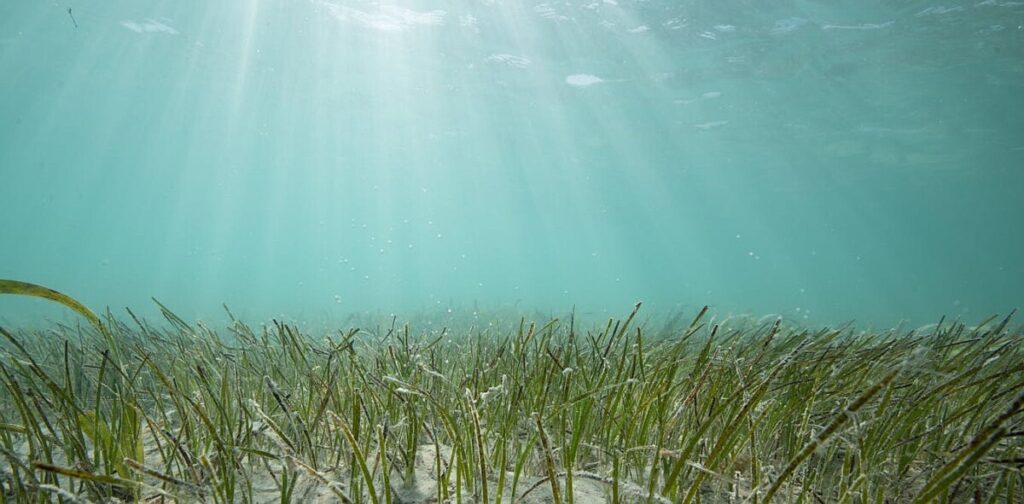
Seagrass meadows are an essential part of Florida’s coastal ecosystem.
Jenny Adler
During a day at the beach, it’s common to see people walking up and down the shore collecting seashells.
As a
paleontologist
and
marine ecologist
, we look at shells a bit differently than the average beachcomber. Most people dig up shells in the sand and see beautiful color patterns or unusual shapes. But we tend to focus on how old these shells are and what they tell us about the habitat they come from.
You may be surprised to learn that the translucent spiral shell you plucked from the sand belonged to a snail that lived long before Columbus sailed to the New World. And that unassuming clamshell you might nonchalantly toss away belonged to a mollusk that filtered seawater when pharaohs ruled Egypt.
In recent decades, scientists have used methods such as
radiocarbon dating
to assess the age of shells, along with bones and other skeletal remains, scattered around Earth’s surface.
Increasingly, paleontologists and conservation biologists like us are turning to these remains as potential treasure troves of information about what various habitats were like before humans entered the picture. The insights we glean from this approach, known as
conservation paleobiology
, can result in more effective conservation, restoration and management strategies aimed at the protection or recovery of many essential habitats.
This approach has proved, among other things, that
cows reshaped shellfish communities
on the California shelf,
caribou used the same calving grounds for millennia
, and
Caribbean sharks were much more diverse
in the past.
Over the past decade, we have applied conservation paleobiology to
Florida’s Nature Coast
, home to an extensive and intricate
patchwork of seagrass meadows and sand
. Prior to our studies, scientists’ understanding of those meadows was largely uninformed by historical data.
A curious young manatee approached our team of scientific divers at work in Wakulla Springs in May 2020. This charismatic marine mammal inhabits seagrass meadows along Florida coasts, but in the winter and spring it shelters in warm waters of Florida springs and rivers.
Michal Kowalewski
Why seagrass matters
It may not be obvious at first glance why we should be interested in the past history of seagrass meadows.
But these meadows are among the
most important structural habitats
on our planet. Myriad species, including sea turtles and manatees, forage, shelter or reproduce in those habitats, making seagrasses
major hot spots of biodiversity
.
Beyond these benefits, seagrasses offer extremely valuable services. They
oxygenate ocean waters
, draw down carbon dioxide and stabilize bottom sediments. And critically for Florida’s coastline, seagrass can dampen wave energy, which helps to
protect shorelines
and coastal communities from the punishing effects of tropical storms and hurricanes.
By providing all these services, seagrasses fuel a tremendous economic engine that generates
global revenue in excess of US$6 trillion annually
, according to an analysis published in the journal Nature Reviews Biodiversity in February 2025.
Unfortunately, seagrass meadows are in decline globally, vanishing rapidly due to broad-scale
environmental changes and an onslaught of local human impacts
.
Efforts are underway
all over the world to protect seagrasses that still exist and restore those that have been lost.
Found in Citrus County, Florida, in 1989, this exceptional rock slab preserves multiple blades of seagrass, proving that these grasses have been around Florida for at least 40 million years.
Roger W. Portell, Florida Museum of Natural History
Shells in Florida’s seagrass meadows
The challenge inherent to our research is that seagrasses don’t have a hard skeleton, so they are very rarely found in the fossil record.
Fortunately, we found that the shells of mollusks that prefer to dwell in seagrass are a reliable proxy for the grass itself. In general, the quality of
ecological data provided by fossil shellfish
is outstanding.
When living and dead organisms are alike, we can infer that local ecosystems have not changed notably despite human activities. Conversely, when live and dead mollusk species differ, it usually is a sign that a habitat has been
heavily altered by humans
.
Location, location, location
In our initial study, our team
examined about a 40-mile (65-kilometer) swath of nearshore habitats
in an area just north of the
Suwannee River
.
We found that seagrass meadows often span only a few acres, forming a regional patchwork of vegetated and open-sand habitats. We also observed that distinct sets of mollusk species inhabit meadows and open sands today. This was not surprising, as many previous studies have shown that
different mollusks live in seagrass and open-sand habitats
.
Next, we looked at the shells of dead mollusks found in
surface sediments
in the area. Using radiocarbon dating, we showed that about half of these shells belonged to mollusks that lived prior to the
Industrial Revolution
. Many shells dated back to previous millennia.
If these small patches of seagrass meadows were waxing, waning or shifting location over the recent centuries, then we would expect each spot on the seafloor to harbor a mix of dead shells representing species from both habitats. However, we found that the species of dead mollusks in seagrass patches were remarkably similar to those that live there now. The same was the case for the mollusks from open sands.
This suggests that this mosaic of seagrass patches and open-sand bottoms has been remarkably stable for hundreds of years. We do not know why the seagrass consistently thrived for centuries in specific spots within a seemingly uniform environment. But whatever the reason, this habitat is not a mosaic of meadows in constant flux, but rather, a seascape that has remained the same for a long time.
This is an important find for conservation efforts. It means that it may be unwise to assume that we can compensate for seagrass losses by simply planting new meadows in open-sand habitats.
These mollusk shells were collected by divers from Florida seagrass meadows in Tampa Bay in October 2025. Such shells typically provide a record of diverse organisms that inhabited the area over hundreds of years.
Invertebrate Paleontology Division, Florida Museum of Natural History
Broadening the scope
In our newest study, we broadened our scope to compare living mollusks and dead mollusks
across multiple estuaries along the Nature Coast
, a 93-mile (150-kilometer) stretch of Florida’s Gulf Coast.
As with our first study, this broader study revealed many remarkable similarities between the mollusks that live there now and the mollusks from previous centuries and millennia, documented by shells.
We found that the mollusks that are common today and those that were common in the past represent virtually the same suite of species, and their relative abundance stayed steady, too.
Even more remarkably, both the live mollusks and shells from previous centuries document the same changes in dominant mollusk species between the southern and northern regions of the study area.
Today, mollusks are not the same everywhere along the Nature Coast. This reflects the fact that coastal waters are increasingly nutritious in the north. Consequently, seagrass is taller and denser moving north, and the suites of mollusk species that live in them
change as well
.
The shells of dead mollusks tell the same story. This indicates that not much has changed along this stretch of the Gulf Coast since preindustrial times.
Highlighting what’s working
Knowing that seagrass meadows in this area have maintained their ecological character and integrity for centuries or longer is a powerful argument for their continued protection.
Understandably, most conservation paleobiology studies have focused on threatened species, degraded habitats or imperiled systems, such as
reef sharks
,
oyster beds
or
freshwater mussels
. As a result, these studies generally document population collapse, biodiversity loss, habitat shrinking and overall ecosystem decline.
But we believe it is equally important for investigators in our field to study systems that are believed to be stable and resilient. In this case, the unspoiled status of the Nature Coast seagrass meadows makes them a much-needed benchmark to assess the state of other seagrass systems that have been altered by human activities. This can offer insights into which conservation efforts are working and how best to restore and maintain similar habitats elsewhere.
Michal Kowalewski receives funding from the US National Science Foundation, University of Florida Foundation and the Felburn Foundation, Florida.
Thomas K. Frazer receives funding from the National Oceanographic and Atmospheric Administration, Florida Fish and Wildlife Conservation Commission, Florida Department of Environmental Protection, Florida Department of Transportation, and South Florida Water Management District and The Ocean Conservancy.


