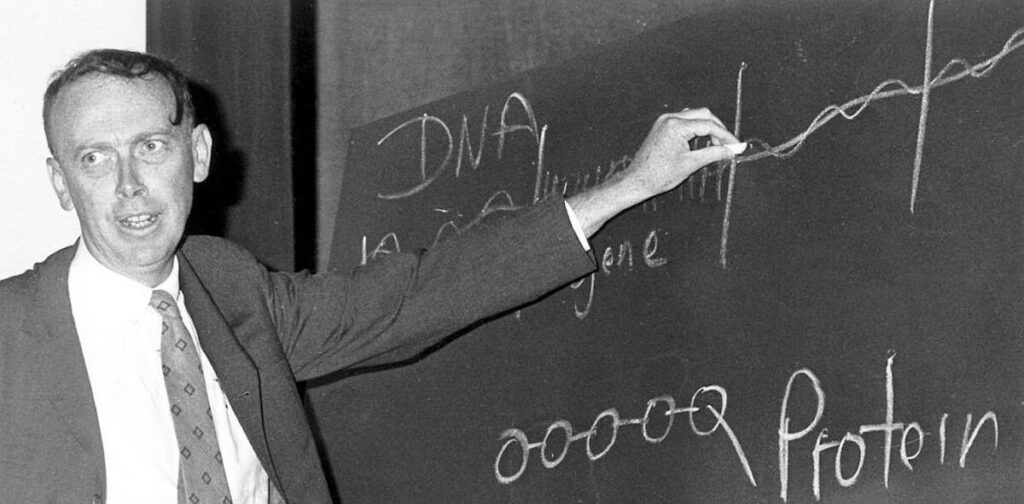
James Watson exemplified the best and worst of science – from monumental discoveries to sexism and cutthroat competition
James Dewey Watson, the renowned American molecular biologist, passed away on November 6, 2025, at the age of 97, leaving behind a legacy that is as groundbreaking as it is controversial. Best known for co-discovering the structure of DNA alongside Francis Crick and Maurice Wilkins, Watson was awarded the Nobel Prize in Physiology or Medicine in 1962. This monumental discovery not only unveiled the double helix structure of DNA but also revolutionized our understanding of genetics, laying the groundwork for fields such as molecular biology and evolutionary phylogenetics. Watson’s early academic journey began at the University of Chicago, where he initially aspired to be an ornithologist. However, his fascination with genetics was ignited by Erwin Schrödinger’s influential book, “What is Life?”, prompting him to delve into the molecular underpinnings of heredity.
While Watson’s scientific contributions are undeniable, his legacy is also marred by controversy, particularly regarding his treatment of fellow scientist Rosalind Franklin. Although Franklin’s X-ray crystallography was crucial to the discovery of DNA’s structure, her contributions were largely overlooked in Watson and Crick’s initial publications. This oversight has led to ongoing discussions about gender equity in science, with Franklin being increasingly recognized as a key figure in the discovery narrative. Watson’s own reflections on these events, particularly in his 1968 book, have drawn criticism for their dismissive tone towards Franklin, illustrating the pervasive gender biases in the scientific community of his time. As the scientific community has evolved, there are now more robust policies and practices aimed at ensuring fair credit is given to all contributors, reflecting a broader commitment to inclusivity and ethical standards in research.
Despite his significant achievements, Watson’s later years were marked by a series of public controversies stemming from his racist and sexist remarks, which have overshadowed his scientific accolades. His outspoken nature transformed how science was communicated, providing a candid look into the competitive world of scientific research, but it also revealed troubling attitudes that persist in various forms today. As the scientific community continues to grapple with issues of equity and integrity, Watson’s legacy serves as a complex reminder of both the heights of human achievement and the depths of human prejudice. His contributions to science are immense, yet they are inextricably linked to the ongoing struggle for recognition and respect for all individuals in the field, particularly those historically marginalized.
James Watson was both a towering and controversial figure in science.
Gerhard Rauchwetter/picture alliance via Getty Images
James Dewey Watson was an American molecular biologist most known for co-winning the
1962 Nobel Prize in physiology or medicine
for discovering the structure of DNA and its significance in transferring information in living systems. The importance of this discovery cannot be overstated. It unlocked how genes work and gave birth to the fields of molecular biology and evolutionary phylogenetics. It has inspired and influenced
my career as a scientist
and as director of a
bioinformatics and functional genomics research center
.
Watson was also an
outspoken and controversial figure
who transformed the way science was communicated. He was the first high-profile Nobel laureate to give the general public a shockingly
personal and unfiltered glimpse
into the cutthroat and competitive world of scientific research.
Watson died
on Nov. 6, 2025 at age 97.
Watson’s pursuit of the gene
Watson attended the University of Chicago at age 15, initially
intending to become an ornithologist
. After reading Erwin Schrödinger’s book of collected public lectures on the chemistry and physics of how cells operate, “
What is Life?
,” he became interested in finding out what genes are made of – the biggest question in biology at the time.
Chromosomes – a mixture of protein and DNA – were known to be the molecules of heredity. But most scientists were convinced that proteins, with 20 different building blocks, were the likely candidate as opposed to DNA with only four building blocks. When the 1944
Avery-MacLeod-McCarty experiment
demonstrated that DNA was the carrier molecule of inheritance, the focus immediately shifted to understanding DNA.
Watson completed his doctorate in zoology at Indiana University in 1950, followed by a year in Copenhagen studying viruses. He met biophysicist
Maurice Wilkins
at a conference in 1951. During Wilkins’ talk on the molecular structure of DNA, Watson saw preliminary X-ray photographs of DNA. This prompted him to follow Wilkins to the Cavendish Laboratory at the University of Cambridge to pursue work into uncovering the structure of DNA. Here, Watson met physicist-turned-biologist
Francis Crick
and developed an immediate bond with him over their shared research interests.
Watson, at center, was jointly awarded the 1962 Nobel Prize in medicine with Francis Crick, left, and Maurice Wilkins.
AP Photo
Soon, Watson and Crick published their seminal findings on the
structure of DNA
in the journal Nature in 1953. Two other papers were also published in the same journal issue on the structure of DNA, one
co-authored by Wilkins
and the other
co-authored by chemist and X-ray crystallographer Rosalind Franklin
.
Franklin took the X-ray photographs of DNA crystals that contained the data necessary for solving the structure of DNA. Her work, taken together with the work of the Cavendish Laboratory members, led to the 1962 Nobel Prize in physiology or medicine awarded to Watson, Crick and Wilkins.
The prize and the controversy
Although they were aware that Franklin’s essential X-ray photographs circulated in an internal Cavendish Laboratory summary report, neither Watson nor Crick acknowledged her contributions in their now famous 1953 Nature paper. In 1968, Watson
published a book
recounting the events surrounding the discovery of the DNA structure as he experienced them, wherein he minimizes Franklin’s contributions and refers to her in sexist language. In the book’s epilogue, he does acknowledge Franklin’s contributions but stops short of providing full credit for her role in the discovery.
Some historians have argued that part of the justification for not formally recognizing Franklin was that her work had not been published at the time and was “common knowledge” in the Cavendish Laboratory because researchers working on the DNA problem routinely shared data with one another. However, the co-opting of Franklin’s data and its incorporation in a formal publication without attribution or permission is now largely viewed as a
well-known example of poor behavior
both in science and in the treatment of female colleagues by their male counterparts in professional settings.
During the race to decipher DNA, science was an old boys’ club.
In the decades since the Nobel Prize was awarded to Watson, Crick and Wilkins, some have recast Rosalind Franklin as a feminist icon. Whether or not she would have endorsed this is uncertain, as it is unclear how she would have felt about being left out of a Nobel Prize and written about disparagingly in Watson’s account of events. What has become clear is that her contribution was critical and essential, and she is now widely regarded as an
equal contributor
to the discovery of the structure of DNA.
Future of science collaboration
How have attitudes and behaviors towards junior colleagues and collaborators changed in the years since Watson and Crick were recognized for the Nobel Prize?
In many cases, universities, research institutions, funding agencies and peer-reviewed journals
have implemented
formal policies
to transparently
identify and credit the work and contributions of all researchers involved in a project. While these policies don’t always work, the scientific environment has changed for the better to be more inclusive. This evolution may be due to recognizing that a single individual is rarely able to tackle and solve complex scientific problems by themselves. And when problems occur, there are more
formal mechanisms
for people to seek mitigation.
Frameworks for sorting disputes can be found in author guidelines from journals, professional associations and institutions. There is also a journal called
Accountability in Research
that is “devoted to the examination and critical analysis of practices and systems for promoting integrity in the conduct of research.” Guidance for scientists, institutions and grant-funding agencies on how to structure author attribution and accountability represents a significant advancement in fairness and ethical procedures and standards.
These are the aluminum plates Watson and Crick used to represent the four bases in their model of DNA.
Science & Society Picture Library/Getty Images
I’ve had both positive and negative experiences in my own career. These range from being included on papers when I was an undergraduate to being written out of grants to having my contributions left in while I was dropped from authorship without my knowledge. It is important to note that most of my negative experiences occurred early in my career, likely because senior collaborators felt they could get away with it.
It’s also likely that these negative experiences occur less often now that I am upfront and explicit with my expectations regarding co-authorship at the outset of a collaboration. I am prepared and can afford to turn down collaborations.
I suspect this mirrors experiences that others have had, and is very likely amplified for people from
groups that
are underrepresented
in science
. Unfortunately, poor behavior, including
sexual harassment
, is still happening in the field. Suffice it to say, science as a community still has a long way to go – as does society at large.
After co-discovering the structure of DNA, James Watson went on to study viruses at Harvard University and helm
Cold Spring Harbor Laboratory
, reviving and substantially expanding its physical space, staff and worldwide reputation. When the
Human Genome Project
was in its infancy, Watson was an obvious choice to lead and drive it forward, later stepping aside after a protracted battle over whether the human genome and genes themselves could be patented – Watson was
firmly against gene patents
.
Despite all the immense good Watson did during his lifetime, his legacy is tarnished by his long history of
racist and sexist public comments
as well as his ongoing disparagement of Rosalind Franklin both personally and professionally. And it is regrettable that he and Crick chose not to acknowledge all those who contributed to their great discovery at the critical points.
Andor J. Kiss does not work for, consult, own shares in or receive funding from any company or organization that would benefit from this article, and has disclosed no relevant affiliations beyond their academic appointment.


