Government reopens: Can air travel recover in time for Thanksgiving?
The federal government has reopened after a six-week impasse, bringing a much-needed sigh of relief to the aviation industry just in time for the Thanksgiving travel rush. Airlines are bracing for an unprecedented surge, expecting to carry around 31 million passengers between November 21 and December 1. The Sunday following Thanksgiving is poised to potentially set a record for the busiest day ever at U.S. airports. However, the aftermath of the government shutdown has left many travelers anxious about the air travel experience, particularly given the recent spate of flight cancellations and delays. As former airline pilot Shye Gilad notes, the transition back to normalcy won’t be instantaneous; it will require careful navigation through the residual effects of the shutdown.
Key factors influencing the recovery of air travel include the Federal Aviation Administration’s (FAA) management of flight restrictions and the staffing situation at air traffic control facilities. As of now, mandatory flight cancellations remain at 6% for 40 major airports, which is a slight relief from the FAA’s earlier plans to increase that number. Transportation Secretary Sean Duffy emphasized that a significant part of the recovery hinges on air traffic controllers returning to work, many of whom were affected by the shutdown and had called out in large numbers. Fortunately, with the government reopening, controllers are expected to receive their back pay, which could help stabilize staffing levels. Reports indicate that cancellations and delays have been decreasing over the past few days, signaling a potential turnaround as airlines work to restore their operations.
As airlines scramble to re-establish their schedules, travelers can take proactive steps to ensure a smoother journey. Experts recommend flying early in the day to mitigate the risk of disruptions, familiarizing oneself with airline mobile apps for quick rebooking, and planning to arrive at airports well ahead of peak travel times. The reopening of the government also means that the TSA’s MyTSA app will be operational again, allowing travelers to check real-time security wait times. With a bit of patience and preparation, travelers can navigate the busy holiday season more effectively, while also remembering to approach airport staff with kindness and understanding during this hectic period.
The federal government reopened late Wednesday, ending a six-week stalemate in Washington.
Now, the race is on to get air travel back on track, with just over a week to go until the unofficial start of the
Thanksgiving travel rush
— and the stakes are high.
Airlines are expecting to fly a record-setting 31 million passengers between Nov. 21 and Dec. 1. It’s also quite possible the Sunday after Turkey Day could break the record for the busiest day ever at U.S. airports.
But after
tens of thousands of flight cancellations and delays
over the past week, the key question remains: Will holiday travel run smoothly, or will travelers run into a shutdown hangover at airports?
“It’s not a light switch,” cautioned former airline pilot Shye Gilad, professor at Georgetown University’s McDonough School of Business. “I still think it’s going to be a more-challenging-than-normal travel season.”
Still, with flight cancellations and delays on the decline and critical aviation workers set to get paid, there’s new optimism the worst air travel disruptions could be behind us.
“Reopening the government will allow U.S. airlines to restore their operations ahead of the busy Thanksgiving holiday,” a trade group for the largest airlines said in a statement late Wednesday.
What it will take to get air travel back on track
A few key factors will determine how fast air travel returns to normal.
FAA flight limitations
For starters, the Federal Aviation Administration still has to decide when to end
mandatory flight restrictions
at dozens of the nation’s busiest airports.
As of Wednesday, airlines were still required to cancel 6% of flights at 40 major hubs. That restriction will remain in place Thursday, fueling hundreds of flight cancellations.
However, in an encouraging sign late Wednesday, the U.S. Department of Transportation said it would not
expand
those restrictions. The FAA had previously planned to increase cancellations to 8% of departures on Thursday, and 10% beginning Friday.
Now, the required cuts will remain at 6% of flights.
Control tower at Ronald Reagan Washington National Airport (DCA). ANDREW CABALLERO-REYNOLDS/AFP VIA GETTY IMAGES
Those limitations were meant to ease the burden on air traffic controllers, who called out of work in large numbers last weekend after weeks without a paycheck.
Air traffic controller staffing
How soon can airlines return to a full schedule? “It depends on controllers coming back,” Transportation Secretary Sean Duffy
said this week
.
Things seem to be headed in the right direction. On both Tuesday and Wednesday this week, the FAA reported just a small handful of “staffing triggers” at air traffic control facilities. On Saturday, there were 81, according to the U.S. Department of Transportation.
Cancellations and delays are already dropping
Not coincidentally, the number of flight delays and cancellations dropped for the third straight day on Wednesday, FlightAware showed.
That improvement came as controllers learned they’d get paychecks within 48 hours of the government reopening — something aviation sector leaders saw as a key step to getting staffing (and flights) back up to speed.
SPENCER PLATT/GETTY IMAGES
How will airlines rebound?
Much of the burden is now on airlines to bounce back after carriers had to make sweeping, sudden flight reductions this past week — upending carefully-crafted departure schedules in the midst of the shutdown chaos.
A key factor for Thanksgiving: “How soon will the airlines be able to disentangle their schedules to restore connectivity,” said Michael McCormick, air traffic control expert at Embry-Riddle Aeronautical University.
“If the shutdown ends this week,” McCormick had predicted, “The airlines will, most likely, be able to restore connectivity prior to the Thanksgiving push.”
ANDREW CABALLERO-REYNOLDS/AFP VIA GETTY IMAGES
Airlines were optimistic.
“I think you’ll be as close to normal as you can get by Friday-Saturday,” Delta Air Lines CEO Ed Bastian
said
Wednesday on CNBC.
What passengers should expect
In the coming days, I expect you’ll start to see airlines winding down
flexible travel waivers
they put in place during the shutdown, which gave travelers more freedom to change their tickets or cancel and get a refund.
How long those lenient policies last will likely depend on how long the FAA’s flight restrictions remain in place.
As for travelers with Thanksgiving trips booked, let’s run down a few other quick-hit tips:
Able to change? Fly in the morning
If your ticket allows changes and you have some flexibility, I’d aim to fly first thing in the morning, if possible. No matter the time of year, we tend to see travel disruptions mount as the day goes on.
Know your mobile app backward and forward
Start familiarizing yourself now with your airline’s mobile app so that you’re prepared to take quick action and rebook yourself if any trouble arises.
This is key to getting a seat on another flight when delays and cancellations pop up.
Read more:
Flight canceled or delayed? Here’s what to do next
Which travel days will be busiest?
If you’re hoping to beat the crowds, returning home from Thanksgiving a little early (either on Black Friday or on Saturday, Nov. 29) could be your best bet.
Airlines expect Sunday, Nov. 30, and Monday, Dec. 1, will be the two busiest days of this holiday rush.
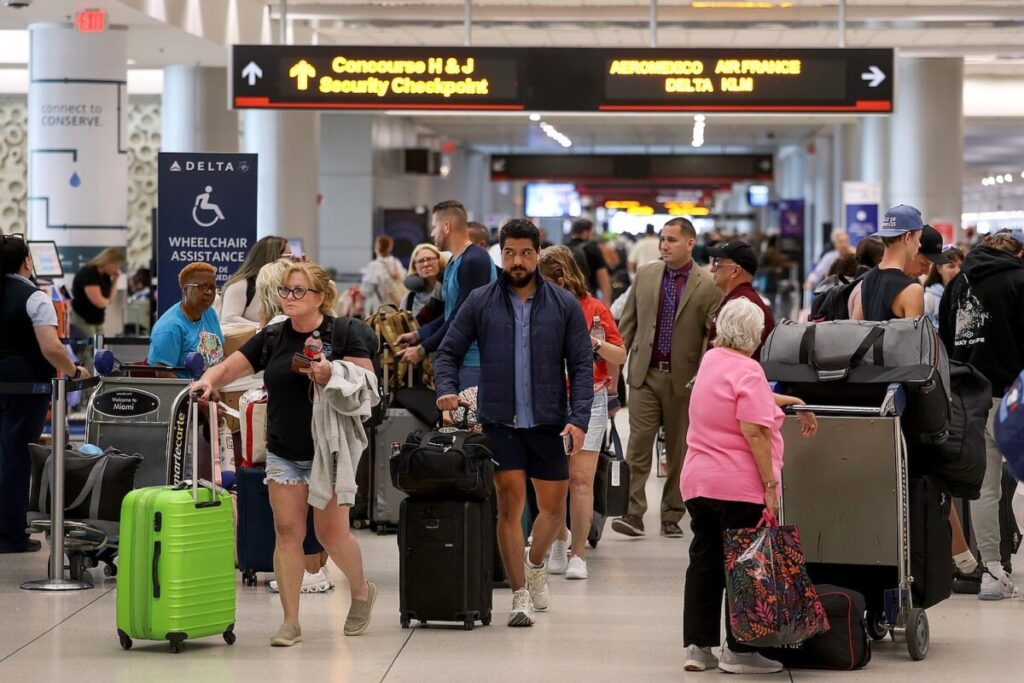
Travelers wait to check in at Miami International Airport (MIA). JOE RAEDLE/GETTY IMAGES
Keep in mind, the Sunday after Thanksgiving last year was (at the time)
the busiest day ever at U.S. airports
.
Plan for the TSA lines
If you
are
flying on those days, you’ll likely want to factor that in when planning how early to get to the airport.
The good news: once the government is fully open again, you should be able to
use the MyTSA app
to check real-time and expected security wait times. The app wasn’t reliable during the shutdown, but should be up and running again by the holiday rush.
TSA officers on duty at Ronald Reagan Washington National Airport (DCA). ANDREW CABALLERO-REYNOLDS/AFP VIA GETTY IMAGES
TSA PreCheck and Touchless ID
If you’re a
TSA PreCheck
(or
Global Entry
) member, make sure your
Known Traveler Number
is attached to your reservation, so that TSA PreCheck will show up on your boarding pass.
Read more:
What to do if a boarding pass isn’t marked TSA PreCheck
And if you’re flying out of an airport offering the new
TSA PreCheck Touchless ID program,
opt into that fast-tracked program through your airline profile.
Keep the lines running smoothly!
Of course, you’ll also want to do your part to keep the lines moving fast, packing with the
TSA’s 3-1-1 liquids rules
in mind. The good news? This will be the first holiday season when no travelers have to
remove their shoes at checkpoints
.
The top holiday 2025 travel tip
And, finally, after a chaotic and stressful few weeks for all employees at airports, Gilad suggested having some grace for airline, security and airport workers as one of his top holiday 2025 tips.
“There’s those things you can do to reduce your risk. Fly early, look for longer connection times. But also, a lot of it is, too, your attitude. Be kind to these people,” Gilad said, offering his take on how travelers might want to approach this particular Thanksgiving travel window.
“If I’m going to give this a shot,” he said, “I should expect that things are going to be challenging and I should be thinking about how I can help.”
Related reading:
When is the best time to book flights for the cheapest airfare?
The best airline credit cards
What exactly are airline miles, anyway?
6 real-life strategies you can use when your flight is canceled or delayed
Maximize your airfare: The best credit cards for booking flights
The best credit cards to reach elite status
What are points and miles worth? TPG’s monthly valuations
Editorial disclaimer: Opinions expressed here are the author’s alone, not those of any bank, credit card issuer, airline or hotel chain, and have not been reviewed, approved or otherwise endorsed by any of these entities.


