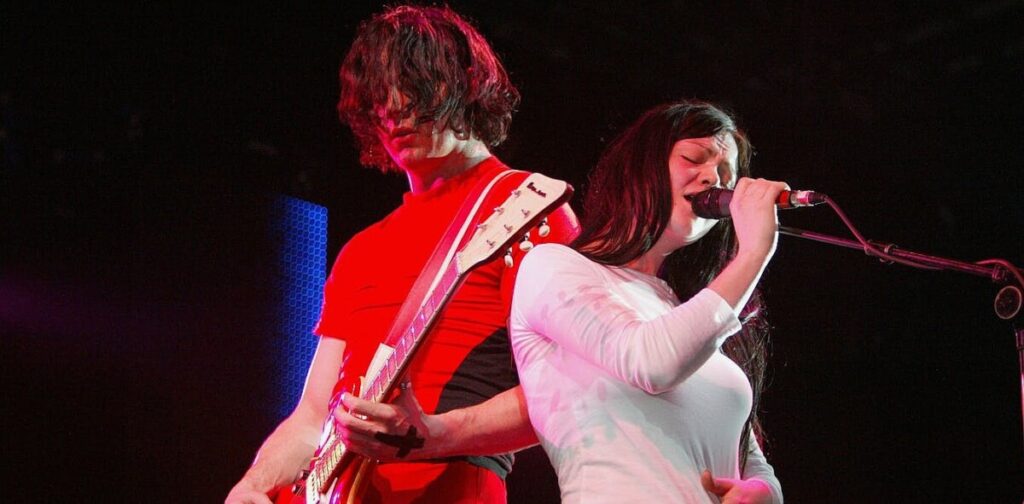
The White Stripes join the Rock & Roll Hall of Fame − their primal sound reflects Detroit’s industrial roots
In the 2008 documentary “It Might Get Loud,” musician Jack White’s innovative spirit is vividly captured as he constructs a makeshift guitar from scrap materials, demonstrating the ethos of resourcefulness that defines The White Stripes. Surrounded by discarded wood and a vintage amplifier, White declares, “Who says you need to buy a guitar?” This moment encapsulates the band’s DIY approach to music, which helped propel them to the forefront of the garage rock revival in the late 1990s. Co-founded by White and drummer Meg White, The White Stripes released six influential albums between 1999 and 2007, with notable works like “Elephant” and “Get Behind Me Satan” earning Grammy Awards for Best Alternative Music Album. Their last performance together was on the final episode of “Late Night With Conan O’Brien” in 2009, but their legacy continues to resonate, culminating in their upcoming induction into the Rock & Roll Hall of Fame alongside iconic acts like Outkast and Cyndi Lauper.
The White Stripes’ music is a reflection of their Detroit roots, blending punk, blues, and garage rock with a gritty, lo-fi aesthetic. Their songs often address themes of industrial struggle and innovation, as seen in tracks like “Hotel Yorba,” which pays homage to a historic Detroit hotel, and “The Big Three Killed My Baby,” a critique of the automotive giants that shaped the city. Their reliance on vintage equipment and rejection of modern production techniques underscore a battle between man and machine, a theme that Jack White articulated in a 2010 interview, emphasizing the need for musicians to “fight against” the overwhelming influences of technology. The spontaneity of their live performances, characterized by a lack of set lists and real-time creativity, further exemplifies their commitment to authenticity and raw musical expression.
Influenced by the likes of the Flat Duo Jets and the Detroit punk scene, The White Stripes forged a unique sound that continues to inspire contemporary artists. Their tracks are marked by a fusion of styles, incorporating elements of folk, blues, and rock, while also featuring the primal energy of punk. Meg White’s distinctive drumming and Jack White’s electrified riffs create a sonic landscape that is both innovative and timeless, as heard in hits like “Seven Nation Army” and “Icky Thump.” Ultimately, The White Stripes did not merely look to the past; they served as a catalyst for the evolution of the underground Detroit sound, raising its profile on the global stage and leaving an indelible mark on the music industry. As they prepare for their induction into the Rock & Roll Hall of Fame, their legacy as pioneers of modern rock continues to be celebrated and examined by music scholars and fans alike.
In the opening scene of “
It Might Get Loud
,” a 2008 music documentary, musician Jack White appears surrounded by scrap wood and garbage. He hammers nails into a board, wraps wire around a glass Coca-Cola bottle as a makeshift guitar bridge, attaches a pickup, and plugs the contraption into a
vintage Sears Silvertone amplifier
– anything more modern or of better quality would never do.
White then uses his signature slide bar to play a distorted, electric riff on the rudimentary instrument. He declares, matter-of-factly, “Who says you need to buy a guitar?” and casually puffs a cigarette.
This scene of manufacturing innovation, crafting what is needed out of what is available, is a signature of The White Stripes, the influential rock band White co-founded in the late 1990s.
Drummer Meg White and guitarist/vocalist Jack White, originally Jack Gillis before taking Meg White’s name during their four-year marriage, make up The White Stripes. Hailing from
Detroit
, the band helped lead
the garage rock revival
, releasing six studio albums between 1999 and 2007.
Their recordings “Elephant,” “Get Behind Me Satan” and “Icky Thump” each
won Grammys
for Best Alternative Music Album. The White Stripes’ last televised performance together was “We’re Going to Be Friends” in 2009 on the
final episode of “Late Night With Conan O’Brien
.”
The band’s legacy of innovation has earned them a place in
the Rock & Roll Hall Fame
. They will be inducted in Los Angeles on Nov. 8, 2025, along with Outkast, Cyndi Lauper and Soundgarden.
As
a professor who studies popular music
as an expression of the human experience, I have written about a broad range of artists, from
Townes Van Zandt
and
Maren Morris
to
Prince Paul
and
boygenius
.
I find The White Stripes’ experiment in sonic complexity particularly impressive because it was created by just two performers. Their soundscape relied on instrumental and vocal manipulations of tone and timbre and on stylistic fusions of blues, folk music, garage rock and movements such as British punk and
Dutch De Stijl art
.
The White Stripes often expressed themes related to
Detroit’s industrial struggle and innovation
in their gritty, genre-bending sound and lyrical storytelling.
Battle between man and machine
Several songs directly reference Detroit icons. The jaunty 2001 single “Hotel Yorba,” which blends blues and folk while heavily featuring acoustic guitar, honors a
Detroit hotel
built in 1926. The
music video
was partially filmed outside the aging building, with indoor scenes filmed elsewhere.
Jack White said the band wanted to know more about the Hotel Yorba’s history but
were chased out
by an armed manager. In September 2025, the hotel
was closed
due to unsafe living conditions.
In contrast, the song “The Big Three Killed My Baby,” released in 1999, refers to Detroit’s major automakers at the time: Ford, General Motors and Chrysler. Infused with a punk style, the song discusses the conflict between gas and electric engines. With a tone of anguish, it serves as a biting critique of these companies’ lack of creativity and, as the song states, the use of “planned obsolescence,” which intentionally limits a product’s useful life cycle. The close of the song reveals that what has truly been killed is the consumer’s common sense.
The White Stripes relied heavily on
timeless, vintage equipment
,
disavowing technological advancements and heavy-handed production techniques
. But even their primitive instruments are seen as a foe in the
struggle between man and machine
.
“I always look at playing the guitar as an attack. … It can’t be this wimpy thing where you’re pushed around by the idea, the characters, or the song itself,” Jack White said in a 2010 interview. “It’s every player’s job to fight against all of that.”
Likewise, spontaneity,
lack of set lists
and real-time creativity were hallmarks of their performances.
A
2002 live performance
of “Dead Leaves and the Dirty Ground” begins with brief, chaotic, distorted guitar-wailing and a single, powerful strike of bass drum and cymbal. The performance features a blues-infused rock riff and sweet vocal melodies with high-pitched repetitions and steady cymbal beats punctuated by bass drum and tom hits. That’s the raw, unfiltered, unmitigated, underproduced, auto-tune-avoidant intensity and artistic sound for which The White Stripes strove.
The White Stripes perform “Dead Leaves and the Dirty Ground” on “Saturday Night Live” in 2002.
A sound forged by punk and blues
The White Stripes had many influences, including
the Flat Duo Jets
, who shared their instrumentation of drum, guitar and vocals, and similarly fused styles such as ’50s rockabilly and blues-inspired punk. They were also heavily ensconced in the Detroit garage rock and punk scenes, which included bands such as
The Detroit Cobras, The Dirtbombs, The Paybacks and Rocket 455
. Each act was unique in how it deployed its creative foundations, mainly a primal, raw, electric sound with consistent, pounding rhythms and edgy vocal timbres.
This sonic layering and stylistic fusion is carried on by many of the artists of Jack White’s
Third Man Records
in Detroit. The label’s satellite locations in Tennessee and England also connect The White Stripes to the
blues traditions of the Mississippi region
and the
punk scenes of London
.
Acknowledged delta blues influences included Blind Willie McTell and Son House, whose “Grinnin’ in Your Face” –
Jack White’s favorite song
– maintains a powerful simplicity echoed throughout many White Stripes songs.
A folklike acoustic sound is mirrored in The White Stripes’ tracks “You’ve Got Her in Your Pocket” and “It’s True That We Love One Another.” Similar acoustic simplicity is heard in “Your Southern Can Is Mine,” “Apple Blossom” and “This Protector,” which use imperfections of intonation, melodic repetition, prescribed harmonic structures and soulful sounds.
The harder edges of punk and garage rock are equally present in the opening riffs of the songs “Icky Thump,” “Blue Orchid,” “Fell in Love With a Girl” and midway through “Seven Nation Army.”
Meg White’s tom and bass drum pulsations – as recognizable and definitive of The White Stripes’ sound as Jack White’s electrified blues riffs – are heard in the openings of the songs “Jimmy the Exploder,” “Little Cream Soda,” “The Hardest Button to Button,” “Astro” and even “Seven Nation Army,” which
became a popular sports arena staple
.
More than a mere look backward, The White Stripes served as a catalyst of progress, raising the stature of the underground Detroit sound to the world’s stage.
Read more of our stories about
Detroit and Michigan
.
Nathan Fleshner does not work for, consult, own shares in or receive funding from any company or organization that would benefit from this article, and has disclosed no relevant affiliations beyond their academic appointment.


