Signatures meant more in Mesopotamia than they do now − what cylinder seals say about ancient and modern life
**Exploring the Legacy of Cylinder Seals in Ancient Mesopotamia**
Cylinder seals, originating from ancient Mesopotamia between 2350 and 2150 B.C.E., represent one of the earliest forms of personal signatures, an innovative invention that played a crucial role in the administrative and cultural life of one of the world’s first civilizations. These small, often intricately carved objects, typically made from precious stones like lapis lazuli or chalcedony, were rolled over moist clay to leave an impression that authenticated documents and transactions. This practice not only highlights the importance of record-keeping in Mesopotamian society but also serves as a precursor to modern signatures, emphasizing the continuity of identity and authorship throughout history.
The artistic tradition of cylinder seals flourished in Mesopotamia from the late fourth to the first millennium B.C.E., showcasing a rich array of imagery that reflected the cultural, religious, and daily life of the time. The seals often depicted scenes of mythology, warfare, and daily activities, revealing the personal identities of their owners through engraved texts that included names, professions, and social status. Interestingly, while elite members of society typically owned seals made from more exotic and valuable materials, lower classes used simpler versions, indicating a stratification of identity based on material wealth. This differentiation extended to gender, as evidenced by the ownership of seals by both men and wealthy women, albeit in smaller numbers.
The craftsmanship behind cylinder seals was a specialized art form, with artisans known as seal-cutters creating these intricate designs. Many seals were pre-carved with popular motifs, allowing clients to personalize them with inscriptions that reflected their individual identities. This personalization underscores the intimate connection between the seals and their owners, as losing a seal was considered a bad omen. In a broader context, cylinder seals not only illuminate the artistic and cultural landscape of ancient Mesopotamia but also offer insight into the social dynamics and personal identities that shaped this remarkable civilization, elements that continue to resonate in contemporary society.
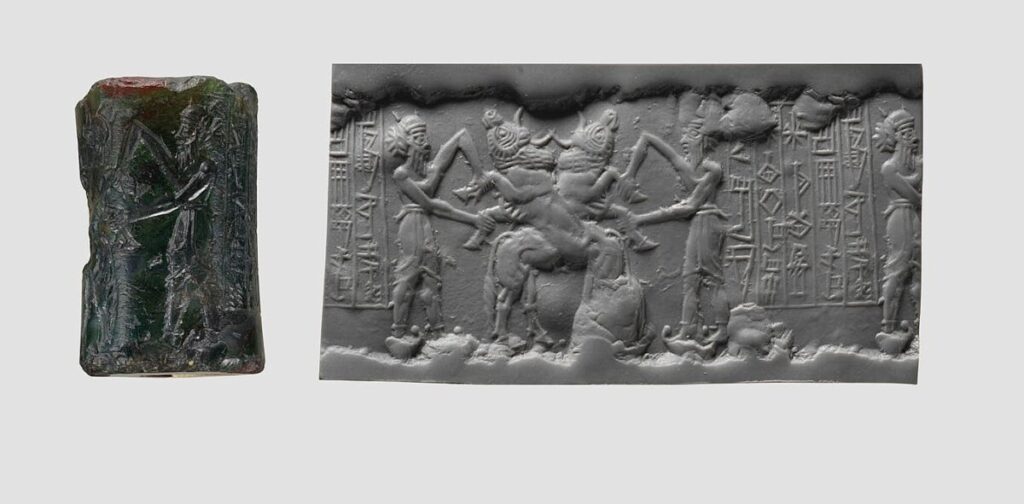
An Akkadian cylinder seal, circa 2350-2150 B.C.E., depicts a contest scene. The image on the right shows the impression the seal would make.
Gift of Nanette B. Kelekian, in memory of Charles Dikran and Beatrice Kelekian, 1999/Metropolitan Museum of Art
The
earliest form of the signature
came from ancient Iraq in the form of cylinder seals.
Mesopotamians, the ancient inhabitants of the land between the Euphrates and Tigris rivers, are
credited for many firsts
in human history, including writing, urbanism and the state. Among these inventions,
cylinder seals
are perhaps the most distinctive but least known.
Babylonian seal made of chalcedony, circa 14th century B.C.E., inscribed with a hymn to the goddess Inanna. The seal was owned by a man named Tunamisah, son of Pari.
Gift of The Right Reverend Paul Moore Jr., 1985/Metropolitan Museum of Art
Seals as artifacts
Thousands of these tiny objects
– often no bigger than 2 inches (5 centimeters) in height and 1 inch (2.5 cm) in diameter – are displayed in museums today. They testify to an
artistic tradition in ancient Iraq and Syria
that remained uninterrupted from the late fourth to first millennia B.C.E.
In essence, a cylinder seal was a small sculpture that served a crucial utilitarian purpose:
signing documents
. It was generally made of a precious or semiprecious stone such as lapis lazuli, agate or chalcedony. Images and texts were engraved into the stone with a
technique called intaglio
. Notably, these engravings would need to be made in reverse of how the markings would look when it was used.
When rolled on a moist clay tablet, these engravings left low-relief markings, signifying that the object’s owner authorized the written document. In this respect, a cylinder seal’s impression is the ancestor of modern handwritten and digital signatures.
Clay envelope and tablets from Kültepe-Kanesh (now Turkey), circa 20th-19th centuries BCE. The writer, Ashur-muttabbil, impressed – or signed – the envelope twice with a cylinder seal.
Bequest of Edith Aggiman, 1982/Metropolitan Museum of Art
Seals and identity
While cylinder seals were a creation of the Sumerians who inhabited southern Mesopotamia about 6,000 years ago, they rapidly spread to the rest of
Western Asia and the eastern Mediterranean
and became important items in everyday life.
Communities in this vast region – especially those in Mesopotamia, an area poor in raw materials –
imported stones from distant lands
to make their seals. Mesopotamians extracted diorite from Oman, lapis lazuli from Afghanistan, and carnelian and agate from the Indus Valley and other parts of South Asia.
Seals made of these exotic stones were extra valuable, so only the elite could afford them. Often affiliated with the state and temples, these people were typically royalty, high-level bureaucrats and priests. In contrast, people from lower classes used seals made of less valuable materials, such as limestone, clay or glass.
Mesopotamians and their contemporaries in Western Asia expressed their identities not just through the material of their seals but also through the
texts and images engraved on them
. The seal texts often introduced the owners with their names, genealogies, gender, professions and hometowns. Thanks to this information, researchers know that not just men but also wealthy women owned seals, albeit in much smaller proportions.
Religious identity, too, was communicated via long prayers addressed to personal gods or via images depicting gods and worshippers.
Assyrian cylinder seal from the late ninth to seventh centuries B.C.E., made of chalcedony and inscribed with a cultic scene. The image on the right shows the impression the seal would make.
Gift of Nanette B. Kelekian, in memory of Charles Dikran and Beatrice Kelekian, 1999/Metropolitan Museum of Art
Making seals
The scope of
Mesopotamian imagery depicted on cylinder seals
was broad. For thousands of years, seal-cutters – the artisans who exclusively specialized in making seals – carved scenes representing daily life and nature, religious rituals, warfare, architectural vistas and mythical stories involving gods, heroes and hybrid creatures such as winged horses and griffins.
Much of this rich imagery was a result of the owners’ personal choices,
often referencing their identities
. In some exceptional cases, Mesopotamian kings or their aides monitored and approved the designs of the cylinder seals they
gifted to high-level officials
.
Many seals seem to have been already carved with the popular cultural motifs before they were sold to clients, although solid archaeological and archival evidence is still needed to confirm this. When a customer bought these premade objects, they may have asked for a new inscription or some adjustments to the imagery. Most known cylinder seals were likely carved anew for elite clients, especially for those from the highest echelons of the society such as royalty.
Akkadian cylinder seal made of serpentine, circa 2250-2150 B.C.E., depicting a bull-man wrestling a lion and a nude, bearded hero wrestling a water buffalo. The image on the right shows the impression the seal would make.
Bequest of W. Gedney Beatty, 1941/Metropolitan Museum of Art
Cylinder seals open a wide window not just into ancient Mesopotamian art and culture but also into the minds of individual Mesopotamians. Carved with personalized images and texts reflecting their views on life and society, seals were intimately connected to their owners. Losing one’s seal was
considered a very negative omen
for its patron. In contrast, modern signatures are often
depersonalized and generic
.
Cylinder seals – along with city life, organized religion and bureaucracy – were a key component of ancient Mesopotamian civilization. These features, in different forms and proportions, continue to define modern life today.
Serdar Yalçin does not work for, consult, own shares in or receive funding from any company or organization that would benefit from this article, and has disclosed no relevant affiliations beyond their academic appointment.


