SETI’s ‘Noah’s Ark’ – a space historian explores how the advent of radio astronomy led to the USSR’s search for extraterrestrial life
In the backdrop of the Cold War and the burgeoning field of radio astronomy, the search for extraterrestrial intelligence (SETI) emerged as a fascinating intersection of scientific inquiry and geopolitical rivalry. Originating in the 1960s, SETI was born from the need to explore artificial radio signals that could indicate the presence of intelligent life beyond Earth. This new field arose as radio telescopes, initially designed for astronomical observations, began to pick up interference from telecommunications. Rather than merely a nuisance, this interference sparked the idea that scientists could actively search for signals from extraterrestrial civilizations. As the United States and the Soviet Union were the only two nations equipped with the technology to pursue this ambitious endeavor, the race for discovery took on a distinctively competitive flavor.
Prominent Soviet astronomer Iosif Samuilovich Shklovsky played a crucial role in the development of SETI during this period. His pioneering work in detecting hydrogen through radio waves opened new avenues for understanding astronomical phenomena. In 1960, Shklovsky published an influential article titled “Is Communication with Intelligent Beings of Other Planets Possible?” which later evolved into the popular book “Universe, Life, Intelligence.” This literary contribution not only captured the imagination of scientists but also led to the USSR’s first radio message sent towards Venus in 1962, featuring the Morse code message “Lenin, USSR”—a symbolic act showcasing Soviet technological prowess rather than a serious attempt to communicate with extraterrestrial beings.
The formal organization of SETI efforts took shape in 1964, when Soviet scientists convened a conference at the Byurakan Astrophysical Observatory in Armenia, away from the prying eyes of Moscow. This gathering marked a significant step towards a coordinated search for artificial radio signals, establishing SETI as a state-backed initiative. Despite facing challenges such as government secrecy and the constraints of the Cold War, Soviet scientists managed to foster international collaboration, culminating in a 1971 symposium that brought together researchers from both sides of the Iron Curtain. This event symbolized a rare moment of cooperation during a time of heightened tension, as scientists united in their quest to decipher the cosmos. Today, SETI continues to thrive as a vital field of research, contributing to our understanding of the universe while navigating the complexities of radio frequency interference and international cooperation.
https://www.youtube.com/watch?v=PL9PGt25Rcg
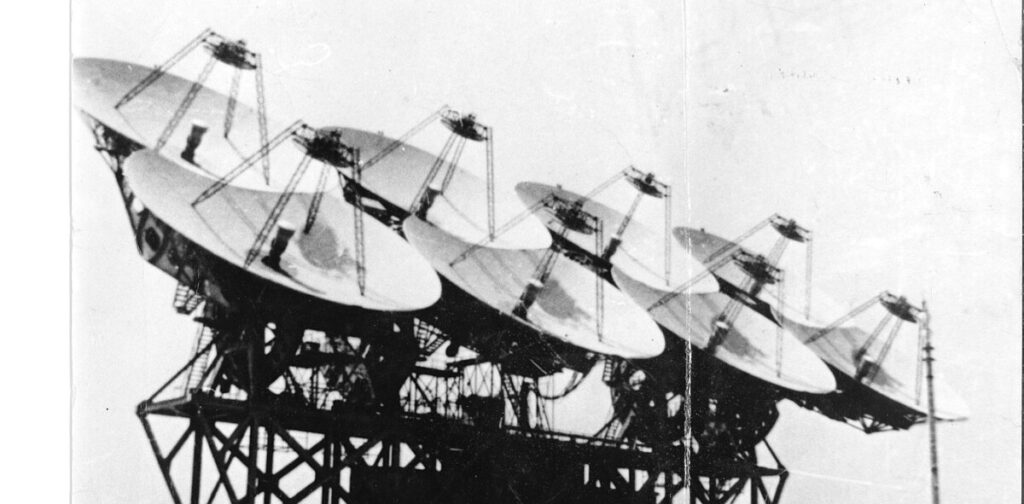
The planetary radar, built in 1960 in Crimea, from which the Morse signal ‘MIR, Lenin, USSR’ was sent in November 1962.
National Radio Astronomy Observatory Archive
As humans began to explore outer space in the latter half of the 20th century,
radio waves proved a powerful tool
. Scientists could send out radio waves to communicate with satellites, rockets and other spacecraft, and use radio telescopes to
take in radio waves
emitted by objects throughout the universe.
However, sometimes
radio telescopes would pick up
the artificial radio signals from telecommunications. This interference threatened sensitive astronomy observations, causing inaccurate data and even damaging equipment. While
this interference frustrated scientists
, it also sparked an idea.
During the Cold War, a
new field emerged
at the intersection of radio astronomy and radio communications. It put forward the idea that astronomers could search for radio communications from possibly existing extraterrestrial civilizations. Astronomy usually dealt with
observing the universe’s natural phenomena
. But this new field made the detection of technologically, or artificially produced radio waves, the object of a natural science.
This field has continued today and is now called the
search for extraterrestrial intelligence, or SETI
. SETI encompasses all that scientists do to search for intelligent life beyond Earth. It includes one of the original uses of radio telescopes: to study signals from across the galaxy in hopes of detecting intelligent messages.
When the idea behind SETI was first proposed and pursued in the 1960s, only two countries, the U.S. and the USSR, had the technical capability for it. As the only space powers at the time, they were the key actors affected by radio frequency interference.
As a historian of science
, I’ve worked to make sense of what happened throughout the history of Soviet SETI during the space race by analyzing a range of primary sources. SETI captured the scientific imagination of many prominent Soviet astronomers in the 1960s and early 1970s.
Astronomers have not yet confirmed any detection of radio signals –
or any other kinds of signs
– from extraterrestrial civilizations. But many scientists are still searching, even as their bold ideas run into obstacles. Some evidence suggests
humans might be the only intelligent life
in the universe.
Soviet SETI: The golden age of radio astronomy
SETI is intertwined with the profound changes brought by radio astronomy. Up until the second part of the 20th century, scientists could see astronomical objects and phenomena only
in optical or visible light
. Optical light is the same kind of light that the human eye is sensitive to.
After World War II, scientists figured out that they could peacefully use radar antennas, developed for use in that war, to detect
radio signals coming from objects out in the universe
. Deciphering these signals allowed researchers to study astronomical objects in the universe. They learned, for example, about the most abundant element: hydrogen.
In the former Soviet Union, the prominent radio astronomy pioneer
Iosif Samuilovich Shklovsky
played a key role in detecting radio signals from hydrogen.
Scientists knew that every chemical element would absorb certain wavelengths of light and reflect others, and the light signals that an object absorbed or reflected could tell astronomers what element it was. Most hydrogen could not be observed directly in optical light, so astronomers didn’t spot it out in space until they started looking beyond the visible light spectrum.
Shklovsky figured out
how to detect hydrogen with radio waves
, which helped astronomers map the distribution and motion of hydrogen gas in and between galaxies.
Historians generally consider the year 1960 the start of the
golden age of radio astronomy
. After the detection of hydrogen, astronomers discovered previously unknown types of stars, such as
pulsars
and quasars
. These phenomena offered scientists new insights into the nature of astrophysical phenomena and fundamental physics.
The Priroda issue in which Shklovsky’s article ‘Is Communication with Intelligent Beings of Other Planets Possible?’ was published.
Priroda/RAS
Shklovsky later grew fascinated with the possibility of using radio waves to contact other intelligent beings in the universe. In 1960,
he published an article
on this topic in one of the country’s most prestigious scientific journals.
Shklovsky’s article soon expanded into a widely popular book called “
Universe, Life, Intelligence
,” published in 1962. That same year, the USSR’s Academy of Sciences
sent its first radio message
in the direction of Venus from a radar in Crimea.
The experiment involved
bouncing radio signals off the surface of Venus
to transmit the following words using Morse code: Lenin, USSR and mir, which in Russian means both world and peace. Even though statistically increasing radio interference risk, this message was mainly symbolic. The Soviet Union wanted to depict its technological might and wasn’t expecting to communicate with extraterrestrials. Soviet SETI was thus not yet a real pursuit.
Iosif S. Shklovsky at a SETI conference in Soviet Russia in 1975.
NRAO/AUI/NSF
Starting an organized search
Shklovsky and the majority of other radio astronomers pursuing the search for extraterrestrial intelligence were all located in central Russia at the time. The USSR Academy of Sciences was also located there. But this group needed more formal measures to move their search from a few initiatives into a coordinated effort.
Due to concerns over unwanted public attention, the scientists
organized a conference
far from Moscow,
at the Byurakan Astrophysical Observatory
in the Soviet Republic of Armenia, in 1964. At this conference, researchers formed a group specifically dedicated to studying artificial radio signals from space. With this group, SETI became a top-down, state-led activity.
A 1971 Conference Proceedings volume focused on SETI (CETI in Cyrillic) and was published in Russian.
With this validation, scientists could now theoretically
look for artificial signals
, potentially from an alien origin. However, any discussions about artificial radio signals were subject to strict government surveillance, given the fact that military satellites depended on them, too.
Soviet scientists
faced several obstacles
. For example, their own government’s secrecy made coordination difficult. The Cold War also
set limits
on developing SETI internationally. However, they had a green light to search and study peculiar signals they suspected had artificial origin.
International collaboration
Efforts to collaborate internationally on artificial signals culminated in 1971 with
a symposium, again at Byurakan
. There, about 50 scientists – the majority from the U.S. and the USSR, but also some from Czechoslovakia, Hungary, the U.K. and Canada – agreed to disagree on how to best conduct SETI.
Some in attendance
compared this gathering to Noah’s Ark
, because an almost equal number of prominent scientists from East and West of the Iron Curtain managed to meet that year. And the gathering took place in Armenia at the foot of
Mount Ararat
, located in neighboring Turkey. This mountain is where archaeologists believe Noah’s Ark may have beached.
After almost a week of discussion at Byurakan, the two geopolitical blocks designated an official SETI group. That group still exists today, and it still connects researchers all around the world who conduct SETI research. Given the secrecy around radio signals in space, this international SETI group marked a momentous diplomatic achievement at the height of the Cold War.
Postcard with Soviet scientists conducting SETI experiments in the Pamir region of Tajikistan, with a note on the back to their U.S. correspondent.
NRAO/AUI/NSF
SETI started in the Soviet Union with a few strong Moscow-based initiatives. It continued through group events in Armenia – from the first state-level Soviet conference to the international one.
SETI is the first and only domain of astronomy to study artificial radio signals themselves. It indirectly addressed radio frequency interference during a time when these frequencies were highly unregulated.
Stakeholder countries eventually addressed their radio frequency interference issues with
international agreements
on radio frequency usage and allocation. An international committee approved a
feasible and comprehensive radio frequency allocation plan
for the first time in the 1970s. This plan has been revised and renewed ever since. Today, space scientists and astronomers use an
internationally agreed upon plan
to minimize this interference.
Remarkably, SETI began even before this allocation plan. SETI continues its rich legacy today by
continuing to search for signals
– and along the way discovering new astrophysical objects and phenomena.
Gabriela Radulescu has received funding from the Smithsonian National Air and Space Museum as a Guggenheim Postdoctoral Fellow (2024-2025), from the American Institute of Physics for a Grant-in-Aid, as well as from the Elsa-Neumann Scholarship and the Technical University of Berlin Coordinating Office for Women’s Advancement and Gender Equality for her doctoral research.


