Private equity firms are snapping up mobile home parks − and driving out the residents who can least afford to lose them
In recent years, mobile home parks, often seen as a crucial pathway to affordable homeownership for many Americans, have come under increasing threat due to rising rents and the aggressive buyouts by private equity firms. Once a stable option for low- and moderate-income families, these parks are now facing a crisis as rents have surged by 45% over the past decade, according to census data. This financial strain is exacerbated by the fact that many residents own their homes but rent the lots they sit on, leaving them vulnerable to eviction and significant financial distress when park ownership changes hands. A poverty law attorney in Virginia highlights the plight of these residents, many of whom are struggling to protect their homes—their primary source of wealth—amidst soaring costs and the looming threat of eviction.
Historically, mobile homes were designed for mobility, providing affordable housing solutions for veterans and workers in the mid-20th century. However, as the concept of mobile homes evolved into what are now known as manufactured homes—largely stationary and often permanently affixed to their lots—homeownership in mobile home parks became a more stable, albeit precarious, option for many. Today, approximately 20.6 million Americans live in manufactured homes, with a significant portion residing in mobile home communities. Yet, as private equity firms increasingly invest in these parks, the model of homeownership is shifting dramatically. With institutional investors now accounting for 23% of all manufactured home park purchases—up from 13% just a few years prior—residents find themselves trapped by rising lot rents and the complexities of eviction laws that often favor park owners.
In response to this growing crisis, some states are beginning to implement measures aimed at protecting residents. For instance, Maine recently passed a law granting park residents the right of first refusal when their park is up for sale, while other states are exploring cooperative ownership models to empower residents. Advocates are also pushing for rent control policies to limit annual rent increases and strengthen tenant protections. However, the road ahead is fraught with challenges, as many residents continue to face the daunting prospect of losing their homes amidst a landscape increasingly dominated by profit-driven investment firms. Without widespread systemic changes, the dream of homeownership for many low-income families residing in mobile home parks hangs in the balance, underscoring the urgent need for advocacy and reform in this sector of the housing market.
https://www.youtube.com/watch?v=wkH1dpr-p_4
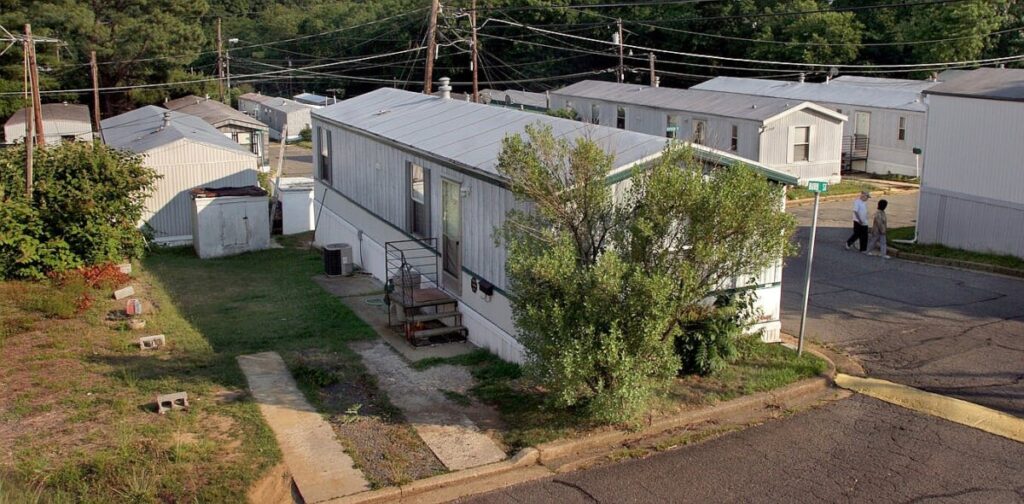
In mobile home parks, like this one in Fairfax, Va., residents often own the home itself but rent the lot where the home sits.
Michael Williamson/The Washington Post via Getty Images
One of America’s most affordable paths to homeownership is slipping away.
At manufactured home parks – sometimes called trailer parks or mobile home parks – rents are rapidly rising due to
large-scale buyouts by private equity firms
.
Although private equity’s foray into the housing market is not new, the
buyout of mobile home parks by investment firms
is on the rise – with devastating consequences for residents. Over the past decade, rents in these parks
have risen 45%
, according to census data. Once a park is sold,
the risk of eviction rises significantly in the following year
.
I’m a poverty law attorney in Virginia
, and many of my clients are residents of mobile home parks. Over the past four years, I’ve watched their communities get sold, one by one, to large investment firms. Many of them are desperately struggling to protect their homes – for some, their only source of wealth – in the face of exploding rents
and threats of eviction
.
The immovable mobile home
Today, the term “mobile home”
is a misnomer
.
Historically, mobile homes were
trailers designed for travelers and workers living near factories
. With so many veterans returning home after World War II, trailers provided an easy and affordable way for them to obtain housing in the face of shortages. The trailers could be moved from place to place as people either attended school or sought work.
Many workers at the Los Alamos National Laboratory in New Mexico were housed in trailers in the 1940s and 1950s.
Corbis/Getty Images
A shift occurred in the 1950s. Those with higher incomes bought houses, and
those with less means continued to live in mobile homes
. Eventually, mobile home communities cropped up throughout the country as places for people to park their mobile homes for months, years or permanently.
Nowadays, mobile homes are more often called “manufactured homes.” They are assembled in factories and rarely move once they’ve been purchased and settled. In fact, more than 90% of manufactured homes
never move from their original site
.
Today,
around 20.6 million Americans
live in a mobile or manufactured home. About one-third of mobile homes
are located in mobile home communities
.
In these communities, the residents usually own the home itself, but they rent the lot that the home sits on. They are responsible for the upkeep of their home, but the park owners are responsible for park infrastructure, including street maintenance and sewage systems.
Although many Americans still think of these homes as mobile, they’re prohibitively expensive to move. Many have had the wheels or hitches removed years ago. Additionally, many owners of trailers or manufactured homes have invested in additions, such as porches or extra rooms, that have made these homes even more difficult to relocate.
Starting in the 1950s, mobile homes became more permanent fixtures, with owners building out additions such as porches, fences and walkways.
Found Image Holdings/Getty Images
Private equity swoops in
According to the National Low Income Housing Coalition
, no state has enough affordable housing for those with the lowest incomes.
In the midst of a housing affordability crisis, mobile homes are seen as a way for those with limited incomes
to generate wealth and access homeownership
. Indeed, over half of all manufactured homeowners
earn less than US$50,000 a year, and one-third are over age 60
.
However, this type of homeownership is becoming more difficult to maintain for many due to the
increased buyout of mobile home parks by large investment firms
– a trend that mirrors the rest of the housing market.
Increasingly, housing is being treated as a commodity rather than an essential social good – what’s sometimes called the “
financialization of the housing market
.”
For private equity firms,
housing has been a fruitful investment
. But in order to maximize returns on their investments, they usually increase rents and cut costs. Company leadership is often totally divorced from their tenants; instead, they hire on-site and regional managers who exercise disproportionate control over evictions and rule enforcement. Overall, this financialization has transformed the way those with limited incomes are able to obtain shelter – including the owners of mobile homes.
In the past, manufactured home communities were largely “mom-and-pop” enterprises. Though they were still subjected to abusive practices, tenants usually knew their landlords and saw them often, and rents were much more stable.
Since Aspen, Colo., is one of the most expensive places to live in the country, mobile homes are the only way for some locals to get their foot in the door of homeownership.
RJ Sangosti/MediaNews Group/The Denver Post via Getty Images
In 2020 and 2021,
institutional investors accounted for
23% of all manufactured home park purchases, up from 13% between 2017-2019. Now, 23 private equity firms
own over 1,800 parks in the U.S
.
Once bought,
lot rents usually begin rising
. Mobile home park residents are especially vulnerable due to their circumstances: Since their homes are so difficult to move, they are essentially trapped when faced with rising lot rents. One study of Florida mobile home communities found that in the months after a park sale,
eviction filings increased by 40%
. Residents often find themselves forced to choose between paying exorbitant costs to move their home or paying unaffordable lot rents.
State laws put the squeeze on tenants
Because they’re so unique, manufactured home communities are often governed by a special set of state laws.
In my state, Virginia, the
Manufactured Home Lot Rental Act
covers rules that park owners and residents must follow. If someone is evicted for failing to pay their lot rent, they still own their home but can no longer live in the park.
Often, states impose short time frames for someone to move their home following an eviction. In North Carolina, for example,
a tenant has just 21 days
to remove the manufactured home from the park following an eviction judgment. In Virginia, a homeowner has 90 days after being evicted
to move or sell their mobile home
, but they must continue paying rent during that time.
Residents protest the sale of a mobile home park in Bell, Calif., in 2021.
Gina Ferazzi/Los Angeles Times via Getty Images
In many states, if a resident fails to move their home in time, the park owner may repossess the home or move it. Even if the resident lives in a state that continues to protect ownership of the mobile home against park owners, it is often difficult to enforce, as park owners may now have a lien on the mobile home for any amount the resident owes. The result is that many residents who are evicted lose their home.
Putting power back in the hands of residents
Currently, only 22 states have laws
that require advance notice to residents of park sales
. Most simply provide a timeline for owners to inform park residents of their intent to sell.
Nonetheless, many states are
coming up with strategies
to keep residents from being forced out and help them assume ownership of the parks.
Recently,
Maine passed a law
that gives park residents a right of first refusal if their park is up for sale. The law also levies a fee for out-of-state investors who buy parks, which can put residents in a better position to purchase the parks where they live.
In other cases, residents have banded together to buy the park by forming a cooperative with external support. They then apply for financing and purchase the park.
Resident Owned Communities USA
is one example of an organization that works to support resident ownership in manufactured home parks.
Many advocates are also pushing for rent control policies in mobile home parks, limiting the amount that new owners can raise rents annually. In 2019,
New York state passed a law
limiting annual rent hikes in mobile home parks to 3%, though this can climb to 6% annually in certain circumstances.
Additional solutions include limiting evictions to narrow circumstances, tightening lot lease contracts to give residents additional protections and
strengthening zoning rights
for existing mobile home parks.
In my practice, I see park residents eager to maintain their long-standing homes and communities in the face of outside investors and unresponsive local governments. But until these solutions are widely adopted, residents will continue to lose their wealth – and with it, this crucial path to homeownership.
I represent tenants facing eviction from mobile home parks, as well as tenant associations in mobile home parks advocating against displacement.


