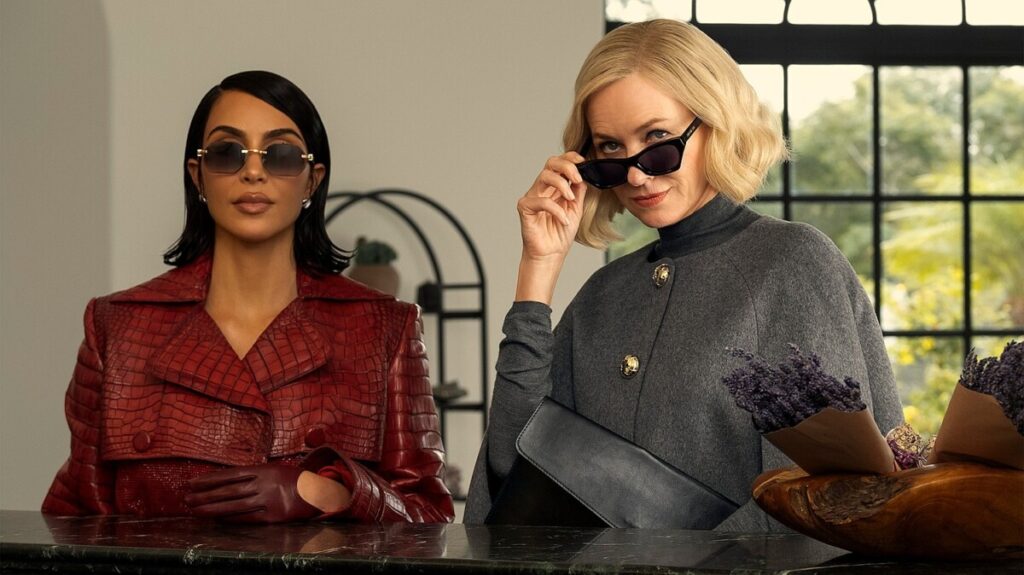
All’s Fair Is an Atrocity
In her latest critique, beauty writer Jessica DeFino introduces the concept of the “mirror world,” a term that encapsulates the curated, often unrealistic beauty standards perpetuated by social media, particularly through platforms like Instagram. This notion becomes particularly relevant in the context of Ryan Murphy’s new Hulu series, *All’s Fair*, which has been described as an extended series of Instagram Reels rather than a traditional television show. The series, featuring a cast led by Kim Kardashian, Niecy Nash-Betts, and Naomi Watts, follows the lives of three divorce lawyers who leave their staid law firm to start a more glamorous and ostensibly empowering practice. However, the show quickly reveals itself to be a chaotic collection of flashy visuals and disjointed storytelling, lacking substantial narrative cohesion.
The plot, which is set against a backdrop of ostentatious wealth and hyper-feminine aesthetics, feels secondary to the extravagant imagery that dominates each episode. The characters, including Kardashian’s Allura Grant, navigate a world filled with private jets and extravagant office spaces that resemble “vaginal canals,” all while engaging in superficial banter that often borders on the absurd. DeFino highlights the show’s failure to deliver a meaningful critique of the beauty culture it ostensibly seeks to explore, instead presenting a series of caricatures that seem to reinforce stereotypes rather than challenge them. The show’s writing has garnered comparisons to the likes of *Fifty Shades* author E.L. James, suggesting a lack of depth and originality, with cringe-worthy dialogue that leaves audiences questioning its intent.
Despite the overwhelmingly negative reviews, *All’s Fair* has paradoxically become a must-watch phenomenon, possibly due to its sheer audacity and the spectacle of its execution. The performances vary widely, with Sarah Paulson’s portrayal of the villainous Carrington Lane standing out for its theatricality. DeFino raises critical questions about the underlying messages of the show, particularly regarding its treatment of women and the portrayal of feminist themes in a narrative crafted by male creators. She suggests that rather than empowering women, *All’s Fair* may be pandering to them through a superficial lens, offering a glossy facade that distracts from the deeper societal critiques it fails to engage with. In a world where the lines between reality and the curated aesthetics of social media blur, *All’s Fair* serves as a provocative commentary on the absurdities of late-capitalist beauty culture, leaving viewers to ponder what it truly means to be represented in the “mirror world.”
The beauty writer Jessica DeFino refers often to the
“mirror world”
inside our phone, the uncanny, glistening selfieverse that’s also become more real for many of its devotees than the lumpy, blotchy meatspace where the rest of us live. I thought about the mirror world while watching
All’s Fair
, Ryan Murphy’s new creative product—I can’t call it a television show, because it isn’t one. Rather, it’s Instagram Reels at episode length, 45-minute collections of bedazzled moving images, targeted at the idly scrolling second-screen viewer. Scenes pass quickly, as if to emulate the true feed experience: Here’s a private jet, swaddled in ultra-feminine bouclé; here’s a ring, its diamond as big as a grape, slipped gently onto a finger with a two-inch acrylic talon; here’s lunch, three lavishly adorned bites of salad; here’s the face you know better than your own after two decades of overexposure, poreless and glazed and unmistakably Kim Kardashian, with arachnid eyelashes and lips so pillowy that you could fall asleep on them. If you’re not already on your phone, you may as well be.
All’s Fair
is technically a drama on Hulu about divorce lawyers, but only in the sense that someone needed something to tie all of these visuals together. Scenes start, jarringly, without introduction or fanfare, as though we’ve been vaulted into the action; the plot resists all attempts by the viewer to impose any kind of order. But: 10 years ago, infuriated by how sexist and stuffy their law firm was (this was, mark you, a good two years into the
Lean In
girlboss tote-bag-feminism era), and by how the partners at their firm
refused to see the potential of divorce law
(I laughed into my hand), three trailblazing legal eagles named Allura Grant (played by Kardashian), Emerald Greene (Niecy Nash-Betts), and Liberty Ronson (Naomi Watts, regretfully) left to start their own firm. Flash forward to the present day, and their dream is fully realized: Allura drives a Bentley to her womb-like office (the curved hallways resemble nothing so much as vaginal canals), every partner meeting comes with champagne, and practicing law apparently consists of walking into a room and declaring, “Ladies!!!!,” as though you’re kicking off an inexhaustible bachelorette group chat. (
The New York Times
felt obliged
to ask this week
whether women ruined the workplace;
All’s Fair
says: “You betcha.”)
[
Read: No, women aren’t the problem
]
This summary is basically it. There are subplots involving Allura’s marriage to an NFL player 10 years her junior, and the firm’s antagonist, a vicious rival lawyer named Carrington Lane (Sarah Paulson, chewing scenery so aggressively that she must still have splinters in her teeth). Each episode has a few cameos from actors who I can only hope were paid unspeakable amounts to play clients: Grace Gummer as an abused wife; Elizabeth Berkley as a gaslighted wife; Jessica Simpson, covered in facial prosthetics, as a trophy wife coerced into getting botched plastic surgery. The writing suggests that ChatGPT was asked to
emulate
Fifty Shades
’
E. L. James
, and however cringeworthy and brand-name-peppered that sounds, I can promise you it’s so much worse. “From cocktails to cock rings in one 24-hour period,” Watts’s Liberty says at the end of the first episode. “God, I love my job.” Now
that’s
acting.
The reviews of
All’s Fair
have been so uniformly dire that the show has emerged, paradoxically, as a must-watch. I can only assume that this is exactly what Murphy and his co-creators—including the playwright and two-time
Pulitzer finalist
Jon Robin Baitz—were going for. You simply can’t make something this bad without intention, even if the intention is just to be widely memed each week via Evan Ross Katz’s Instagram account. The performances are wildly disparate: Paulson’s key is psychotic operatic, Glenn Close’s (she plays the mentor figure Dina Standish) is animated to excess, Nash-Betts’s is sitcom charming, and Kardashian’s is
Days of Our Lives
perfume ad. I don’t mean to malign Kardashian—whose character seems very sweet on the show—but her particular art form works only in the hyper-specific world of heavily edited images. On Instagram, and even on her reality show, Kardashian comes across as thrillingly impervious, wearing impassivity like body armor and putting her body and face through Olympian ordeals to draw our collective gaze. On scripted television, she’s much more vulnerable to someone else’s camera angles, and to a genre that rewards expression, not provocative blankness.
[
Read: Reclaim imperfect faces
]
Watching the show, you may have questions. Such as:
Does this portend the end of culture as we know it?
and
Is the scene where the lawyers all talk about vaginal filler made of salmon sperm critiquing the absurdity of late-capitalist beauty culture or endorsing it?
My question was:
What does Ryan Murphy really think about women?
He’s spent much of his career portraying us as grotesques and static archetypes—divas, witches, den mothers, monsters—in shows
The New Yorker
has described as “cynical hits.” The first five seasons of
American Horror Story
featured not a single female director;
All’s Fair
is a drama co-created by three men about a supposed feminist wonderland. Is this show written
for
women? Or, as seems more likely to me, are we being pandered to in plain sight—patronized, diminished, and fed designer-label eye candy and weak-sauce revenge plots by someone who recently noticed
Selling Sunset
at the top of Netflix’s most-watched list? It’s easy to absorb endless amounts of branded pap when you’re on your phone. The experience of being bombarded with shoe-closet-makeover reels and deep-plane-facelift infomercials from Miami plastic surgeons is as normal there as breathing. It’s harder to take on television. It seems much more obvious, somehow—all the ways we’re being pacified and manipulated to consume, to desire, to disassociate.


