Can Mamdani Pull Off a Child-Care Miracle?
Zohran Mamdani’s recent election as New York City’s next mayor marks a significant shift in the city’s political landscape, as he aims to tackle the escalating cost-of-living crisis with ambitious proposals, including universal child care. Mamdani, a Queens assembly member, has quickly risen to national prominence, capturing the attention of voters with promises of fast, free buses, a freeze on rents, municipal grocery stores, and notably, universal child care. This last proposal, while less publicized, could transform the lives of many families in New York, addressing a pressing issue that has long been overlooked in American policy discussions.
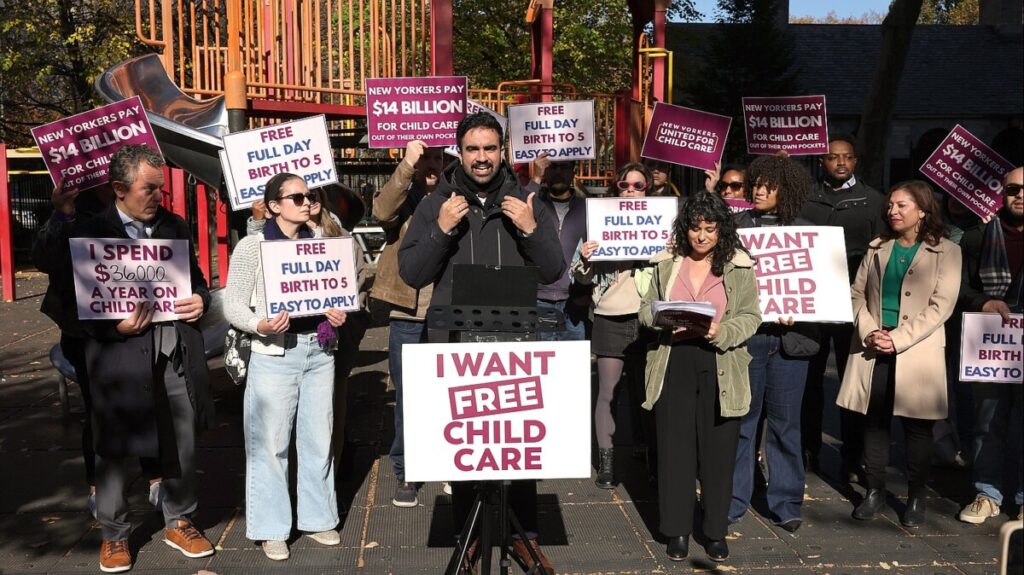
The current child-care crisis in New York City is dire, with only one licensed spot available for every four children under three years old. The exorbitant costs of day care—averaging $18,200 per year for home-based settings and $26,000 for centers—force many families to make difficult choices, often leading them to leave the city in search of more affordable living conditions. The economic implications are staggering; a lack of affordable child care not only impacts individual families but also costs the city approximately $23 billion in economic activity and $2.2 billion in tax revenue annually. Mamdani’s proposal aims to provide high-quality, year-round care for infants and toddlers, while also ensuring that early-childhood educators receive salaries comparable to public-school teachers. This ambitious plan faces significant challenges, including the need for substantial funding—estimated at around $6 billion annually—requiring tax increases that must be approved by the state government.
Mamdani’s vision for universal child care reflects a broader shift in societal attitudes towards early childhood education, particularly in the wake of the COVID-19 pandemic. The crisis highlighted the essential role of child care as a form of social infrastructure, prompting discussions about the need for systemic change. While other states like New Mexico and Connecticut are making strides toward affordable child care, New York City stands at a crossroads. Mamdani’s success or failure in implementing his plans could set a precedent for other cities grappling with similar issues. As he embarks on this ambitious journey, the need for a well-coordinated approach that balances immediate results with long-term sustainability will be crucial. If successful, Mamdani’s administration could not only improve the lives of countless families but also serve as a model for child-care reform across the nation, proving that while creating a universal system may be challenging, it is not impossible.
https://www.youtube.com/watch?v=ymAwxjuktF4
Z
ohran Mamdani
will be New York City’s next mayor. The Queens assembly member has rocketed from local political obscurity to national political celebrity in less than a year, making bumper-stickery campaign promises aimed at alleviating the city’s cost-of-living crisis. Fast, free buses. A freeze on rents. Municipal grocery stores. Universal child care.
That last proposal has gotten little attention—perhaps because a relatively small sliver of New Yorkers would directly benefit, perhaps because the proposal hinges on a tax increase Albany would have to approve, perhaps because early-childhood initiatives are so pervasively underemphasized in American life.
When Mayor Bill de Blasio created a universal prekindergarten program and a near-universal 3-K program in New York a decade ago, it was rightly described as a
miracle
. But in many ways, that undertaking was far simpler than what Mamdani
is promising
. He aims to provide high-quality, year-round care to toddlers and infants as young as six weeks old, while setting day-care workers’ earnings “at parity” with those of public-school teachers. It’s a cosmically aspirational set of goals, and it faces a steep set of obstacles. But if he can pull it off, the scheme would transform New York’s demography and economy, constituting one of the most radical examples of policy entrepreneurship in recent memory.
I
say this as a parent:
Day care is great. Good programs enhance children’s cognitive development and school readiness, increasing
educational attainment
and improving
health
outcomes decades later. There’s “a mountain of scientific evidence that the early years are the most important,” Philip Fisher, the director of the Stanford Center on Early Childhood, told me.
But unlike other wealthy countries, the United States forces parents to go it alone for the first three years of their children’s lives, and more often the first five. Though targeted investments in kids have among the highest returns of all public expenditures, Washington devotes just 0.4 percent of
its budget
to young children. Some cities offer municipal child-care programs, and some low-income families get vouchers. Still, parents shoulder most of the burden of the cost of child care.
As a result, the United States has a severe child-care shortage, and the situation is especially dire in New York. The city has
one licensed spot available
for every four children under the age of 3. Close to half of neighborhoods have less than 20 percent of the necessary capacity for kids under the age of 2.
Enrolling in a program is like taking on a second mortgage. In the five boroughs, day care
costs, on average,
$18,200 a year in a home-based setting, or $26,000 in a center. The federal government holds that child-care costs should eat up no more than 7 percent of a family’s income. By that standard, a household in New York has to earn $300,000 or $400,000 a year to have one kid. Wealthy families have the option of hiring au pairs or nannies. Middle-income families commute long distances to drop their kids off before work. Low-income families set up informal arrangements with family members or shift their hours to watch their kids.
In a
recent survey
of working mothers in New York, 34 percent said that they had declined a promotion or chosen a part-time schedule because of child-care pressures. Nearly as many said they had lost a job. And the cost of child care forces many families out of the city: Households with young kids are
twice as likely
to leave New York for cheaper pastures as those without.
The lack of affordable child care is a societal and economic catastrophe, not just one afflicting individual households. Parents’
caregiving challenges
cause the city to forgo $23 billion in economic activity and $2.2 billion in tax revenue a year. Providing a public option would lift mothers’ earnings by close to
$1 billion annually
, the city has estimated. Broadly, the paucity of public spending on early-childhood programs is a central driver of the country’s gender wage gap and the low rate of labor-force participation among women.
Even as parents fork over 10, 20, 40 percent of their paychecks to
child-care providers
, nursery schools and day-care centers cannot afford to pay their workers much. The city’s early-childhood workers earn half what workers in other
industries do
. A quarter live below the poverty line, many earning less than they would at big-box stores and fast-food chains.
[
Michael Powell: The mainstreaming of Zohran Mamdani
]
The market is broken and it can’t fix itself. Yet policy makers have historically considered universal-child-care systems too high in cost and too low in political benefit to bother enacting. Day care has a narrow constituency: Perhaps
one in 15
American households includes an infant or toddler. Although voters might give their warm approval to early-childhood initiatives, not many of them turn out for day care on Election Day or switch their support to candidates that would fully finance Head Start. (That some voters believe children would be better off if their mother stayed at home figures in too.)
The political winds are shifting. The country’s affordability crisis has hit apocalypse levels, discouraging couples from having kids and stoking profound disillusionment among young voters. In his campaign, Mamdani spoke directly to that disillusionment; exit polls showed he won a
supermajority of ballots
cast by New Yorkers under the age of 45. The coronavirus pandemic decimated the child-care system, forcing thousands of day cares to close and requiring millions of parents to watch their kids and do their day jobs simultaneously. The pandemic also spurred many Democrats to recognize child care as social infrastructure, not a niche, nice-to-have benefit.
New Mexico
has become the first state to guarantee free child care for all residents, and is in the process of scaling up its system. Connecticut is
making it free
for families making less than $100,000 a year, and affordable for everyone else. Could New York City be next?
T
he budget
poses the first and central challenge to Mamdani’s plans. His campaign has estimated that universal child care would require roughly $6 billion a year. He wants to increase taxes on millionaires and corporations to cover the cost, bumping the city’s
annual budget
up by 11 percent. Albany would have to approve the tax increase.
Governor Kathy Hochul has made child care a priority, sharply increasing the state’s
spending on
grants,
paid leave, and tax credits.
The issue is personal for her. Decades ago, she quit her job as an attorney for Senator Daniel Patrick Moynihan to stay home because the
cost of care
was so high. “I’ve had conversations with Assembly Member Mamdani about how we can get to universal child care,” she said in a
joint appearance
with him in Queens last month. “I believe we can.”
[
Read: New Mexico’s free-child-care gamble
]
But Hochul has repeatedly said that she
opposes the tax hike
, citing concerns about the 50-plus percent marginal rates already applied to the city’s wealthiest individuals, and about pushing businesses and families to
lower-tax jurisdictions
. Hochul is up for reelection next year. Would it be more advantageous for her to approve the tax increase and show solidarity with the city that’s home to nearly half of state residents, or to appeal to corporations and moderates by holding tax rates steady? The answer is not clear.
Even if the tax hike passes, the revenue might not be enough to create a truly universal system. The nonprofit Prenatal to Five Fiscal Strategies has estimated that a comprehensive program would cost $6.6 billion a year at prevailing wages, and $9.5 billion if child-care workers made a living wage, as of 2023. (The numbers would be higher now, thanks to wage growth, rent increases, and so on.) Bringing workers’ earnings to “parity” with public-school teachers might require even more money. I asked the Mamdani campaign for details on what it meant by “parity.” Would compensation be based on education levels and tenure? Would it include benefits as well as salaries? I did not hear back.
Nevertheless, if Mamdani got his $6 billion, it would pay for a tremendous expansion of the city’s child-care infrastructure. With the money secured, the real challenge would begin.
E
legant-sounding policy designs
for child-care systems exist, experts told me. They just wouldn’t work very well in practice. The city could enroll toddlers and babies in public schools. “I don’t think anybody thinks that’s a great idea,” Emmy Liss, an early-childhood consultant and a former de Blasio staffer, told me. Elementary-school classrooms would have to be retrofitted to accommodate six-month-olds and 2-year-olds. The city would risk putting hundreds of providers out of business as parents switched over to the public option.
Alternatively, New York could give all families vouchers, allowing them to choose their own providers. But if the country’s public schools are any guide, rich families would use the vouchers to offset their costs while poor families would struggle to find quality care and cover their bills. The system would rely on “providers being incentivized in the private market to just go open new sites” in the places where they’re needed, Liss told me, and the city would have little recourse if they did not.
A messy system, combining different models, would actually be a better system.
The obvious first step would be to age the city’s 3-K program down: enrolling 2-year-olds and 1-year-olds in public day-care centers, as well as for-profit, nonprofit, and home-based programs, and paying those programs directly. It works for 3-year-olds. It would work for younger kids, too, experts told me. Still, Mamdani will have to repair the city’s relationships with providers as he expands enrollment. For years, the Department of Education has antagonized care centers by
revoking their leases
and failing to make
payments on time
. Some programs have had to take out loans to cover payroll, and some have closed. “I cleaned our accounts” out, Ingrid Matias Chungata, the executive director of Nuestros Niños, in Williamsburg, said at a city-council
meeting in February
. “Fifty-two years of savings, of having a cushion—it’s all gone.”
Then the Mamdani administration would have to figure out how to turn hundreds of small-scale day cares—many run by women of color in their apartment or house—into municipal contractors. At the moment, the city is not equipped to strike deals with so many vendors, analysts told me. Nor are day-care owner-operators equipped to sign contracts with the city. Mamdani might be able to use New York’s
family-child-care networks
as intermediaries instead.
Mamdani wants to support informal arrangements too, such as grandparents watching their grandchildren. His administration will need to figure out how to apply health-and-safety regulations and compensate these caregivers. New York City will also likely need to provide vouchers to families with uncommon needs, experts told me, such as parents who work the graveyard shift. (That way, the Mamdani administration would not need to include overnight care and other specialty options in its contracts with day care centers.)
Finally, the city would need to take on all that administrative complexity, and give parents a clear set of choices and an easy path to enrollment.
O
f course
, setting up a universal-child-care system is not the same thing as delivering universal child care.
New York City has 32,917
early-childhood workers
. It probably needs 32,917 more to achieve total coverage. Mamdani’s proposal to raise wages will spur many individuals to apply for child-care jobs and set up home-based day cares. Still, City Hall might need to offer loan forgiveness and cash bonuses to entice enough workers—all without worsening long-standing staffing shortages in other parts of the
school system
.
City Hall will also have to make sure that child-care providers offer the kind of slots needed, where they are needed—a problem that has bedeviled the 3-K program. Mamdani might have to build and operate public centers in underserved neighborhoods or pay day-care chains to open facilities in child-care micro-deserts. Similarly, he might need to provide bonuses to centers enrolling infants and kids with health issues and disabilities.
Giving parents the opportunity to stay home with their babies, if they wish, might be the best way to cover the youngest kids. “Other countries solve the infant-care issue by providing a year of paid family medical leave or paid parental leave,” Julie Kashen of the Century Foundation told me. Thus far, Mamdani hasn’t included six months or a year of leave in his child-care proposal.
[
Read: The problem with ‘affordable’ child care
]
I could write thousands more words on the hurdles the new administration will face and the questions it will need to answer to get to universal child care. Mamdani will have to expand the city’s community-outreach, contracting, site-inspection, and workforce-development infrastructure. He will need to decide how to scale up the system, balancing the political need for immediate results with the technocratic need for a slow rollout. And if tax revenue declines or real-estate prices climb or the White House goes after the city’s budget …
These concerns might sound like an argument that Mamdani shouldn’t create a universal-child-care system, or that he won’t be able to. But they could also be seen as an argument for letting politicians promise the perfect so that their administrations can figure out how to deliver the good. More than 1 million voters propelled Mamdani into office this week, and his
victory speech
focused on the cost of living and the mayor’s mandate to bring it down.
New York City has double the budget of the state of Massachusetts. It educates as many children in its public-school system as the Pentagon commands adults in the active-duty military. It has a history of delivering inferior programs and failing to solve pressing issues, but it also has a history of getting big, tough things done, including the wildly popular pre-K and 3-K initiatives.
New York could show other governments that creating a universal-child-care system might be expensive and difficult, but it isn’t impossible. If Mamdani falls short, expanding the number of free day-care spots while raising educators’ wages instead—well, it won’t be what he promised. But it still sounds like a miracle to me.


